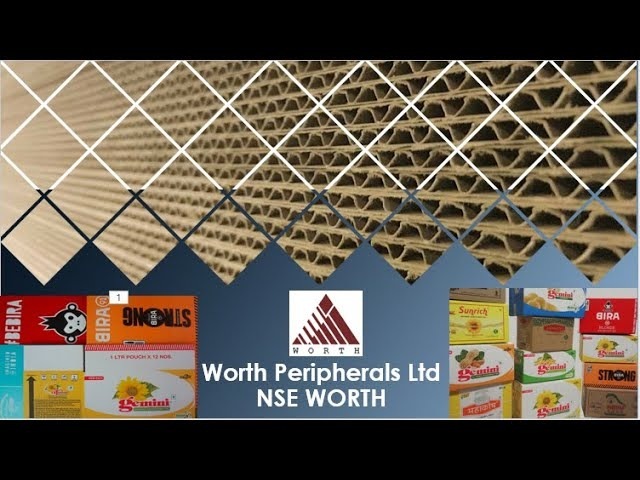
Worth Peripherals Limited (WPL) is a company that essentially builds the armor for India’s FMCG giants. They manufacture corrugated boxes—the unsung heroes of logistics. While the stock sits at a modest Market Cap of ₹209 Cr, don’t let the small size fool you into thinking it’s a quiet operation. The company is currently sitting at a critical juncture where the old, steady packaging business is funding a massive greenfield expansion into personal care via its subsidiary, Worth Wellness.
The numbers tell a story of a business that is holding its ground but facing the heat of raw material volatility. With Revenue from Operations reaching ₹304.90 Cr (Consolidated) for FY26, there is a visible 10.6% growth compared to the previous year. However, the Net Profit for the year stands at ₹18.52 Cr, which is a slight 6.8% increase, indicating that while they are moving more boxes, the margins are under pressure. The Operating Profit Margin (OPM) is hovering around 11%, showing that the game in corrugated packaging is a game of pennies, not pounds.
There are red flags that any serious investor must notice. First, the Return on Equity (ROE) is a humble 8.14%. For a manufacturing setup, this suggests that the capital isn’t exactly sprinting; it’s more of a brisk walk. Second, the company’s expansion into “Worth Wellness” is a complete pivot into personal care—a high-margin but high-competition arena. WPL has already pumped in significant capital, with Capital Work-in-Progress (CWIP) exploding from ₹1.02 Cr to ₹78.62 Cr in just one year.
Investors are watching WPL not for its boxes, but for its transformation. The company has a Debt-to-Equity ratio of 0.22, which is healthy, but the total borrowings have jumped from ₹20 Cr to ₹41.5 Cr to fund this new dream. Will the personal care plant, which is currently in “advanced stages of machine installation,” become a cash cow or a capital trap? This is the billion-rupee question that makes WPL an intriguing study in corporate evolution.
2. Introduction
Worth Peripherals Limited, incorporated in 1996, has spent nearly three decades perfecting the art of the “Regular Slotted Container.” Based out of Indore, Madhya Pradesh, the company has built its reputation on being a reliable supplier to some of the biggest names in the FMCG sector, including the likes of Unilever (through SEDEX audits).
The company operates in a sector where the product is a commodity, but the service is a moat. If a box fails, the high-value product inside is at risk. By securing ISO 9001-2015 and 4 Pillar SMETA certifications, WPL has positioned itself as a “quality-first” player in a crowded Indore packaging hub.
The story of FY26 is one of consolidation and transition. Management is effectively using the cash flow from the legacy packaging business to bet big on a subsidiary. This is a classic “Small-cap Pivot.” While the core business of boxes grew its volume, the management’s focus has clearly shifted toward the subsidiary, Worth Wellness Private Limited.
With a promoter holding of 68.16%, the skin in the game is significant. However, the market seems to be pricing the stock cautiously at a P/E of 14.2, which is lower than the industry average of 19.7. The market is clearly waiting for the wellness business to start generating its first rupee of revenue before it grants a valuation re-rating.
3. Business Model – WTF Do They Even Do?
At its core, WPL buys Kraft paper and turns it into structural masterpieces. They manufacture:
Regular Slotted Containers (RSC): The standard boxes you see everywhere.
Die Cut Boxes/Trays: Customized shapes for specific product display or protection.
Multi-colour Corrugated Boxes: For brands that want their packaging to double as marketing.
Z-Sleeve and Honeycomb Partitions: High-strength internal packaging for fragile goods.
The business model is a “Volume-Margin” play. They operate three units with a combined capacity that allows them to service massive orders from FMCG players. The catch? Raw material (Kraft paper) accounts for nearly 65-70% of their cost. This means WPL is essentially a pass-through entity. If paper prices spike, they have to negotiate with the FMCG giants to raise prices—a battle where the giants usually have more leverage.
Management has realized that “boxes” can only take them so far. This led to the creation of Worth Wellness, a subsidiary aimed at personal care products. They are moving from “packaging the product” to “making the product.” It’s a bold move that changes their identity from a B2B packaging vendor to a potential B2C or contract manufacturing player.
4. Financials Overview
The Q4 FY26 results show a company that is growing top-line but struggling to keep the bottom-line pace due to rising costs and interest.
Consolidated Financial Performance
Metric (₹ Cr)
Latest Qtr (Mar ’26)
Same Qtr Last Yr (YoY)
Previous Qtr (QoQ)
Revenue
76.13
71.16
75.09
EBITDA
9.03
8.39
8.21
PAT
4.56
5.20
4.08
EPS (₹)
2.19
3.17
2.02
Annualised EPS Calculation:
Since we have the Q4 (March) results, we use the full-year reported EPS for the purpose of valuation and annual performance tracking. The reported Consolidated EPS for FY26 is ₹9.29.
Witty Commentary:
The revenue grew YoY, but the Net Profit took a hit of nearly 12% in the same period. Why? Look at the tax and finance costs. The company is paying for its expansion. Management “walked the talk” on expansion—the CWIP is no longer a small line item; it is a giant looming over the balance sheet. They promised a new plant, and the machinery is now being bolted