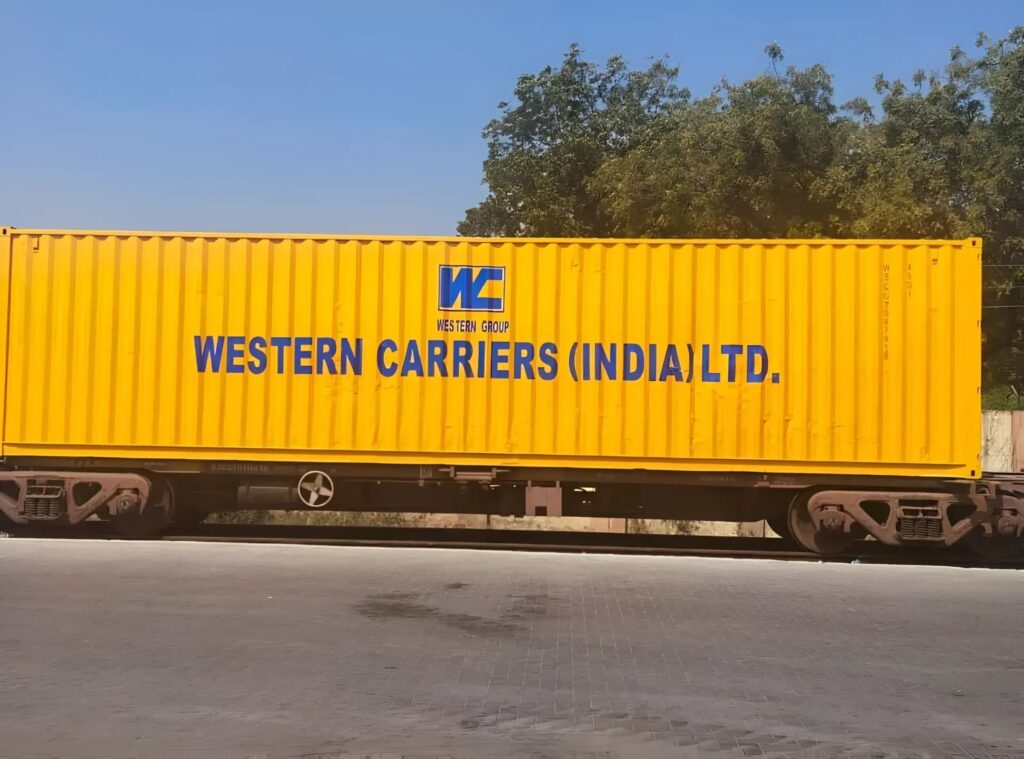
1. At a Glance
In the great Indian logistics bazaar where every truck fancies itself as a startup and every godown dreams of becoming a “fulfilment centre,” Western Carriers (India) Ltd (WCIL) is quietly laying down its multi-modal railway tracks — literally and metaphorically. At a market cap of ₹1,228 crore and a stock price of ₹120, this 50-year-old logistics veteran is now trying to convince investors that “old is the new agile.”
But investors aren’t buying the hype just yet. Over the last three months, the stock has fallen 9.7%, while the 6-month return is a healthier +26.6%, meaning — someone’s hope rally met someone else’s exit. The company’s Q2FY26 (Sep 2025) results screamed slowdown: Revenue ₹440 crore (up 1.9% QoQ) and PAT ₹8.95 crore (down a brutal 52.8% QoQ).
ROCE stands at 13.2%, ROE 10.6%, and debt-equity at a mild 0.23x, making it more disciplined than your average transport contractor. But with working capital days rising from 66 to 96, even the most efficient supply chain operator seems caught in its own logistical labyrinth.
And if you thought logistics was boring, think again. These guys have 850+ shipping containers, 500 trucks, and an asset-light model so asset-light it could give yoga gurus an inferiority complex.
2. Introduction
Every logistics story in India begins the same way: “We provide end-to-end supply chain solutions.” What it often means is — “We move stuff from A to B and pray that C pays on time.” But Western Carriers is one of the few who’ve earned the right to say it with a straight face.
Born in 1972, when India barely had highways, WCIL has transformed from a regional transporter into a multi-modal, rail-focused logistics giant. From trucks and rakes to rivers and ports, if it moves, Western probably handles it. They call themselves a 4PL company, meaning they don’t just move goods; they manage the guys who manage the guys who move goods. Essentially, it’s logistics inception.
The company’s clients are a who’s who of industrial India — Hindalco, JSLA, Vedanta, Cipla, HUL, and more. When your clients are literally the supply chain of India, you can’t afford delays — and Western’s rail-based model ensures the cargo keeps rolling, even when highways turn into parking lots.
The latest few months have been a blockbuster in the order department. From Vedanta’s ₹1,089 crore mega order to Hindustan Zinc’s ₹170 crore and Jindal Stainless’ ₹558 crore + ₹230 crore combo, this company’s order announcements are starting to sound like weekly web series episodes.
But numbers don’t lie — and neither does the margin compression. OPM, once a sweet 10.9%, has slipped to 4.3%. What happened? Welcome to the low-margin, high-volume Olympics known as Indian logistics.
3. Business Model – WTF Do They Even Do?
Let’s decode this 4PL (Fourth Party Logistics) jargon before it drives us all nuts. A 3PL company
arranges trucks and storage. A 4PL like Western Carriers orchestrates the entire chain — strategy, execution, analytics, customs, and paperwork. Basically, they run the whole circus while others juggle balls.
Here’s their show:
- Rail Transport: Their bread and butter. With over 55 rake handling points and mini + jumbo rakes carrying 1,500–2,000 MT each, Western’s rail muscle is unmatched.
- Road Transport: 500+ GPS-enabled trucks because, of course, every truck today must come with GPS — otherwise investors think you’re from the 1990s.
- Warehousing: 16 leased warehouses across 12 states. Asset-light leasing ensures flexibility, but also means they pay rent for everything — like millennials in Mumbai.
- CHA, Stevedoring & Customs: They manage the paperwork nightmare at ports, ensuring your cargo doesn’t become a permanent museum exhibit.
- Project Logistics: For moving heavy machinery, power plants, or other “if this falls, we’re dead” items.
Their asset-light model means fewer capex headaches but constant dependency on rented infra. Think of it as the Airbnb of logistics — they don’t own the house, but they get paid for managing it.
So yes, they’re everywhere — on rails, roads, and rivers. But can they also stay afloat in the P&L sea?
4. Financials Overview
| Metric | Latest Qtr (Sep 25) | YoY Qtr (Sep 24) | Prev Qtr (Jun 25) | YoY % | QoQ % |
|---|---|---|---|---|---|
| Revenue (₹ Cr) | 439.62 | 431.43 | 415.82 | 1.9% | 5.7% |
| EBITDA (₹ Cr) | 18.83 | 36.14 | 20.80 | -47.9% | -9.5% |
| PAT (₹ Cr) | 8.95 | 18.96 | 10.79 | -52.8% | -17.0% |
| EPS (₹) | 0.88 | 1.86 | 1.06 | -52.8% | -17.0% |
Annualized EPS = ₹0.88 × 4 = ₹3.52 → P/E = 120 / 3.52 ≈ 34x.
That’s not cheap for a company with decelerating growth. OPM dropped from 8.4% YoY to 4.3%, suggesting someone’s been discounting too aggressively or fuel costs bit hard.
The EBITDA slide makes one wonder: is rail freight becoming the new “commodity business”?
5. Valuation Discussion – Fair Value Range Only
Let’s put our valuation helmets on.
Method 1 – P/E Approach:
Industry average P/E = 25x.
WCIL FY25 EPS = ₹6.39, TTM = ₹4.61.
Fair Value Range = ₹4.61 × (20–30) = ₹92 – ₹138.
Method 2 – EV/EBITDA:
EV
