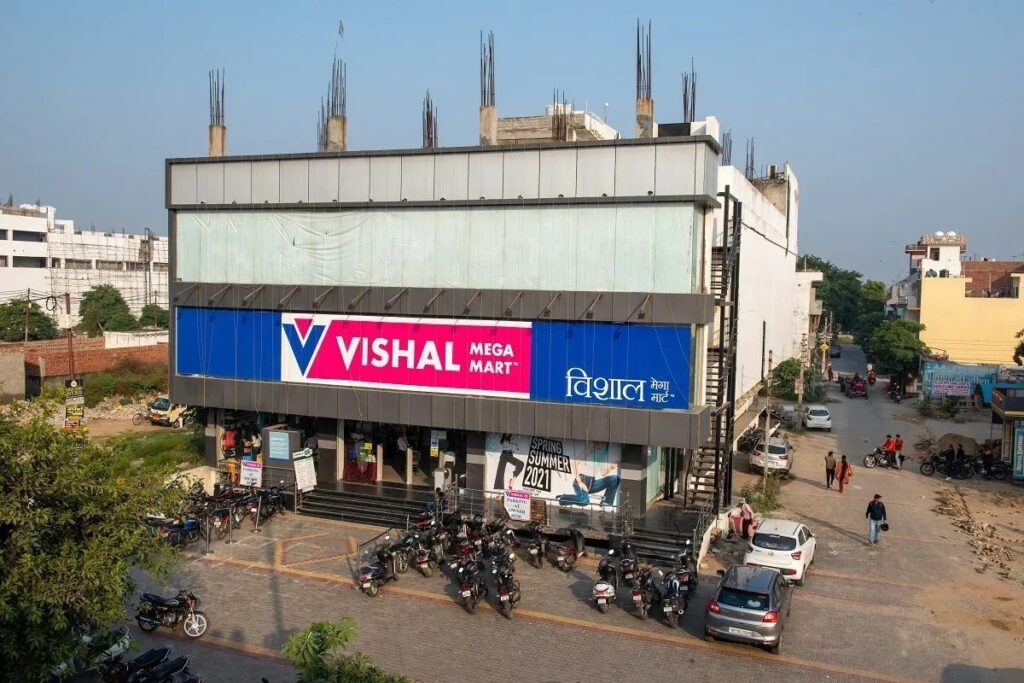
1. At a Glance – Budget Bazaar, Premium Valuation
Let’s not beat around the kirana shelf. Vishal Mega Mart Ltd is a mass-market discount retailer trading like a premium consumption darling. Market cap sits at ₹58,436 Cr, current price ₹125, and the stock has politely corrected ~15% in three months, reminding everyone that gravity exists even in retail.
Q3 FY26 numbers were loud and clear: ₹3,670 Cr quarterly sales (+17% YoY) and ₹313 Cr PAT (+19% YoY). Stores? 771 and counting. Revenue mix screams affordability—FMCG (45%), General Merchandise (28%), Apparel (27%)—with own brands contributing 74.7%. That’s margin control on steroids.
But here’s the meme moment: Stock P/E ~74x, EV/EBITDA ~31.6x, ROCE ~13%, ROE ~10%. Budget shoppers downstairs, luxury multiples upstairs. Is the market pricing a D-Mart-style compounding machine… or a future disappointment aisle? Keep reading.
2. Introduction – From Bazaar to Balance Sheet Stardom
Founded in 2001, Vishal Mega Mart went after the middle and lower-middle income Indian household—the value-conscious, discount-hunting, festival-driven consumer. This isn’t aspiration retail; this is survival retail with scale.
The playbook is simple but execution-heavy: large-format stores, private labels, third-party manufacturing, and aggressive Tier-II/III expansion. As of H1 FY26, 742 stores across 493 cities with 12.76 million sq. ft. of retail space—placing Vishal among the top three offline-first diversified retailers by space.
Q-commerce entry? Yes. 460 cities, 695 stores enabled, ~11 million registered users. Not flashy, but practical—hyperlocal from existing stores instead of burning VC cash on dark warehouses.
The IPO? ₹8,000 Cr OFS only. No fresh capital. Translation: balance sheet doesn’t get fitter; promoters and PE get liquid. Investors get… vibes and valuation.
3. Business Model – WTF Do
They Even Do?
Imagine D-Mart and a local bazaar had a very disciplined child. That’s Vishal Mega Mart.
Three Pillars:
- Apparel: In-house brands across age groups. Cheap, functional, repeat purchases.
- General Merchandise: Home needs, toys, crockery—impulse meets necessity.
- FMCG: Staples, packaged foods, non-food essentials. High frequency, low ticket.
The Secret Sauce:
- 26 private labels, 74.7% of revenue, 19 brands >₹100 Cr, 6 brands >₹500 Cr.
- 850+ third-party vendors, non-exclusive contracts. Vishal designs, vendors manufacture, Vishal controls pricing and quality. Asset-light ego, asset-heavy margins.
Distribution:
A hub-and-spoke model with a central DC, one additional DC, and 17 regional centers. Efficient replenishment, low waste, faster turns. A 600,000 sq. ft. automated warehouse in Haryana is coming—because future scale needs future infra.
Simple model. Brutal execution. That’s retail.
4. Financials Overview – The Numbers That Matter
Q3 FY26 Performance Table (₹ Cr)
| Metric | Latest Qtr (Dec-25) | YoY Qtr (Dec-24) | Prev Qtr (Sep-25) | YoY % | QoQ % |
|---|---|---|---|---|---|
| Revenue | 3,670 | 3,136 | 2,981 | 17.0% | 23.1% |
| EBITDA | 605 | 505 | 395 | 19.8% | 53.2% |
| PAT | 313 | 263 | 152 | 19.1% | 106.0% |
| EPS (₹) | 0.67 | 0.58 | 0.33 | 15.5% | 103.0% |
Annualised EPS (Q3 rule):
Average of Q1–Q3 FY26 EPS = (0.44 + 0.33 + 0.67) / 3 = 0.48 → Annualised EPS ≈ ₹1.92
Witty take: Revenue is jogging, EBITDA is sprinting, PAT just drank Red Bull.