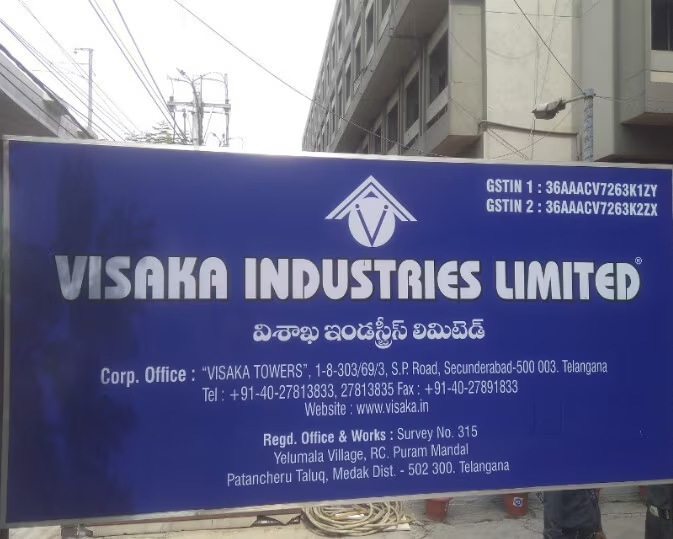
Visaka Industries Ltd Q1FY26 – Cement Sheets, Solar Roofs, and Synthetic Yarns Playing Antakshari with Margins
1. At a Glance
Visaka Industries Ltd (NSE: VISAKAIND, CMP ₹79.9) is like that relative who runs a cement shop by day, solar startup by evening, and yarn factory on weekends—diversified, but confusing. With a market cap of just ₹690 Cr, it’s the second-largest asbestos fibre cement sheet player in India but trades at a P/E of 55 (because the profit is thinner than hostel chai). Sales in FY25 stood at ₹1,590 Cr, with OPM at 7.1%. Debt is ₹479 Cr (Debt/Equity 0.64), and promoter holding is 48.4%. The 3-month return is -6.8%, but in one year it has already broken more hearts than a Tinder ghost—down 22.5%. Current Book Value is ₹86.9, meaning the stock trades below book (P/BV 0.92). On the positive side, Q1FY26 PAT jumped 118% YoY to ₹22.9 Cr. But before clapping, note: RoE is practically 0%, which is like studying all night and still failing viva.
2. Introduction
Visaka Industries has been around since 1981, which means it’s older than most startup founders but younger in perception than its cement peers. The company has three avatars:
The dusty cement sheet uncle (ACS + non-asbestos boards).
The hip solar entrepreneur (ATUM panels).
The textile cousin (Wonder Yarns).
On paper, this is diversification. In reality, it’s a juggling act with asbestos dust in one hand and solar dreams in another.
The stock once flirted with ₹114, but now hovers around ₹80, reminding investors of that one crush who promised forever and then disappeared after three dates. The company’s sales growth over 5 years? 7.9%. Profit growth over 5 years? -69%. Basically, the treadmill is on, but they’re running backwards.
Still, every few quarters, Visaka surprises with a spike in profits (Q1FY26 PAT +118%), making traders wonder: is this revival or just seasonal jugaad?
3. Business Model – WTF Do They Even Do?
Visaka’s business model is like a thali—something for everyone, but not everything top quality.
Building Products (ACS & V-Next): Traditional cement roofing sheets (Visaka/Shakti brands) and modern non-asbestos boards (V-Next). Together, this segment contributes ~85% of revenues.
Textiles (Wonder Yarns): Synthetic yarns with ~80% market share in mélange yarns. Customers include Raymond, Arvind, Siyaram. Think of it as the silent money-spinner, though margins are as thin as Raymond’s slim-fit trousers.
Solar Roofing (ATUM): Their green poster child—an integrated solar roof that generates power while covering your house. Marketed as innovation, but still <2% of revenue. Recognition? Yes. Profitability? Jury’s out.
Distribution muscle: 10,000+ dealers, 41 depots, 34 offices. They can reach you even if you’re hiding in rural Bihar.
Imports: 99% asbestos fibre comes from Russia (no, Putin isn’t giving discount codes). This raw material is 53% of costs. One geopolitical hiccup and margins vanish faster than free samosas at a wedding.
So WTF do they do? They try to be cement, textile, and renewable all at once. Classic desi “beta sab try kar lo, dekhte hain kahan settle hote ho” story.
Commentary: Looks like Visaka suddenly remembered how to earn money. EPS jump is suspiciously high—either operational efficiency kicked in, or “other income” magic (₹38 Cr this quarter). Without that, profits would look like Maggi noodles without masala—plain and disappointing.
Question for you: Do you think this quarterly jump is sustainable, or just a jugaad quarter?
5. Valuation Discussion – Fair Value Range Only
Method 1 – P/E Approach: Industry median P/E ≈ 36. If we take annualised EPS ₹24.2:
Lower range (20×): ₹484
Upper range (30×): ₹726
Method 2 – EV/EBITDA: EV = ₹1,150 Cr, EBITDA (FY25 TTM) ≈ ₹113 Cr → EV/EBITDA = 10.2. Industry peers trade ~8–12. Fair Value Range = ₹70–₹95.
Method 3 – DCF (simplified): Assume FCF = ₹40 Cr annually, growth 5%, WACC 12%. Fair Value = ~₹600 Cr EV → per share ~₹70.
Fair Value Range (Consolidated):₹70 – ₹726. Wide, because profits swing like a drunk uncle at a sangeet.
⚠️ Disclaimer: This fair value range is for educational purposes only and is not investment advice.
6. What’s Cooking – News, Triggers, Drama
CEO Exit (Aug 2025): Abinash Mishra resigned citing “personal reasons.” Translation: “numbers were too personal.”
Stadium Naming Rights Case (Jun 2025): High Court awarded ₹25.9 Cr in arbitration. Imagine fighting over stadium naming rights while core business struggles. Priorities.
Land Sale (Jun 2025): Sold Gujarat land for ₹45.3 Cr. Smart deleveraging or selling furniture to pay rent?
ATUM Solar Recognition (Jan 2025): Got MNRE ALMM certification. Sounds big, but adoption still slower than