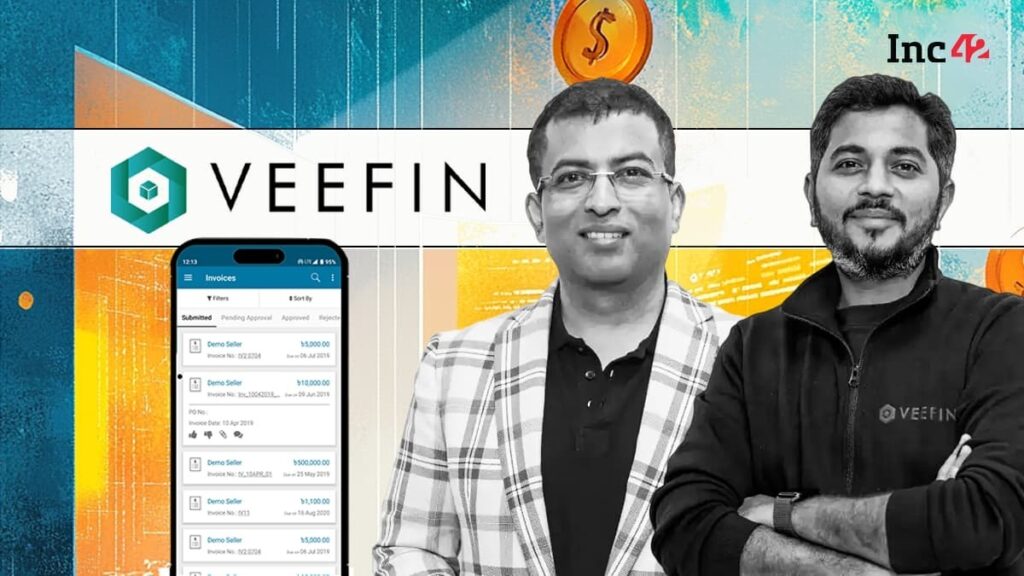
1. At a Glance – Blink and You’ll Miss the Red Flags (and the Growth)
₹738 Cr market cap. ₹289 stock price. Down ~48% in one year. Quarterly revenue ₹104 Cr. Quarterly PAT ₹7.78 Cr. OPM flirting with 20%. Sounds sexy? Wait.
Veefin is that company which banks love, markets hate, and promoters have mortgaged like a Gujarati uncle funding three weddings at once. It sits at the intersection of transaction banking, supply chain finance, LOS/LMS, and a government-backed digital marketplace (PSB Xchange). Basically, if money moves between a bank, a corporate, and an MSME — Veefin wants a toll booth there.
But the stock? It’s been punished like it leaked insider info (it didn’t). Price fell from ₹570 to ₹289, while sales grew 215% YoY and profits grew ~78%. Meanwhile, 66% of promoter holding is pledged, ROE is stuck at ~5–6%, and debtor days exploded to 231 days.
So what is Veefin?
- A misunderstood SaaS compounder?
- A services-heavy cash-flow nightmare?
- Or a fintech infra company early in its lifecycle but late in governance hygiene?
Let’s dissect. Slowly. With gloves. 🧤
2. Introduction – This Is Not a Bank, Not a NBFC, Not a Typical IT Company
Veefin is not lending money. It’s not taking credit risk. It’s selling software plumbing to people who do lend money. That’s important — because whenever fintech stocks fall, the first accusation is always: “Credit cycle kharab ho gaya hoga.”
Nope. Veefin doesn’t care if loans default — it just wants banks to process them faster, smarter, and digitally, and then send Veefin an invoice.
Founded in 2020 (yes, COVID baby), Veefin rode:
- PSU banks waking up from coma
- Supply chain finance digitisation
- Government pushing platforms like PSB Xchange
- Banks outsourcing tech instead of building in-house garbage
And boom — revenue went from ₹7 Cr (FY22) to ₹79 Cr (FY25). That’s not growth, that’s puberty.
But markets don’t reward growth alone. They reward quality of growth, cash discipline, and capital allocation sanity.
Veefin
currently looks like a student who topped college but forgot to submit hostel receipts. Let’s see why.
3. Business Model – WTF Do They Even Do? (Explained for Lazy Smart People)
Imagine a PSU bank manager who still uses Excel 2007. Veefin sells him software so that:
- Loans don’t take 6 months
- Vendors get paid
- MSMEs don’t cry
- And auditors stop yelling
a) Transaction Banking (The Cash Cow 🐄)
This includes:
- Supply Chain Finance (SCF)
- Trade Finance
- Cash Management
- Internet Banking modules
SCF margins are ~54%. This is elite territory. Think SaaS meets toll booth. Veefin claims its SCF platform supports $40+ billion of annualised transactions. That’s not Veefin’s revenue — that’s flow volume. They skim fees.
Sticky clients. Long relationships (>7 years). Banks hate switching core systems. Once installed, you’re married.
b) Lending Lifecycle Solutions (~40%)
LOS/LMS, collections, fraud detection, GenAI tools.
This is more competitive. Everyone and their VC-backed cousin is here. But Veefin’s edge is deep PSU integration, not fancy UI.
c) PSB Xchange – Sarkari Fintech with Teeth
A digital marketplace exclusively for Public Sector Banks, corporates, and MSMEs.
Pipeline: ₹3,000+ Cr loans
This is not a joke app. It has CXO appointments, board focus, and regulatory blessing.
If this scales, Veefin becomes infra, not software.
d) Services & Acquisitions – The Mixed Masala Plate
Acquired stakes in:
- White
