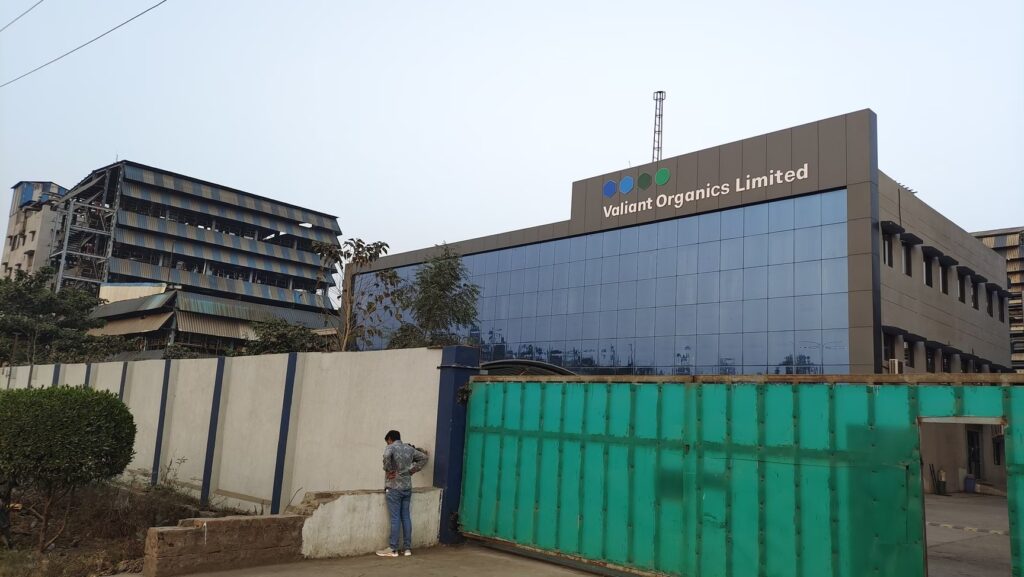
1. At a Glance
Valiant Organics Ltd (VOL) — the once-celebrated jewel of the Aarti Group cousins — has recently been giving “Valiant” a new meaning: courageously facing market meltdowns, fires, and CRISIL downgrades, all while its stock price did a full kamikaze dive from ₹508 to ₹255. That’s a 50% price erosion — or as investors call it, “Friday ka heartbreak.”
As of 24 November 2025, the stock traded at ₹255 with a market cap of ₹713 crore. Over the last 6 months, it’s down 41.5%, and over the past year, down 22% — proving once again that “chemicals may compound, but confidence can evaporate faster than solvent.”
For Q2FY26, the company posted sales of ₹157 crore and PAT of ₹5.6 crore, with margins just about 3.6% — but at least it’s positive again after a rollercoaster FY25 that included losses, fire incidents, and one seriously grumpy CRISIL rating officer. ROCE stands at 2.97%, ROE at -0.45%, and P/E at 32.7, which tells you optimism still survives somewhere in D-Street.
So yes, the stock’s down, profits are up (sort of), and the factories are smoking (literally and financially). Grab your lab coat — we’re going deep into the chemical drama that is Valiant Organics.
2. Introduction
Valiant Organics Ltd, incorporated in 1984, started as a humble chlorophenol manufacturer and grew into a midcap specialty chemical player serving dyes, pharma, and agrochemical industries. It’s run by the Gogri, Gala, and Chheda families — chemical royalty known for Aarti Industries’ legacy.
In FY20, the stock was flying high; by FY24, it had morphed into a cautionary tale. A combination of fire accidents, environmental closures, demergers, and flat growth turned what was once a “multibagger” into a “multi-beggar.”
But the story isn’t just about losses. The company is actively restructuring, integrating, and rebuilding after a tumultuous two years. Its plants across Gujarat and Maharashtra form a dense industrial web producing chlorophenols, amines, and other exotic molecules — the kind of stuff that makes your perfume smell good and your pharma tablet possible.
Yet, competition, global slowdown, and regulatory heat have bruised the company’s P&L. CRISIL has already downgraded its ratings in July 2024, and management’s firefighting skills were tested when — quite literally — a fire hit the Ahmedabad plant in October 2024.
Still, Q2FY26 shows signs of recovery. Net profit at ₹5.6 crore is up 150% YoY, which means the chemistry might be turning stable again. Or maybe investors are just hoping for a new catalyst (pun intended).
3. Business Model – WTF Do They Even Do?
Valiant Organics is basically that nerdy kid in school who knows how to mix acids without dying. It manufactures specialty chemicals and pharma intermediates, serving sectors like dyes, pigments, agrochemicals, and pharmaceuticals.
Here’s how their chemistry lab is divided:
- Ammonolysis Unit: Produces Para Nitro Aniline (PNA) and Ortho Chloro PNA — these are dyes and pigment raw materials.
- Hydrogenation Unit: The big money-spinner. Makes intermediates like PAP (Para Amino Phenol — used in paracetamol), Ortho Anisidine, and IPPCA.
- Chlorination Unit: Produces chlorophenols (PCP, OCP, 2,4-DCP, etc.) used in agri, cosmetics, and pharma.
- Acetylation & Sulphonation: Think dyes and pigment chemicals — fancy names, old markets.
- Methoxylation: Where Para Nitro Anisole and Ortho Nitro Anisole come from — niche products feeding the dye chain.
The company runs six plants across five sites — all in Gujarat and Maharashtra — with a total capacity exceeding 75,000 MTPA. These plants are near ports, giving them export advantages (Europe, Japan, China contribute ~6% of revenue).
If chemistry is all about reaction balance, Valiant is trying to balance between industrial scale, product diversification, and regulatory survival.
4. Financials Overview
| Metric (₹ Cr) | Latest Qtr (Sep’25) | YoY Qtr (Sep’24) | Prev Qtr (Jun’25) | YoY % | QoQ % |
|---|---|---|---|---|---|
| Revenue | 157.21 | 160.18 | 204.41 | -1.85% | -23.1% |
| EBITDA | 21.15 | 2.37 | 24.83 | 792% | -14.8% |
| PAT | 5.60 | -11.16 | 7.58 | 150%+ | -26.1% |
| EPS (₹) | 2.00 | -4.04 | 2.71 | NA | -26.2% |
Commentary:
EBITDA margins bounced to 13.45%, up from a dismal 1.48% last year — probably because last year they were busy putting out fires (literally). PAT finally turned green again at ₹5.6 crore, marking a major turnaround. The quarterly profit may look small, but given last year’s chaos, even a stable margin deserves a standing ovation in safety goggles.
5. Valuation Discussion – Fair Value Range Only
Let’s use three approaches to estimate a learning-oriented range (remember, this is for education, not for tips):
(a) P/E Method:
TTM EPS = ₹7.8
Industry P/E = 27.8
→ Fair Range = ₹7.8 × (25–35) = ₹195 – ₹273
(b) EV/EBITDA Method:
EV = ₹905 Cr; EBITDA (TTM) = ₹82 Cr → EV/EBITDA = 11x approx.
Industry average = 10x–14x →
→ Fair EV = 10×82 to 14×82 = ₹820
