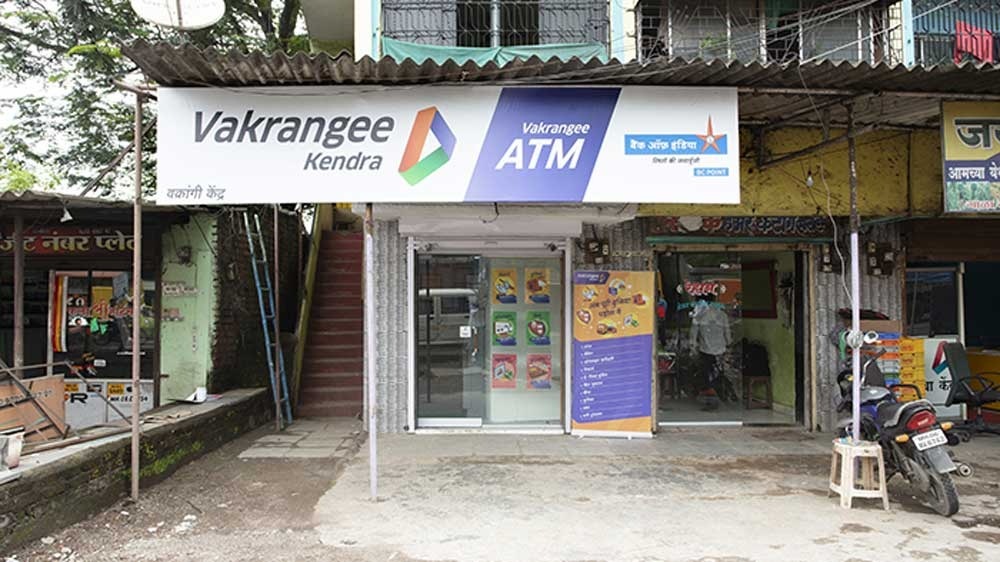
Vakrangee Ltd Q2 FY26: The 98x PE Mystery, 3 Crore Profit & a Franchise Network That Dreams in Crores but Earns in Paise
1. At a Glance
Once the poster child of India’s “Digital India” dreams, Vakrangee Ltd now sits at a market cap of around ₹950 crore — roughly what one Tata subsidiary spends on samosas during board meetings. The company posted a revenue of ₹69 crore and a PAT of ₹3.03 crore in Q2 FY26, up 412% YoY. Sounds impressive till you realise 412% growth from near-nothing is still near-nothing. The stock trades at ₹8.77, down 68% YoY, yet boasts a P/E ratio of 98.1. Somewhere, Benjamin Graham just threw his calculator.
Vakrangee’s operating margin stands at 10.5%, ROE at a thrilling 3.65%, and ROCE at 5.86% — because apparently, math also takes a rural development holiday here. Still, the company runs nearly 23,000 Vakrangee Kendras, most of them in rural India, where each shop sells everything from insurance to mobile recharges to maybe your neighbour’s kidney if it’s government-approved.
But the real question is — can a company with 6,000 ATMs and 12.6 crore transactions actually make money, or is this another episode of “Scalable but not Profitable: Indian Edition”? Buckle up, we’re going deep.
2. Introduction
Vakrangee has been around since 1990 — back when the only digital thing in India was the Casio calculator. Fast forward to FY26, and the company claims to be building “India’s largest last-mile distribution network.” Translation: they want a shop at every pin code, a dream that even Swiggy has stopped dreaming.
Its Kendras are supposed to be the bridge between Bharat and the internet — a franchise model where small shop owners sell everything from banking and e-commerce to health insurance and mobile recharge. It’s a business model that sounds like JioMart, Paytm, and SBI decided to share a dorm room in rural Bihar.
But Vakrangee’s story is not all chai and samosas. This company has seen its share of “why did SEBI send a letter again?” moments, a 93% fall from its 2018 peak, and more corporate clean-ups than a Bigg Boss house. Yet, somehow, it’s still here — raising warrants, acquiring ATM companies, and throwing around phrases like “O2O platform” as if rural India asked for one.
It’s not dead. It’s not thriving. It’s just… existing in PowerPoint presentations.
3. Business Model – WTF Do They Even Do?
Imagine your neighbourhood kirana shop that also doubles as a mini-bank, an insurance kiosk, an e-commerce pickup point, an ATM, and maybe an astrologer’s den if the month’s slow. That’s Vakrangee Kendra.
There are four models:
VK with ATM and Private Bank BC Point – basically a shop with a machine that gives cash and a banker who gives attitude.
VK without ATM, with PSU Bank BC Point – because PSU banks don’t need machines, they have forms.
VK without ATM but with Private Bank BC Point – half the service, double the confusion.
Only ATM – the lonely kiosk that just eats debit cards.
Vakrangee earns from commissions on services, small transaction fees, and partnerships. About 97% of its FY24 revenue came from these Kendras — proof that at least someone’s doing the heavy lifting while head office makes PowerPoints.
So yes, Vakrangee’s “physical plus digital” network sounds grand, but functionally, it’s a glorified service franchise. Think of it as the Indian cousin of 7-Eleven — but instead of coffee, you get an Aadhaar update and a new bank account.
4. Financials Overview
Source table
Metric
Latest Qtr (Sep’25)
YoY Qtr (Sep’24)
Prev Qtr (Jun’25)
YoY %
QoQ %
Revenue (₹ Cr)
69.1
65.25
68.8
+5.87%
+0.43%
EBITDA (₹ Cr)
7.8
5.2
7.8
+49.9%
0%
PAT (₹ Cr)
3.03
0.59
3.32
+412%
-8.7%
EPS (₹)
0.03
0.01
0.03
+300%
0%
Commentary: Vakrangee’s YoY numbers look like a Diwali cracker — loud, bright, and over in seconds. PAT up 412% sounds glorious till you realise it’s ₹3 crore. Even their annualised EPS of ₹0.12 gives a P/E of 73×, so the 98× shown on Screener might just be rounding off to the nearest delusion.
5. Valuation Discussion – Fair Value Range Only
Let’s try not to faint while doing this.
P/E Method: EPS (annualised): ₹0.12 If market decides to stop hallucinating and give it a reasonable 25–35× P/E (sector avg 34.6), → Fair Value = ₹3.0 – ₹4.2
EV/EBITDA Method: EV = ₹873 Cr, EBITDA (TTM) ≈ ₹27 Cr EV/EBITDA = 32.3× currently. If normalized to 12–18× (still generous for low-growth fintech infra), → Enterprise Value Range = ₹324–₹486 Cr → Fair Value per share ≈ ₹3.0 – ₹4.5
DCF (Discounted Cash Flow) Assume: PAT grows 20% CAGR for 5 years (optimism overdose), discount rate 12%, terminal growth 3%. → Fair Value ≈ ₹3.8 – ₹5.2
🎯 Educational Fair Value Range: ₹3.0 – ₹5.0 per share
This fair value range is for educational purposes only and is not investment advice.
So yes, the stock’s current ₹8.77 price is living in an alternate reality — probably the metaverse.
6. What’s Cooking – News, Triggers, Drama
2025 was like a season of Indian Matchmaking for Vakrangee — endless partnerships, questionable choices, and some “it’s complicated” with SEBI.
Renewed deal with Bank of Baroda for banking services — the relationship that refuses to end.
Partnered with TATA AIG, Aditya Birla Health, and Universal Sompo for insurance distribution. Because if you can’t sell profits, sell policies.
Subsidiary Vortex Engineering bagged ATM orders worth ₹39 crore from Punjab & Sind Bank and ₹12 crore from UCO Bank. The ATM business is booming — too bad margins aren’t.
Got a GST tax demand of ₹5 lakh (a rounding error in Airtel’s ad spend).