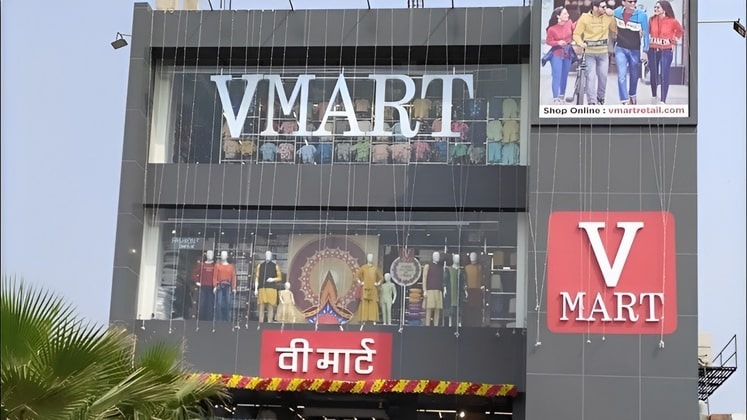
01 — At a Glance
The Value Retailer Selling Dreams at Full Price
- 52-Week High / Low₹962 / ₹497
- Q3 Revenue₹1,126 Cr
- Q3 PAT₹88 Cr
- Q3 EPS₹11.08
- Annualised EPS (Q3×4)₹44.32
- Book Value₹106
- Price to Book4.95x
- Dividend Yield0.00%
- Debt / Equity0.95x
- Store Count554 (Dec 2025)
The Auditor’s Uncomfortable Question: V-Mart just delivered ₹1,126 Cr in Q3 revenue (+9.7% YoY), ₹88 Cr net profit (+25% YoY), and expanded to 554 stores. Management is giddy. Analysts are giddy. The stock traded from ₹962 down to ₹497 in 52 weeks and somehow still costs 35x earnings. In the value retail business, everyone should be selling cheap. V-Mart learned the opposite: sell yourself cheap, and the market will price you at a premium for being such a contrarian.
02 — Introduction
Welcome to the Discount Store That Costs Full Price
Let’s talk about V-Mart Retail. Yes, the company whose entire USP is selling ₹300 jeans at ₹80. Whose founder once said — and I’m paraphrasing — “if we’re selling clothes below cost, we’re winning.” Welcome to the value retail paradox: a business built on underpricing everything except its own stock price.
V-Mart was founded in 2002, opened its first store in 2003, and has spent 22 years perfecting the art of fitting three stores into the space of one Reliance Retail outlet, serving tier-II, III, and IV India with apparel at price points between ₹80 and ₹800 (average ₹249 per item). By December 2025, the company operates 554 stores across 48+ lakh square feet of retail space. That’s a footprint. That’s also a profitability challenge.
Q3 FY26 just wrapped: ₹1,126 crore revenue, ₹88 crore net profit, 554 stores, and a P/E of 35.4x. Profit growth at 25% YoY. Inventory days at 95. Management on the concall says everything is “under control and healthy.” The stock price says: I don’t believe you. The stock crashed 47% from 52-week high to low. Yet the valuation remains stratospheric.
This is the story of a retail company that’s doing everything right operationally but everything wrong financially. Good business. Bad stock. Or possibly just a stock that costs too much for people who got into it at ₹962.
Concall Deep Dive (Jan 2026): Management characterized demand as “stable and cautiously optimistic… not exuberant, definitely not fragile.” Translation: sales growth will continue at single digits. But they sounded genuinely confident about network expansion payback and inventory management improvements. This is not a company in trouble. This is a company trading like one.
03 — Business Model: WTF Do They Even Do?
Dress Tier-4 India. Make 10% Margins. Repeat 554 Times.
V-Mart is a value retail chain operator. Translation: small-format stores (high density, low sq ft per outlet) in tier-II, III, and IV cities, selling apparel at aggressively low price points. ₹80 tees. ₹150 shirts. ₹249 average. The target customer: rural, semi-urban India. Income: aspirational. Cotton: 80% of the product mix. Occasions: driven by agri cycles, festivals, and wedding season — not impulse, not fashion, not trend-chasing.
The business model is simple in theory, complex in practice. V-Mart operates 554 stores under three brand umbrellas: V-Mart (83% revenue), Unlimited (16%, South-focused), and LimeRoad (1%, the online marketplace they acquired to go omni-channel). Private label accounts for ~70% of apparel sales, meaning they’re manufacturers’ preferred partners, not brands paying royalties to global parents.
Gross margins: mid-40s%. Operating expenses: tight — manpower, rent, utilities, local marketing. Pre-tax margins at Q3: 10% (healthy for retail). After-tax: 7.8% (solid). But here’s the kicker — store economics are improving. New stores ramp faster than old stores. Same-store sales growth (SSSG) at 3% for V-Mart format. Foot traffic: 25 million in Q3. Inventory turns: healthy, with 95 days in stock (down from prior year due to better liquidation discipline).
Stores55449 stores in 9M
Retail Area48+ Lakhsq ft
Footfalls Q325 Mnquarterly
Avg Price₹249per item
Expansion playbook (Jan 2026 concall): “75-plus new stores by year-end.” “Capex meaningfully lower than industry averages.” “Area addition targeting 13–14% annually.” “New stores ramping up much faster than historical averages.” Translation: they’re getting better at opening stores that actually make money. Except the market doesn’t care yet.
💬 Would you ever buy clothes at ₹249 average, or do you think value retail in Tier-4 India is hitting a ceiling? Drop your town’s retail story!
04 — Financials Overview
Q3 FY26: The Numbers Nobody’s Excited About
Result type: Quarterly Results | Q3 FY26 EPS: ₹11.08 | Annualised EPS (Q3×4): ₹44.32 | 9-Month (H1+Q3) EPS: ~₹12.7
| Metric (₹ Cr) |
Q3 FY26
Dec 2025 |
Q3 FY25
Dec 2024 |
Q2 FY26
Sep 2025 |
YoY % |
QoQ % |
| Revenue | 1,126 | 1,027 | 807 | +9.6% | +39.4% |
| EBITDA | 210 | 172 | 126 | +22.1% | +66.7% |
| EBITDA Margin % | 18.6% | 16.7% | 15.6% | +190 bps | +300 bps |
| PAT | 88 | 72 | -9 | +25.0% | NM |
| EPS (₹) | 11.08 | 9.04 | -1.12 | +22.5% | NM |
The Story Hidden in the Asterisk: Q3 looks great until you realise Q2 had a loss. Nine-month P&L shows YTD PAT of ₹113 crore (~3x YoY). That’s coming from Q1+Q3 strength and Q2 weakness. Management blamed festival calendar shifts (Durga Puja moved from October to September across lunar calendar, so Q2 got the boost last year). Strip that out, and growth is mid-teens on revenue, but the margin story is the real hero — EBITDA expanding 190 bps YoY in Q3, driven by better inventory health (less discounting), higher full-price sell-through, and lower shrinkage. This is management executing well. But the P/E at 35.4x assumes this continues flawlessly forever.
05 — Valuation: Fair Value Range Only
Is ₹529 Cheap, Fair, or Overpriced?
Method 1: P/E Based
Annualised EPS (Q3×4) = ₹44.32. Industry median P/E for retail = 15–18x. Value retail peers (Vishal Mega Mart, Electronics Mart) trade at 39–63x. V-Mart at 35.4x is cheaper than industry but expensive vs historical norms (3-year avg ~15–20x). Conservative fair P/E band: 18x–25x (accounting for execution risk on expansion and demand volatility).
Range: ₹798 – ₹1,108
Method 2: EV/EBITDA Based
Annualised EBITDA (Q3×4) = ₹840 Cr. Current EV = ₹4,980 Cr (Market cap ₹4,202 Cr + Net debt ~₹778 Cr). EV/EBITDA = 5.9x. Retail peers trade at 8–12x. But VMRL’s EBITDA is volatile (Q2 showed weakness). Conservative fair multiple: 7–9x EBITDA.
EV range (7–9x): ₹5,880 Cr – ₹7,560 Cr → Per share:
Range: ₹756 – ₹976
Method 3: Book Value Based
Book Value per share = ₹106. P/B multiple: historically 1.5–3x for retail (depending on ROE). VMRL’s 3-year ROE is -3.3% (a red flag). Current P/B: 4.95x. Fair P/B: 2–3x (for a retail chain with modest but improving unit economics).
→ P/B 2–3x = ₹212–318 per share
Range: ₹212 – ₹318
Conservative: ₹212
CMP: ₹529
Optimistic: ₹1,108
CMP ₹529
⚠️ EduInvesting Fair Value Range: ₹400 – ₹900. CMP ₹529 sits in the lower-middle range of our analysis, suggesting modest upside under favorable execution but significant downside risk if expansion stumbles or margins compress. This fair value range is for educational purposes only and is not investment advice. Please consult a SEBI-registered investment advisor before making any financial decision.
06 — What’s Cooking: News, Triggers & Drama
The Chaos Inside the Discount Aisle