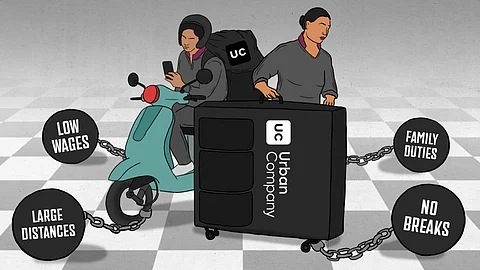
1. At a Glance – The 30-Second Elevator Pitch (With Attitude)
Urban Company is what happens when convenience meets venture capital and then collides with reality. Listed in September 2025 after raising ₹1,900 Cr, the company today sits at a market cap of ₹18,064 Cr with the stock trading around ₹125, down ~15% in the last three months.
Q3 FY26 numbers look like a startup still figuring out adulthood: revenue ₹383 Cr (YoY +32.9%), PAT loss ₹21.3 Cr, and operating margin at -11%. The platform boasts scale—14.59 million consumers, 54k+ monthly active service professionals, and 12,000+ micro-markets—but profitability is still playing hard to get.
Debt is low (₹136 Cr, D/E 0.06), liquidity is comfy (current ratio 4.68), but valuation is spicy: P/B of ~8x for a company still bleeding at EBITDA. The question is simple: Is this Amazon-in-the-making or just Swiggy with a screwdriver?
2. Introduction – Convenience Is Expensive, Boss
Urban Company sells time. And time, as everyone agrees, is priceless—except on the P&L where it’s very expensive. Founded in 2014, the company positioned itself as a full-stack marketplace for home and beauty services. Not just discovery, not just payments—it owns training, quality control, tools, pricing logic, and even micro-geography.
That ambition shows in scale. From cleaning and plumbing to massages and salon-at-home, UC wants to be the default app whenever something at home breaks—or when you are broken after work.
But here’s the catch: platforms love scale, markets love profits. Urban Company has nailed the first and is still negotiating with the second. Despite 5-year sales CAGR of ~39%, operating losses only recently started narrowing. FY25 finally showed net profit of ₹240 Cr, helped by other income and accounting quirks, but quarterly volatility is wild.
So, is this a long-term platform story or a high-burn lifestyle app? Let’s
dissect.
3. Business Model – WTF Do They Even Do?
Think of Urban Company as Zomato for services, except the delivery partner is holding a drill or a waxing strip.
The model has three legs:
- India Consumer Services (77% of FY25 revenue)
Cleaning, pest control, plumbing, beauty, grooming—high-frequency, repeat-use services. This is the engine room. - International Operations (13%)
UAE, Singapore, and briefly Saudi Arabia (now being wound up). Same playbook, higher ticket sizes, tougher unit economics. - Native Brand Products (10%)
Water purifiers, electronic locks—manufactured by third parties, sold via UC’s ecosystem. Basically: “While you’re here, buy this too.”
UC controls training (2.9 lakh sq.ft. across 17 cities), pricing bands, and quality metrics. That’s great for consistency—but expensive. Every new city and service adds fixed costs before volumes kick in.
Lazy investor translation: Amazing control, heavy costs, profits postponed.
4. Financials Overview – Growth Yes, Profits Meh
Result Type Locked: Quarterly Results (Q3 FY26)
Quarterly Comparison Table (₹ Cr)
| Metric | Latest Qtr (Dec-25) | YoY Qtr (Dec-24) | Prev Qtr (Sep-25) | YoY % | QoQ % |
|---|---|---|---|---|---|
| Revenue | 383 | 288 | 380 | 32.9% | 0.8% |
| EBITDA | -42 | -2 | -79 | NA | Improvement |
| PAT | -21 | 232 | -59 | -109% | Improvement |
| EPS (₹) | -0.15 | 11.87 | -0.41 | NA | Improvement |
EPS Annualisation (Q3 Rule)
Q1 EPS: 0.14 | Q2 EPS: -0.41 | Q3 EPS: -0.15
Average = -0.14 → Annualised EPS ≈ -0.56
Translation: losses are narrowing, but
