1. At a Glance – Blink and You’ll Miss the Scale
Uno Minda is no longer “that switches company.” It’s now a ₹71,080 Cr automotive components behemoth trading at around ₹1,231, flexing a 61× P/E like it’s leg day every quarter. In the last three months, the stock has mostly gone sideways (0.09% return), which honestly feels suspicious given Q3 FY26 revenue of ₹5,018 Cr (+20% YoY) and PAT of ₹298 Cr (+28% YoY). ROCE sits at 18.8%, ROE at 17.5%, and debt has ballooned to ₹2,852 Cr—not because of bad habits, but because the company is on a ₹3,093 Cr capex binge across alloy wheels, EV parts, airbags, switches, and sunroofs. This is not a “steady compounder chilling on the couch.” This is a company lifting barbells while simultaneously assembling EV motor controllers. Curious already? Good. You should be.
2. Introduction – From Horns and Switches to an Auto-Tech Octopus
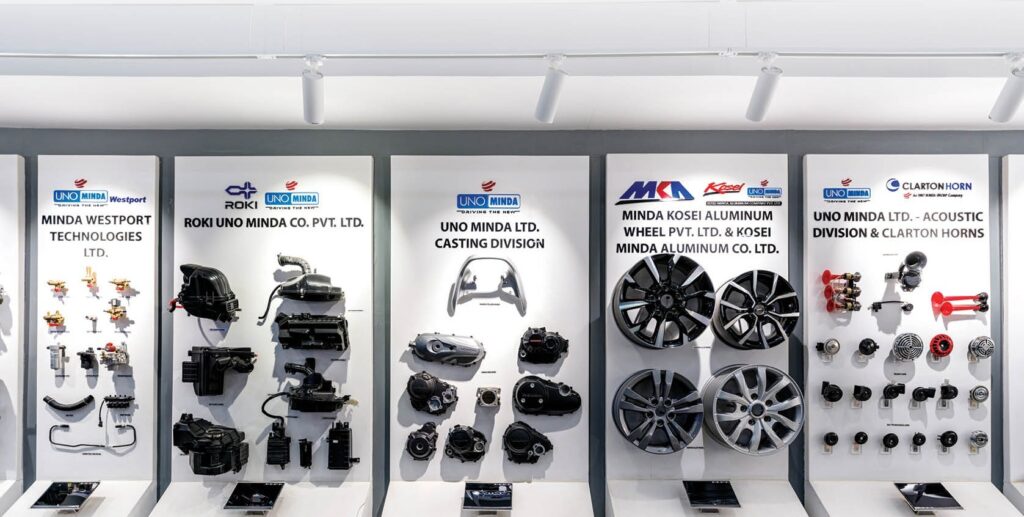
Uno Minda started in 1958, back when “automotive electronics” meant a horn that didn’t embarrass you at traffic lights. Fast forward to FY26, and the company manufactures 25+ automotive systems spanning switches, lighting, alloy wheels, acoustics, seating, EV power electronics, airbags, and even sunroofs.
What’s fascinating is not just the product list—it’s the breadth across vehicle segments. Two-wheelers, three-wheelers, passenger vehicles, commercial vehicles, ICE, hybrids, EVs—Uno Minda is playing automotive Tambola and ticking almost every box.
Revenue concentration? OEM-heavy at 93%, which tells you this is a serious Tier-1 supplier, not an aftermarket jugaad shop. Exports are a modest 11%, so India remains the growth engine. And yet, the company operates 74 manufacturing facilities across six countries, backed by 37 R&D centers globally. That’s a lot of engineers arguing over tolerances.
The big question: is this expansion disciplined, or is Uno Minda trying to do too many things at once? Let’s dig.
3. Business Model – WTF Do They Even Do?
Imagine explaining Uno Minda to a lazy but smart investor:
“They make parts that your vehicle absolutely needs, but you never brag about.”
Switches (25% revenue), lighting (23%), castings (20%), seating, acoustics, and a long tail of “others.” Over time, switches and acoustics have lost some share, while casting and ‘others’ have surged—a sign that the company is deliberately moving into heavier, more complex systems.
The aftermarket business is a sleeper hit: 6,500+ SKUs, 54,000 retailers, 450 partners, across 550 cities. That’s FMCG-level distribution in an auto component disguise. The margins here are typically better, though the revenue share is only 7% for now.
Then comes EVs. Uno Minda isn’t betting on one EV product—it’s building a full low-voltage EV ecosystem (48V–96V): motor controllers, DC-DC converters, traction motors, chargers, cables, and wall-mounted units. As of FY24, EV order book peak annual value exceeds ₹3,000 Cr. That’s not optional diversification; that’s survival planning.
4. Financials Overview – The Quarter That Did the Talking
Quarterly Performance Table (₹ Cr)
| Metric | Latest Qtr (Q3 FY26) | YoY Qtr (Q3 FY25) | Prev Qtr (Q2 FY26) | YoY % | QoQ % |
|---|---|---|---|---|---|
| Revenue | 5,018 | 4,184 | 4,814 | 19.9% | 4.2% |
| EBITDA | 554 | 457 | 552 | 21.2% | 0.4% |
| PAT | 300 | 254 | 323 | 18.1% | -7.1% |
| EPS (₹) | 4.79 | 4.05 | 5.27 | 18.3% | -9.1% |
Commentary:
Revenue is marching forward nicely. EBITDA margins are stable (~11%). PAT dipped QoQ because Q2 had a tax/mix advantage, not because the business forgot how to make money. Nothing alarming—but not euphoric either.
Annualised EPS (Q3 Rule)
