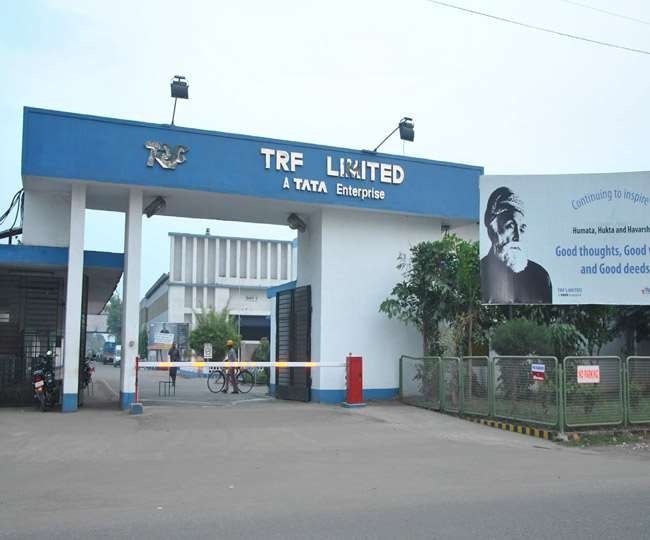
1. At a Glance
TRF Ltd — the Tata Group’s material-handling specialist — just delivered a Q2 FY26 performance that can best be described as “the plot twist nobody expected but everyone predicted.” The Jamshedpur-based engineering outfit reported a quarterly sales figure of ₹22.34 crore and a net loss of ₹6.81 crore, thanks in part to an exceptional employee separation scheme (ESS) charge of ₹11.3 crore. The market reacted with all the energy of a bored crane operator — the stock closed at ₹307, down marginally, valuing the company at a modest ₹337 crore.
This company’s financials read like a redemption arc: debt slashed from ₹554 crore in FY25 to ₹122 crore in Sep FY26, zero pledges, and a 34.1% Tata Steel ownership that gives TRF a solid surname but a complicated family dynamic. Operating margins are at a respectable 22.7%, but sales have fallen off a cliff — down nearly 32% YoY. The cherry on this hard-hat sundae? No dividends for anyone since forever.
So here we are — a material-handling company still trying to handle its own materials: legacy projects, tax demands, and a never-ending “to be merged” saga with Tata Steel that has now been officiallywithdrawn. If you like drama in your data, you’re in the right place.
2. Introduction
Once upon a time in Jamshedpur, a Tata baby named TRF Ltd was born in 1962 to lift India’s industrial backbone — literally. Sixty-three years later, it’s still lifting… just not as high. The company specializes in turnkey material-handling projects for steel, power, cement, and mining sectors — or as engineers call it, “making giant belts that move rocks and coal from one side of the yard to another.”
In FY23, TRF made waves by manufacturing 1,244 metric tonnes of finished goods for Tata Steel, including an EOT crane for the first time — because what’s a better flex than finally building your own lifting equipment after six decades? But every hero’s journey has a villain, and in TRF’s case, it’s stagnating demand, tax disputes, and a merger that went from “approved” to “awkwardly withdrawn” like a college breakup.
To its credit, TRF has turned around from a long era of losses into positive margins and near-zero debt. But its top line still seems allergic to growth. The sales graph has the same slope as a tired conveyor belt at the end of a shift — steeply downward. Yet, this company has survived every recession, every downturn, and every Tata restructuring. Clearly, resilience is its middle name — or maybe just “pending litigation.”
3. Business Model – WTF Do They Even Do?
TRF is that quiet cousin in the Tata family — the one that builds massive machines and systems but gets overshadowed by its more glamorous siblings like Tata Steel or Tata Motors. Its core job is todesign, manufacture, install, and commission bulk material-handling systems— in simpler terms, it makes the infrastructure that moves coal, ores, and cement before they become skyscrapers and smokestacks.
The company operates in two divisions:(a)Project Division:This is the big-ticket engineering business — designing conveyor systems, ship loaders, crushers, and turnkey setups for power, steel, and port clients. Think of it as the “IIT section” of TRF, where drawings meet deadlines.(b)Product Division:This unit manufactures equipment like shuttle conveyors, impact crushers, truflo and vibropulse screens, and even hydraulic cone crushers — the metal world’s equivalent of a protein shake.
Their clientele reads like a government tender wish list — NTPC, NMDC, BHEL, SAIL, Krishnapatnam Port, Tata Steel, and more. And they’ve even exported to Oman, Canada, and South Africa. Essentially, TRF sells the machinery that keeps other heavy industries moving — a literal middleman of motion.
But despite the pedigree, TRF’s business model is highly cyclical and dependent on capital expenditure in infrastructure and mining — sectors where projects are delayed faster than your Zomato order during a cricket match.
4. Financials Overview
Let’s strip this down to cold, hard numbers from Q2 FY26.
| Metric | Latest Qtr (Sep’25) | YoY Qtr (Sep’24) | Prev Qtr (Jun’25) | YoY % | QoQ % |
|---|---|---|---|---|---|
| Revenue (₹ Cr) | 22.34 | 32.70 | 23.42 | -31.7% | -4.6% |
| EBITDA (₹ Cr) | 5.07 | 6.76 | 3.20 | -25.0% | +58.4% |
| PAT (₹ Cr) | -6.81 | 6.02 | 3.51 | -213.1% | -294.0% |
| EPS (₹) | -6.19 | 5.47 | 3.19 | -213.1% | -294.0% |
Commentary:If there were an Olympic event for “Volatility,” TRF’s quarterly performance would bring home gold. The revenue fell sharply YoY, but
EBITDA improved sequentially — showing operational discipline. However, the ₹11.3 crore ESS charge dragged PAT deep into the red.
EPS of-₹6.19wipes out the good work of previous quarters. The company is now in that awkward spot where it’s operating decently but accounting for legacy clean-ups. Basically, TRF’s Q2 balance sheet looks like it’s undergoing therapy.
Annualized EPS based on Q2 (adjusted for loss) =negative territory— a reminder that exceptional items are great only when they’re income.
5. Valuation Discussion – Fair Value Range Only
Let’s crunch this educationally (no financial advice, we promise).
a) P/E Method:Current EPS (TTM) = ₹10.4Industry PE = 34.4TRF PE = 14.8
If TRF traded at a fair multiple near peers (20–25x), fair value = ₹10.4 × (20–25) = ₹208 – ₹260 per share.At current ₹307, it’s already above that zone — clearly, Tata surname premium is real.
b) EV/EBITDA Method:EV = ₹264 Cr, EBITDA (TTM) = ₹44.6 Cr (approx based on 27% OPM on ₹96 Cr sales).EV/EBITDA = 5.9xIndustry average ~10–12x.So fair EV-based range = ₹270 – ₹500 crore → translates to share price of ₹220 – ₹410.
c) DCF (back-of-envelope):Assuming 8% revenue growth (optimistic), 25% margin, 10% discount rate — fair value cluster appears around ₹250–₹360.
Fair Value Range (Educational Purpose Only): ₹220 – ₹380 per share.(This fair value range is for educational purposes only and not investment advice.)
6. What’s Cooking – News, Triggers, Drama
Oh boy, TRF’s news section reads like a legal diary mixed with a soap opera:
- Oct 28, 2025:Board approved results with a ₹11.3 crore ESS hit and capital reduction of SGD 9M in its Singapore arm. The company basically said goodbye to old staffandoverseas equity in one quarter.
- Feb 2024:TRFwithdrewits merger scheme with Tata Steel. That’s right — after years of anticipation, they ghosted the amalgamation. Imagine setting up for a wedding and cancelling at the mandap.
- Tax Litigations:Multiple tax notices — ₹118 lakh (Dec 2024), ₹141 lakh (Sep 2024), ₹377 lakh (May 2024). The company’s legal department probably needs a spa retreat.
- Tribunal wins:Between Mar–Aug 2024,