Transformers & Rectifiers India Ltd Q2FY26 – Shock Lag Gaya: Profits Down 25%, Orders Up ₹3,686 Cr, and a ₹500 Cr Fundraise Sparks a 15,000 MVA Expansion Buzz
1. At a Glance
Transformers & Rectifiers India Ltd (TARIL) just dropped its Q2FY26 results — and it’s the perfect Bollywood-style mix of drama, suspense, and redemption arcs. Sales for the September 2025 quarter came in at ₹460 crore, almost flat YoY, but the PAT fell by 25% to ₹33.9 crore. The market clearly plugged out — the stock closed at ₹392 on November 7, 2025, down 3.11%, a cool 40% off its 52-week high of ₹650.
With a market cap of ₹11,764 crore, a P/E of 47.5x, ROCE of 28%, and ROE of 23.4%, TARIL looks like that overachiever who suddenly tripped but is still wearing Gucci shoes. Despite a weak quarter, it sits on a record-breaking ₹3,686 crore order book and is gearing up to enter the renewable transformer space.
Oh, and did we mention? They raised ₹500 crore from QIBs at ₹665 per share — just before the stock decided to test the laws of gravity. Coincidence or cosmic timing? You decide.
2. Introduction – The High-Voltage Drama
Transformers & Rectifiers India Ltd (TARIL) isn’t your typical smallcap — it’s the sort of company that thrives in chaos, feeding off the power surges of India’s booming infrastructure and power demand. Think of it as the “Rahul Dravid” of the electrical world — consistent, patient, occasionally explosive, and always quietly profitable.
Over the last decade, TARIL went from being a debt-heavy, low-margin struggler to a sleek, operationally fit capital goods player with 28% ROCE. The turnaround story reads like a corporate weight-loss transformation: borrowings trimmed to ₹283 crore (debt-to-equity: 0.23), working capital days sliced to 34, and OPM soaring to 16%.
But just when investors started clapping for the transformation, Q2FY26 came along — a flat sales number and 25% profit dip. Suddenly, the lights dimmed. Yet, amid the flicker, there’s power — literally. The company’s ₹3,686 crore order book, backward integration via the Posco-Poggenamp acquisition, and a bold 15,000 MVA capacity expansion for renewables tell a different story: the voltage may fluctuate, but the current is strong.
So, is TARIL facing a short circuit or just rewiring for the next phase? Let’s plug in.
3. Business Model – WTF Do They Even Do?
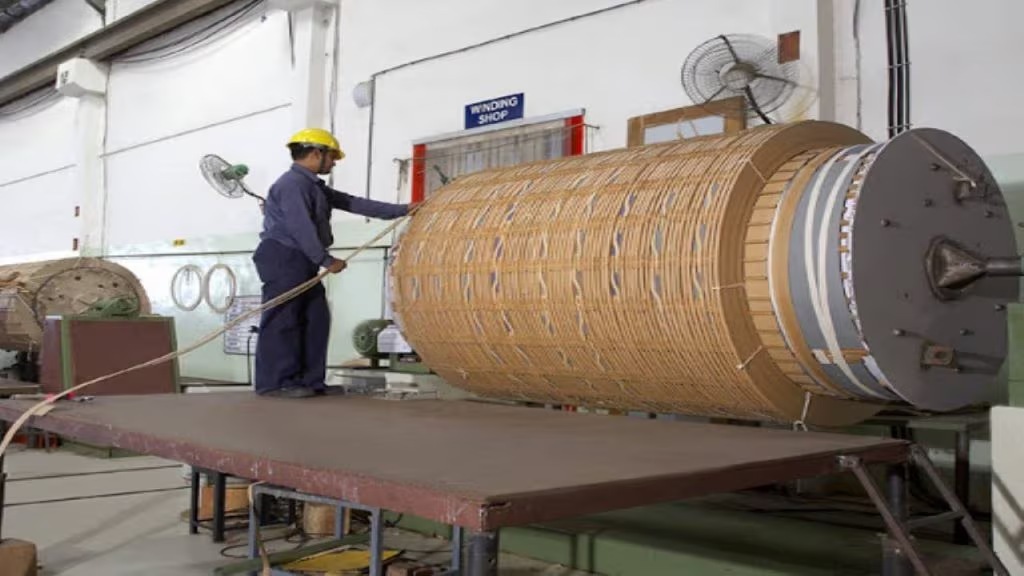
In simple desi terms — TARIL makes those big, humming metal boxes that keep your AC running and your Instagram reels loading. Officially, it manufactures Power Transformers (up to 500 MVA and 1200 kV class), Furnace Transformers, Rectifier Transformers, Distribution Transformers, Reactors, and even Mobile Sub-Stations.
They sell these to giants like PowerGrid, NTPC, Tata Power, Torrent Power, Siemens, and JSW. Basically, if it has wires thicker than your broadband cable, TARIL’s probably involved.
The business runs on a B2B model, serving three verticals:
Power Generation & Transmission – Core customers like PowerGrid, GETCO, and NTPC.
Industrial Clients – JSW, Hindustan Zinc, Bluestar, Torrent Power, etc.
Export Markets – Over 25 countries, though exports have shrunk from 15% in FY22 to 8% in FY24.
With three manufacturing units in Ahmedabad and total capacity of 40,000 MVA (soon to be 55,000 MVA), TARIL is India’s second-largest transformer producer. The company also plans to use its new capacity for renewable applications — because even transformers are going green now.
The latest ace up their sleeve? Backward integration. The 51% acquisition of Posco-Poggenamp Electrical Steel Pvt. Ltd. — a CRGO lamination producer — gives TARIL a cost advantage in its most expensive raw material (33% of input cost). It’s like a biryani maker buying his own rice mill. Smart move, boss.
Commentary: Revenue is stuck in neutral, profits are limping, and margins have taken a knock. But the underlying theme is strong demand visibility. TARIL’s EBITDA margin still remains respectable at 11%, and FY25’s TTM EPS of ₹8.33 keeps the overall annual picture solid. In short, Q2 was a pothole, not a derailment.
5. Valuation Discussion – Fair Value Range Only
Let’s get academic (and a bit masala):
Method 1: P/E-Based Approach TTM EPS = ₹8.33 Industry P/E = 48x Fair Value Range = 8.33 × (40x to 55x) = ₹333 to ₹458
Method 2: EV/EBITDA Approach EV = ₹11,875 Cr EBITDA (TTM) = ₹356 Cr EV/EBITDA = 33.4x (expensive) Fair EV range assuming 20–25x = ₹7,120 – ₹8,900 Cr → Equity Value ≈ ₹7,000 – ₹8,700 Cr → ₹230 – ₹290 per share
Method 3: DCF (Simplified Educational Approach) Assume FY25–29 revenue CAGR of 20%, EBITDA margin at 16%, and terminal growth of 4%. Fair value range: ₹350–₹500
💬 Fair Value Range (Educational): ₹330–₹460 per share.