01 — At a Glance
When Your Moat Becomes a Bathtub (And Fills With Water Heaters)
- 52-Week High / Low₹1,349 / ₹722
- TTM Revenue₹974 Cr
- TTM PAT₹164 Cr
- TTM EPS₹23.30
- Q3 EPS (Dec’25)₹2.91
- Book Value₹114
- Price to Book6.87x
- Dividend Yield1.66%
- Debt / Equity0.01x
- 1-Year Return-32.2%
The Setup: Symphony owns 50% of India’s organized air cooler market. ₹5,385 crore market cap. 36.8% ROCE. Fortress balance sheet. Then Q3 FY26 happened. Revenue collapsed 26% YoY. 9M revenue down 30% YoY. Stock down 32% in a year. CEO Amit Kumar resigned in January 2026. The divestment of Australian and Mexican subsidiaries — which was serious enough to involve two investment bankers and 10 NDAs — got cancelled because valuations didn’t match expectations. Management is now spending ₹11 crores on ads for water heaters that nobody asked for. If this was a company, it would be confused. If it was a stock, it would be on life support.
02 — Introduction
Symphony: The Company That Sells You Cool Air And Dreams
Here’s what Symphony does: it makes air coolers. Not air conditioners — coolers. The humble evaporative cooler that every desi household knows as the “cooling machine that sits in the window and makes weird gurgling sounds when you turn it on at 4 PM in May.”
Except Symphony doesn’t just make coolers for your aunt’s drawing room. It’s a 36-year-old global air-cooling company with operations across six continents, 27.5 million units sold worldwide, 55+ patents, and endorsements from General Electric, Lear Corporation, and Walmart. The organized market for air coolers is roughly ₹5,000 crore in India, and Symphony owns 50% of it. That’s not a business. That’s a license to print money in May and June.
For years, Symphony was the boring stock that just worked. Domestic market dominance. International expansion. Rising margins. Management was professional. Dividends were paid like clockwork. The stock was expensive, sure, but the underlying business was genuinely excellent.
Then Q3 FY26 landed, and suddenly everything looked like it was written by the same writer who gave us “Khiladi 1080” — technically coherent, wildly dramatic, and nobody asked for this plot twist. Revenue down 26% in the quarter. Nine months down 30%. CEO resigned. The subsidiary divestment got rolled back. Management is now spending tens of crores advertising water heaters instead of focusing on the market share they already own. Welcome to the new theatre of absurdity.
Feb 2026 Concall Clarity: Management clarified that the organized air cooler market is only 35% of the total ₹5,000 crore market. The remaining 65% is unorganized and includes metal coolers. Symphony’s 50% share is of the organized segment only. This distinction matters because it means the upside is limited to formalizing the unorganized market — which hasn’t happened in 20 years.
03 — Business Model: Blow Hot Air Into Buckets
Symphony’s Three-Act Play (And None Of Them Are About Coolers Anymore)
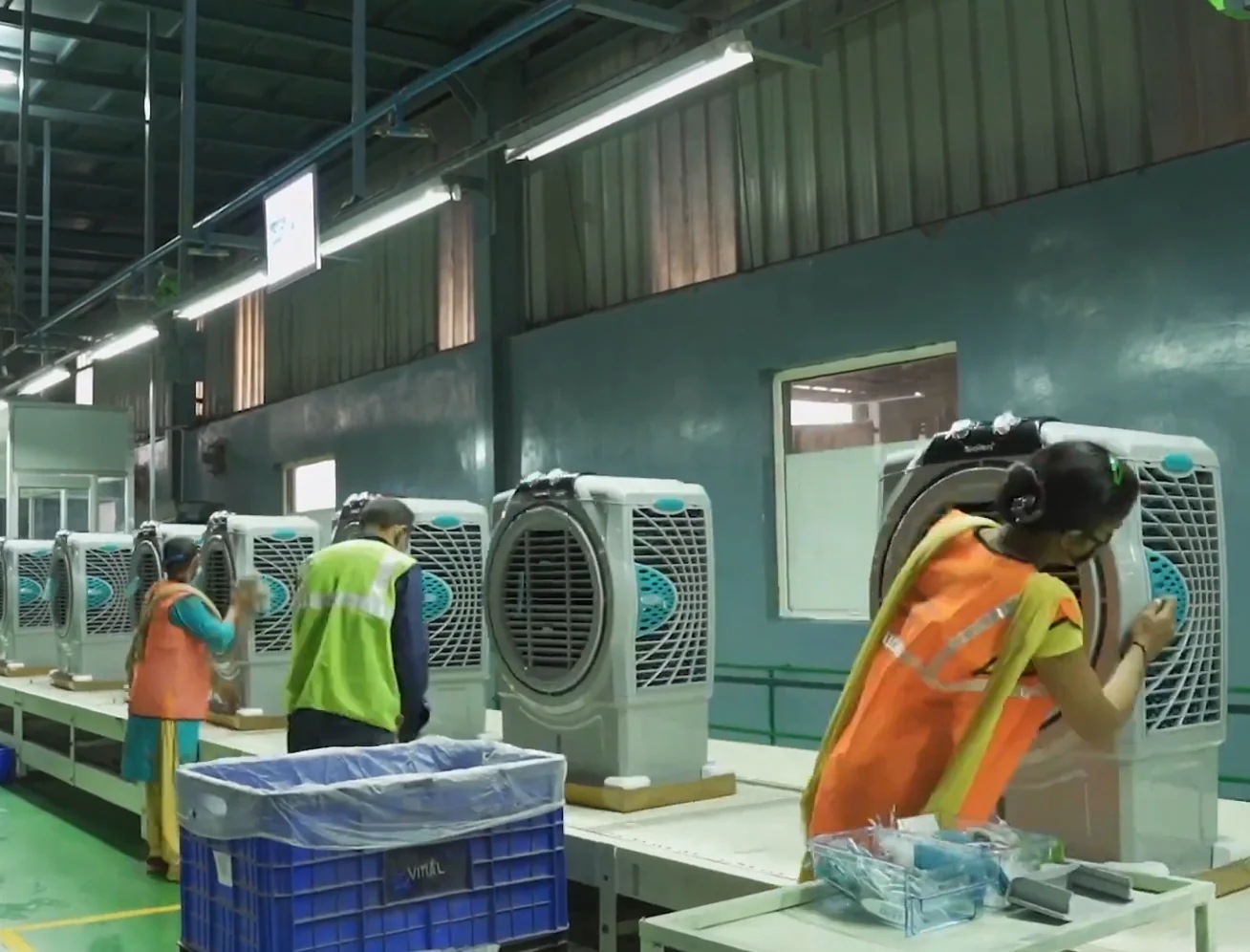
Symphony’s core business is simple: manufacture evaporative air coolers, slap the brand name on them, and distribute across 30,000+ dealers and 1,000+ distributors. The cooler works by passing air through wet pads, cooling it through evaporation, and blowing it into your room. It’s physics from 1920. It’s also why Symphony commands a 50% market share — because distribution is the moat, and they built it over three decades.
Domestic air cooler revenue is seasonal. October to May is the selling season. June to September is the slow season. To address this, management is now pushing three new categories: (1) “Large Space Ventilation Cooling” for commercial/industrial use, (2) “Round-the-year / Counter-seasonal products” (table-top coolers, personal coolers, kitchen cooling fans), and (3) — wait for it — water heaters.
Yes. Water heaters. Storage water heaters, to be precise. Symphony launched these last year in Karnataka, Andhra Pradesh, and Telangana. They’ve now expanded to 8 states. Management spent ₹11 crores in Q3 alone advertising these water heaters — more than 90% of their quarterly ad budget. Why? Because the domestic seasonal business is tired, international subsidiaries are bleeding cash, and somebody in the boardroom decided that the air cooler king should now sell hot water dispensers. It’s like Ferrari deciding to pivot to making toasters.
Org. Market Share50%India: 35% organized, 65% unorganized
Global Units Sold27.5M+Since inception
Distribution Network30K+Dealers & 1,000+ Distributors
The Water Heater Gamble: In the Feb 2026 concall, management clarified that water heaters are in “investment mode” — meaning they’re spending now, profits will come later. Round-the-year products already contribute 26% of standalone revenue (9M FY26). The pitch is that this deseasonal revenue protects against summer-dependent volatility. The reality is that they’re now competing with Bajaj, Crompton, and V-Guard in a mature, price-sensitive water heater market. Good luck with that.
💬 Honest question: If you were Symphony’s CEO, would you double down on water heaters or just accept that you own the coolest (pun intended) market on earth and milk it?
04 — Financials Overview
Q3 FY26: The Numbers That Made Shareholders Go “Haan?”
Result type: Quarterly Results | Q3 FY26 Standalone EPS: ₹3.95 | Annualised EPS (Q3×4): ₹15.80 | TTM EPS: ₹23.30
| Metric (₹ Cr) |
Q3 FY26
Dec 2025 |
Q3 FY25
Dec 2024 |
Q2 FY26
Sep 2025 |
YoY % |
QoQ % |
| Revenue (Standalone) | 182 | 247 | 275 | -26.3% | -33.8% |
| Operating Profit | 31 | 34 | 35 | -8.8% | -11.4% |
| OPM % | 17% | 14% | 13% | +300 bps | +400 bps |
| PAT (Standalone) | 34 | -4 | 17 | NM | +100% |
| EPS (₹) Standalone | 3.95 | -0.46 | 1.97 | NM | +100% |
What Just Happened? Revenue in Q3 was ₹182 crore vs ₹247 crore in Q3 FY25 — a 26% YoY collapse. The silver lining? OPM improved to 17% from 14%, thanks to better cost management despite lower volume. PAT bounced back to ₹34 crore from -₹4 crore, but here’s the catch: Q3 FY25 had a -₹4 crore because of “write-off of Pathways” (some exceptional item). Excluding that one-off, underlying PAT is still weak. Annualised Q3 EPS is ₹15.80, which is 32% lower than TTM EPS of ₹23.30. The stock trades at 32.9x P/E on TTM basis — which sounds fine until you realize that growth has gone backwards.
05 — Valuation: Is This A Bargain Or A Bargain Basement?
Fair Value Range — When Your “Moat” Becomes Murky