Suraksha Diagnostic Ltd Q2 FY26 – From Kolkata’s Test Tubes to ₹1,530 Million in Revenue, This Lab Just Turned Healthcare into a Profit Chemistry Experiment
1. At a Glance
Imagine a diagnostic chain that operates like a Bengali family-run empire — everything centralized, everyone knows everything, and nobody escapes a full body test. That’s Suraksha Diagnostic Ltd for you. Headquartered in Kolkata, this ₹1,632 crore market-cap smallcap is West Bengal’s diagnostic darling. The stock trades at ₹313 (as of Nov 11, 2025), a modest +7.2% return over 3 months, while still wearing a P/E multiple of 51x — a clear sign that investors are paying a premium for a needle prick.
In Q2 FY26, the company reported revenue of ₹78.7 crore (up 17.95% YoY) and PAT of ₹8.83 crore (down 13.06% QoQ — the CFO probably fainted before signing). With an OPM of 30.6%, ROE of 16.5%, and debt-to-equity of 0.51x, Suraksha looks like the kind of company that lends itself to both profit and pathology. But wait — not everything’s rosy: sales growth over the past five years is a mere 9.86%. Maybe Bengal’s people are too healthy… or too broke for tests.
This quarter’s results tell a simple story — Suraksha continues to milk its home turf (West Bengal), controls 230 touchpoints, and has 55 diagnostic centers, while its acquisition of Fetomat signals an ambitious move into premium fetal medicine. But the big question — can Suraksha step beyond Bengal’s borders or will it stay a local legend serving puchka-eating, health-checkup-loving Kolkatans?
2. Introduction
Let’s begin with the irony: the word Suraksha means “safety,” but investing in diagnostics has rarely felt safe. Yet, this Kolkata-based player, incorporated in 2005, has turned its pathology empire into a fascinating cocktail of growth, ambition, and mild chaos (see: CFO resignations, new subsidiaries, and press releases every other month).
Suraksha Diagnostics operates like your neighborhood doctor who suddenly got a corporate makeover. What began as a lab for basic tests is now a 2,300-test powerhouse spanning pathology, radiology, and consultation — complete with polyclinics that host 1,000+ doctors. In short, Suraksha is trying to be the “Apollo of Diagnostics,” but without the Apollo-level nationwide footprint yet.
The company’s FY25 numbers show that it performed 6.69 million tests for 1.19 million patients, meaning each patient got probed an average of 5.52 times. Either people in Kolkata are extremely unhealthy, or the sales team deserves a standing ovation. Average revenue per patient stood at ₹2,118 and EBITDA per patient at ₹715.
Its IPO debut in December 2024 was fully an Offer for Sale — the promoters didn’t need new capital, they just wanted liquidity (respect). But with post-IPO stability, Suraksha’s story now shifts from listing excitement to quarterly execution. Will it remain the Bengal Tiger of Diagnostics or get eaten by Dr Lal PathLabs, Vijaya, and Metropolis in pan-India cage fights?
3. Business Model – WTF Do They Even Do?
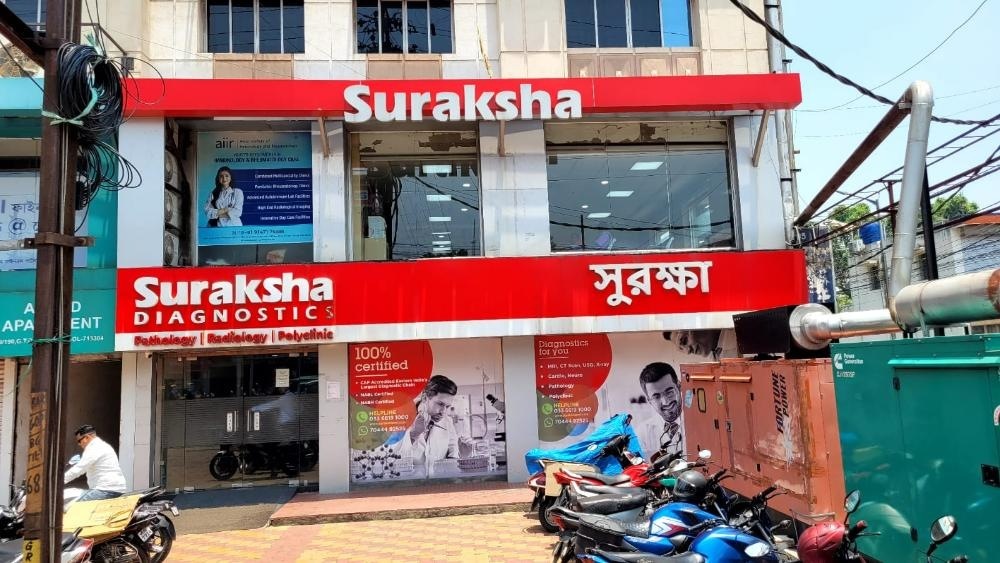
If Dr Lal PathLabs is the rich Delhi cousin, Suraksha Diagnostic is the middle-class but ambitious Bengali relative who believes in hard work, community, and loud marketing banners outside hospitals.
Suraksha’s business model is simple yet beautifully layered:
It offers integrated services — pathology (50.8% of revenue), radiology (45.2%), and doctor consultations (3.97%).
Operates on a hub-and-spoke model with one main lab, 8 satellites, 55 diagnostic centers, and 171 collection points. In total, 230 touchpoints — that’s one lab for every 500 gossip sessions in Kolkata.
The focus is clearly B2C, contributing 93% of revenue, with a small but growing 6.88% from B2B contracts with hospitals and insurance firms.
The company’s operational moat lies in its geographical dominance — 100% of FY25 revenue came from West Bengal (up from 95.3% in Q1). That’s loyalty — or over-dependence, depending on how you see it.
Recently, Suraksha acquired a 63% stake in Fetomat, a specialized prenatal diagnostics and fetal medicine clinic — a move into niche high-margin territory. The play here? Broaden from routine testing to specialized medical diagnostics, and build reputation-driven stickiness.
Essentially, Suraksha is betting on two things: 1) West Bengal’s massive healthcare under-penetration, and 2) regional consolidation through acquisitions. The risk? It’s still very much a Kolkata story.
Commentary: Revenue’s growing like a slow Bengali breakfast — steady, aromatic, but not explosive. PAT dipped as margins softened, mostly due to expansion and one-time integration costs post-Fetomat acquisition. Still, maintaining 30%+ operating margins in diagnostics is nothing short of heroic.
5. Valuation Discussion – Fair Value Range
Let’s play valuation doctor.
a) P/E Method: Industry median P/E ≈ 36.6x (Dr Lal: 48x, Vijaya: 68x, Metropolis: 64x). Suraksha trades at 51x — clearly overprescribed. If normalized to 35–40x on FY26E EPS of ₹7, fair range ≈ ₹245–₹280.
b) EV/EBITDA Method: EV = ₹1,706 Cr; EBITDA (TTM) = ₹88 Cr → EV/EBITDA ≈ 19.3x Peers average ~22x (Vijaya, Metropolis), suggesting fair value range = ₹290–₹330.
c) DCF Method (educational): Assume FCF = ₹25 Cr, growth 12%, WACC 10%. Intrinsic range ≈ ₹275–₹310.
Fair Value Range (Educational Purpose Only): ₹260–₹320 per share. This fair value range is for educational purposes only and not investment advice.
6. What’s Cooking – News, Triggers, Drama
Oh, there’s masala here!
Fetomat Acquisition (Apr 2025): Suraksha bought 63% of Fetomat Wellness — a premium fetal medicine clinic. Expect high-margin test revenues and the possibility of Suraksha babies being diagnosed before they’re even born.
New Genomics Lab (Jul 2025): The company launched Eastern India’s largest genomics lab with ₹22 crore investment, planning ₹46 crore more. Because apparently, regular blood