1. At a Glance
Steel City Securities Ltd is that quiet back-bench student who never topped the class but somehow always passed with decent marks and a smug smile. At a market cap of ₹127 Cr, trading around ₹84, the stock is sitting at 0.95x book value, coughing out a 4.75% dividend yield, and flashing a single-digit P/E of ~9x in a sector where everyone else thinks 25x is “reasonable”.
Latest quarter (Q3 FY26) numbers? Revenue of ₹15.3 Cr, PAT of ₹3.72 Cr, and EPS of ₹2.46. Margins remain juicy with ~30% OPM, but growth? That’s where the vibe turns from DJ night to Doordarshan news bulletin. QoQ revenue fell 6%, profits dropped 23%, and the stock is down ~17% over one year.
Promoters, meanwhile, are chilling — 74.7% holding, zero pledge, and creeping up quarter after quarter. Debt is negligible, balance sheet is clean-ish, but working capital and debtors are doing yoga stretches nobody asked for.
So the big question: is this a boring cash-cow broking + e-governance play hiding in plain sight, or a structurally slow business dressed up as a “cheap stock”? Let’s open the ledger.
2. Introduction
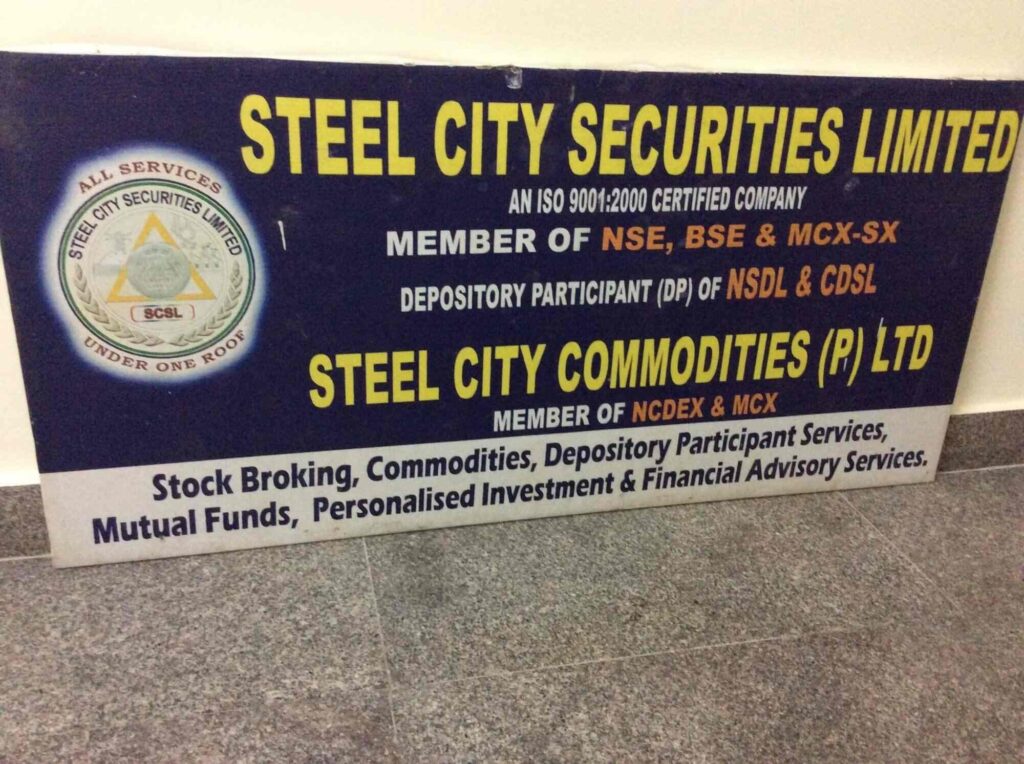
Steel City Securities is not Angel One, not Zerodha, and definitely not the app your cousin downloaded during the COVID bull run. Founded in 1995, this is a retail-focused stockbroking and e-governance company, deeply rooted in Tier-2 and Tier-3 India — Tamil Nadu, Karnataka, Odisha, Chhattisgarh, Maharashtra, and basically every place where WhatsApp forwards travel faster than fibre broadband.
The company runs a hybrid model:
- Traditional retail broking & DP services, and
- E-governance services like PAN, TAN, e-TDS, Form 24G, etc.
Think less “Robinhood disruption”, more “local kirana + CSC centre with NSE terminal”.
What’s interesting is that despite operating in a brutally competitive broking industry, Steel City has survived multiple cycles — Harshad Mehta aftermath, sub-broker extinction, discount broking wars, and SEBI compliance ka tsunami. It didn’t become
big, but it didn’t die either. That itself deserves a polite golf clap.
But survivability alone doesn’t create shareholder wealth. Growth, capital efficiency, and governance discipline do. So let’s see what’s actually under the hood.
3. Business Model — WTF Do They Even Do?
Steel City runs three main engines:
1) Retail Stock Broking & DP Services
This is the core. Equity cash, F&O, commodities, currency — NSE, BSE, MCX, NCDEX, full buffet.
Clients are largely retail, operating through:
- 70+ owned branches
- 16,000+ franchises
- 1,600+ terminals
- 3+ lakh clients
This is old-school broking: relationship-based, commission-driven, sticky but slow. No flashy app, no IPL ads, no “trade in 3 clicks” nonsense.
2) E-Governance Services
This is the underrated bit. Steel City operates TIN-FC centres, offering PAN, TAN, e-TDS, AIR filings, corrections, and government-linked services.
Revenue here is:
- Less cyclical
- Lower margin than broking, but
- Extremely sticky
This segment contributed ~33% of FY22 revenue, acting like the steady uncle who pays EMIs on time.
3) Cross-Selling & Financial Distribution
Mutual funds, IPOs, bonds, insurance (corporate agent of SBI Life), NBFC services like personal loans, gold loans, LAS — basically everything except astrology (yet).
The model isn’t sexy, but it’s diversified. The real problem? Scale and growth velocity.
If you were explaining Steel City to a lazy investor:
“It’s a profitable, dividend-paying, old-economy broking firm
