Section 1 — At a Glance
Sharda Motor makes the parts that clean a vehicle’s exhaust before it leaves the tailpipe. The buyers are carmakers, not drivers.
In the year that ended in March 2026, sales came to ₹3,396.8 crore. That is 20% more than the year before.
Out of every ₹100 of sales, ₹12.30 stayed with the company as operating profit. A year earlier ₹14.00 stayed. Operating profit is what is left after the running costs of the business, before interest, wear and tear, and tax.
After all of those, ₹345.4 crore was left. That last figure is called net profit, and it is 10% above the year before.
Sales therefore grew faster than profit. Management points to the cost of the catalyst metals used inside an exhaust unit. The customer specifies those metals, and their price rose during the year. When a bought-in part costs more, it arrives in the sales figure and leaves again through the cost figure.
The company ended the year holding more than ₹987 crore in cash and easily sold investments. Easily sold investments are holdings that can be turned into money at short notice. Together they are about 45% of everything the company owns. A parts maker with almost half its assets sitting in the bank is an unusual sight on a factory floor.
During the year the company started a third plant at Chakan. It also added capacity in Uttarakhand.
Section 2 — Introduction
Sharda Motor makes exhaust and emission-control systems for cars and small commercial vehicles in India. Small commercial vehicles are the vans and light trucks that carry goods about. An emission-control system is the assembly that sits between an engine and the open air.
For most of the company’s history that was the whole description. If a vehicle needed that assembly, this was one of the firms that made it. The product line was narrow, and the reason it existed was narrow too.
An exhaust system has a job only where an engine burns fuel. Fewer engines burning fuel means fewer exhaust systems fitted. The industry has been told for years that fewer is the direction of travel.
So the company has been widening what it makes. Alongside emission control it now produces structural parts that hold a vehicle’s wheels in place. Those parts are needed whatever is driving the vehicle, fuel or otherwise. One line is tied to combustion and the other is not.
Capacity has followed the widening. A third plant at Chakan was commissioned. The company also extended its manufacturing into Uttarakhand. Two more sets of walls, for a firm whose oldest product depends on something the industry keeps promising to stop doing.
It has also set up a separate arm to sell outside India. That arm is aimed at North America and Europe. Vehicle makers in both places have been rearranging who supplies them.
So the description that held for decades no longer covers the whole company. Exhaust and emission control remain the older and larger half of it. Structural parts, added plants and an export arm are the newer half.
US
Now live
US Stocks terminal is live
13,000+ US tickers · EDGAR fundamentals · screener and filings feed — the same terminal, for American markets.
Explore →
Section 3 — Business Model: WTF Do They Even Do?
Sharda Motor sells two kinds of metal parts to the companies that build vehicles. It does not sell anything to the person who drives one.
The first is the exhaust system. When fuel burns in an engine, what comes out is hot, loud and poisonous. A silencer deals with the loud part. A catalytic converter deals with the poisonous part. It uses a honeycomb coated in precious metals, which turns harmful gases into less harmful ones. The hot-end components are the pipework nearest the engine. That pipework has to survive temperatures that would ruin ordinary steel.
Roughly 30% of the emission systems fitted to cars and small commercial vehicles in India come from this company. Close to one in three of those vehicles clears its emissions test through a part made here.
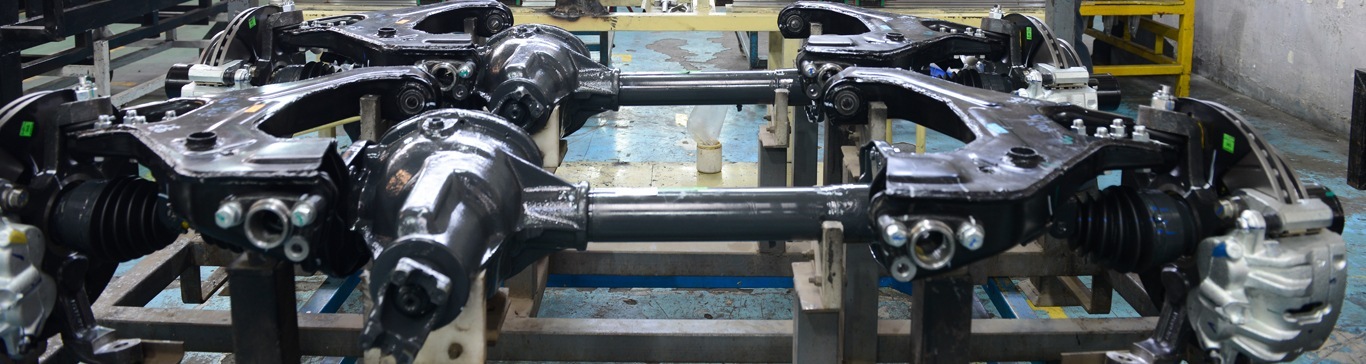
The second product is suspension parts: control arms and links. These are the jointed metal pieces that hold each wheel in position. They let a wheel ride over a bump without taking the rest of the car with it. The company has about 14% of that market.
The second business exists partly because of what the first depends on. A control arm is needed whether a vehicle runs on diesel, petrol, a battery or some combination. An exhaust is needed only by the ones that burn something.
The customer list is short. The two largest buyers of its exhaust systems are Mahindra & Mahindra and Hyundai. Between them they account for 71% of that revenue.
Spending follows the same shape. The