1. At a Glance – South India’s Saree Sultan Having a Mood Swing
Sai Silks (Kalamandir) Ltd, trading around ₹128 with a market cap of roughly ₹1,968 crore, is currently behaving like a heavily embroidered Kanchipuram saree stuck in traffic—beautiful, valuable, but not moving fast enough. Over the last three months, the stock is down ~30%, six months down ~27%, and one year down ~20%. Meanwhile, the company just delivered Q3 FY26 revenue of ₹415.23 crore and PAT of ₹33.14 crore, both down sequentially, reminding investors that even wedding-focused retailers can have off-seasons.
At ~16x trailing P/E and EV/EBITDA of ~7.2x, valuation looks modest compared to peers like Trent or Vedant Fashions. But before you shout “cheap!”, remember: ROE is ~7.8%, ROCE ~12.4%, and inventory days have stretched to a very shaadi-worthy 334 days. That’s almost a full Indian engagement-to-wedding cycle of stock lying unsold.
The business still has solid scale: 68 stores across 20 cities, ~7.6 million customers, ₹1,633 crore TTM revenue, and a dominant saree-led ethnic positioning. But the recent quarterly numbers suggest that growth isn’t a straight-line lehenga twirl—it’s more like classical dance with pauses, spins, and occasional stumbles. Curious why? Read on.
2. Introduction – A Saree Empire with IPO Hangover
Sai Silks is not a fly-by-night fashion startup selling “ethnic vibes” on Instagram. Incorporated in 2005, it has spent two decades building a serious offline saree empire in South India. Weddings, festivals, family functions—if there’s an occasion where aunties argue over zari quality, Sai Silks wants to be in that conversation.
The company operates through four distinct formats—Kalamandir, Varamahalakshmi Silks (VMS), Mandir, and KLM Fashion Mall—covering everything from ₹200 daily wear to ₹3.5 lakh ultra-premium designer sarees. In theory, this should smooth cycles: when premium slows, value picks up; when value crowds thin, weddings save the day.
But theory met reality post-IPO. After raising ₹1,201 crore in 2023, expansion accelerated, warehouses expanded, stores multiplied—and so did inventory. The business is profitable, yes, but working capital has quietly become the main character. Inventory days rising from 163 (FY18) to 334 (FY25) is not fashion; it’s financial yoga.
So the question is not “Is Sai Silks a good brand?”—it clearly is. The real question: can it convert sarees into cash faster than it converts IPO optimism into inventory?
3. Business Model – WTF Do They Even Do? (Besides Selling Sarees)
Think of Sai Silks as a multi-brand, multi-price ethnic fashion mall, but with strong South Indian wedding DNA.
The Four Pillars:
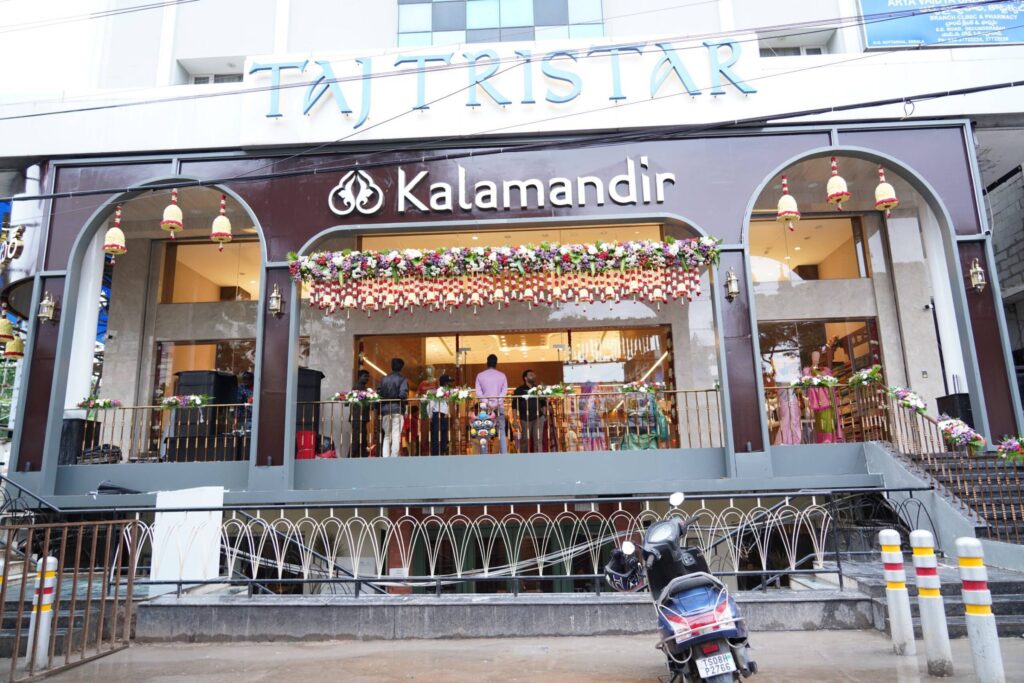
Kalamandir The OG brand. Mid-income ethnic fashion, sarees priced ₹1,000–₹1,00,000. Focused on silk, cotton, georgette, khadi—basically “respectable family function” wear.
Varamahalakshmi Silks (VMS) The current golden child. Premium wedding sarees, heavy handlooms, strong bridal positioning. Price range ₹4,000–₹2,50,000. This now contributes ~50% of revenue and most new store additions.
KLM Fashion Mall Value-fashion format. Daily wear sarees, plus western wear for men, women, kids. Ticket size ₹200–₹75,000. Larger stores, mass appeal.
Revenue mix is heavily skewed: ~71.5% from sarees. So yes, diversification exists, but the saree is still the CEO.
The model is offline-first with omnichannel support—websites, live video shopping, ERP-driven inventory management. It’s traditional retail with modern tools, not D2C hype. But offline retail means inventory risk, and Sai Silks is currently carrying more fabric than a wedding decorator.
4. Financials Overview – Numbers Don’t Lie, They Just Drape Themselves
Result Type Lock: Quarterly Results (Q3 FY26). EPS Annualisation Rule Applied: Q3 → Average of Q1, Q2, Q3 EPS × 4.