01 — At a Glance
The Auto-Cable King Who Bit Off More Than It Could Chew
- 52-Week High / Low₹518 / ₹350
- 9M FY26 Revenue₹2,464 Cr (ex-SCS)
- 9M FY26 EBITDA₹327 Cr
- Q3 FY26 PAT₹13.6 Cr
- Q3 FY26 EPS₹0.91
- Book Value₹99.4
- Price to Book4.07x
- Dividend Yield0.76%
- Debt / Equity0.68x
- Dividend (Interim)₹1.50/share
Auditor’s Opening Note: Suprajit started FY26 with confidence. “We’ll buy a German cable company. It’ll be transformative.” Nine months later, Q3 posted ₹13.6 crore PAT (down 59.4% YoY) while the board declared a 150% dividend because… well, the cash had to go somewhere. Revenue grew 17.7% but profit evaporated like monsoon puddles in March. The SCS acquisition was supposed to turnaround by March 2026. Let’s see.
02 — Introduction
Welcome to the Acquisition That Made Everyone Uncomfortable
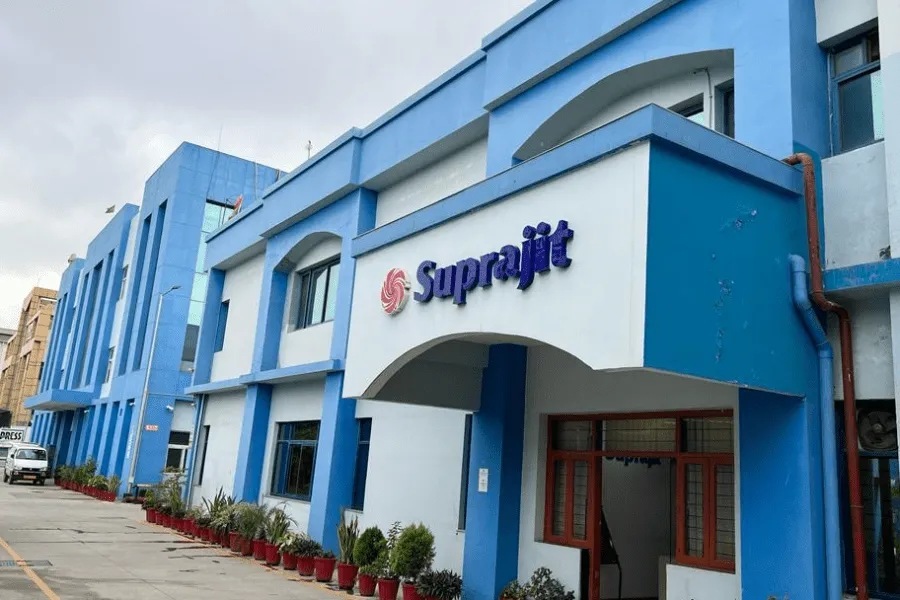
Suprajit Engineering makes cables. Specifically, mechanical control cables for two-wheelers, three-wheelers, and commercial vehicles. Also halogen lamps, LED solutions, and a hundred other automotive parts that your mechanic has never heard of but your car absolutely needs to exist.
Founded in 1985, the company had a decent run: market leader in India (51% share in auto lubricants… wait, wrong company). Let me restart — they control about 80% of the two-wheeler mechanical cable market in India. Your Hero MotoCorp and TVS motorcycles? 100% using Suprajit cables. It’s not glamorous. It’s not a tech play. It’s just the only supplier anyone trusts.
Then in July 2024, management got ambitious. They acquired Stahlschmidt Cable Systems (SCS) — a German business — for €122 crore (~₹1,100 crore at the time). The acquisition brought factories in Morocco, plants in Germany, Canada, Poland, and China. It was going to be a “transformative global play.” What it became was a €122 crore lesson in post-acquisition integration nightmares.
Fast forward to December 2025 (Q3 FY26): SCS is still bleeding. Mexico’s plant got relocated mid-quarter (Juarez to Matamoros). Germany’s labor costs went bonkers. And the standalone domestic cable business is carrying the entire company on its shoulders.
This is the story of a company that said “I want to be global” and then discovered that global means managing 2-wheeler cable makers in Morocco whose biggest customer is a German OEM who just might cancel due to tariff wars.
Concall February 2026 (Management): “The majority of restructuring post the SCS acquisition is substantially complete by end of December… we’ll turn the corner and will be EBITDA positive by end of this quarter.” — Chairman. Translation: The bleeding has stopped, but scars remain.
03 — Business Model: WTF Do They Even Do?
Cables. Globally. With Pain. Lots of Pain.
Suprajit makes mechanical control cables — thin steel wires wrapped in plastic that connect your bike’s throttle to the engine. Yes, that. Your Bajaj Pulsar has roughly 10–15 different Suprajit cables. TVS sport bikes? Same deal. Every 2-wheeler made in India that isn’t completely electric uses Suprajit cables. It’s a 51% market share, which in auto components is basically a monopoly wrapped in boring.
Revenue split (FY25): Two-wheelers 36%, Automotive (3W/4W) 27%, Aftermarket 18%, Non-automotive 19%. That’s the domestic story. Exports? Now 53% of revenue thanks to the global acquisitions. Exports were only 10% a decade ago. That’s the “transformation” part — except it came with ₹1,100 crore of integration pain.
Three major divisions now: Domestic Cable Division (DCD), Suprajit Controls Division (which includes the recently acquired LDC and Wescon operations in the U.S. and Mexico), and SCS (Stahlschmidt from Germany). Each is supposed to be CAGR-ing at different rates. Each is also experiencing different flavors of suffering.
2W Cables51%Market Share
Global Footprint9Countries
Overseas Revenue53%FY25 Mix
Restructuring Cost₹18 CrQ3 Alone
The Acquisitions Rolodex: Speedo Cable (Pricol), Phoenix Lamps (2011), Wescon Controls USA (2016), Osram Karnai (2016), LDC from Kongsberg (FY23, ₹500+ crore), SCS from Germany (FY25, ₹1,100 crore). Total M&A value in last 5 years? Over ₹1,600 crore. Integration success rate? Let’s just say management is still working on it.
💬 If a company keeps acquiring businesses at 10x EBITDA, and keeps missing integration timelines, is that M&A strategy or a very expensive hobby? Drop your thoughts.
04 — Financials Overview
Q3 FY26: The Numbers That Make You Go “Huh?”
Result type: Quarterly Results | Q3 FY26 EPS: ₹0.91 | Annualised EPS (Q3×4): ₹3.64 | 9M FY26 Reported EPS: ~₹2.39 (estimated)
| Metric (₹ Cr) |
Q3 FY26
Dec 2025 |
Q3 FY25
Dec 2024 |
Q2 FY26
Sep 2025 |
YoY % |
QoQ % |
| Revenue | 979 | 832 | 941 | +17.7% | +4.0% |
| Operating Profit | 95 | 97 | 100 | -2.1% | -5.0% |
| OPM % | 9.7% | 11.7% | 10.6% | -200 bps | -90 bps |
| PAT | 13.6 | 33 | 51 | -59.4% | -73.3% |
| EPS (₹) | 0.91 | 2.44 | 3.71 | -62.7% | -75.5% |
The Restructuring Reality Check: Q3 had ₹18 crore in “one-off” restructuring costs across SCS (plant relocation), Controls Division (labor restructuring in Mexico), and integration expenses. Strip those out, normalized EBITDA margin would be ~9.5%. Still down YoY because tariff pass-throughs aren’t recognized until cash is collected — an accounting fun fact that destroys reported margins. Management expects Q4 to be better, but Q4 is always “better” in their playbook.
05 — Valuation: The Uncomfortable Truth
At 39.5x P/E, Is Suprajit Worth Its Hype?