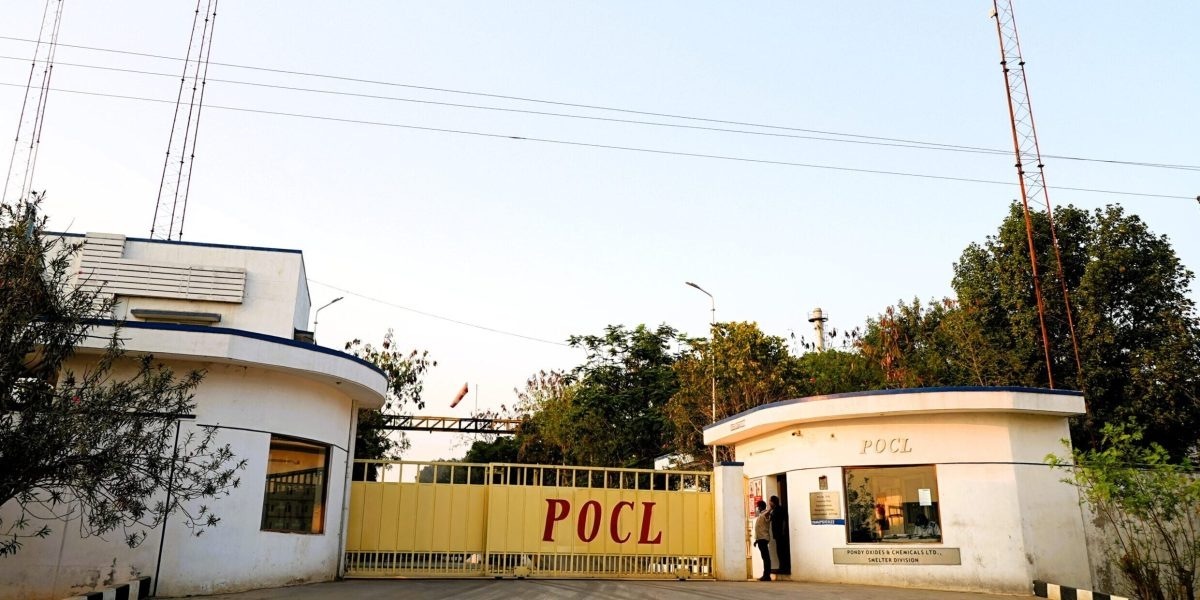
01 — At a Glance
The Scrappy Recycler That’s Recycling Expectations
- 52-Week High / Low₹1,578 / ₹501
- Q3 FY26 Revenue₹776 Cr
- Q3 FY26 PAT₹37.6 Cr
- Q3 EPS₹12.31
- Annualised EPS (Q3×4)₹49.24
- Book Value₹228
- Price to Book4.69x
- Dividend Yield0.34%
- Debt / Equity0.05x
- CRISIL RatingA/Stable
Auditor’s Opening Note: Pondy Oxides delivered its “strongest ever” Q3 FY26 with ₹776 crore revenue (+55% YoY), ₹37.6 crore PAT (+148% YoY), annualised EPS of ₹49.24. Lead capacity doubled to 204,000 MTPA. Copper capacity is doubling. The company raised ₹175 crore via QIP in Dec 2024. CRISIL upgraded ratings to A/Stable in April 2025. And yet the stock sits at 27.4x P/E—a good 45% above sector median. This is the recycling business equivalent of paying premium prices for premium scrap. The irony is spectacular.
02 — Introduction
Welcome to the Lead Recycling Economy. Your Car Battery Called.
Let’s talk about Pondy Oxides & Chemicals. No, not the fancy organic brand. The industrial metals recycler based out of Tamil Nadu that turns your dead car batteries into pure lead, lead alloys, copper, aluminum, and plastic pellets. And yes, someone has to do this. No, it’s not glamorous. And yes, there’s actually serious money in it.
Founded in 1995, POCL is India’s largest secondary lead manufacturer—turning used lead-acid battery scrap into pristine metal that goes straight back into new batteries. It’s the circular economy in its truest form: your car battery dies → POCL melts it → pristine lead emerges → your next car’s battery is born. Rinse, repeat, profit.
The company operates five manufacturing units across Tamil Nadu, Andhra Pradesh. Total lead capacity jumped from 132,000 MTPA (FY25) to 204,000 MTPA (>50% increase). Copper capacity doubling to 12,000 MTPA by end of January 2026. The concall from January 2026 called Q3 FY26 the company’s “strongest ever quarterly and 9-month performance.”
But here’s the funny part: the stock is trading at 27.4x P/E—a 45% premium to the sector median of 26.5x. Is it cheap? Is it expensive? Is it a screaming buy? Is it a value trap? Let’s dig into the numbers, the business, the macro tailwinds, and the very real risks that nobody’s talking about.
Concall Highlight (Jan 2026): “Strongest ever quarterly and 9-month performance.” Management said this. They’re usually conservative. When they say “strongest ever,” they mean it. This is not hyperbole. This is ex-post-facto honesty.
03 — Business Model: WTF Do They Even Do?
They Mine Your Battery Graveyard. Literally.
The business model is clean, simple, and morally satisfying. Every year, millions of lead-acid batteries die in India—cars, motorcycles, trucks, tractors, inverters, UPS systems. All of them contain ~11 kg of lead per battery. Pondy buys this scrap (called “lead battery scrap” or LBS in industry parlance), smelts it at three dedicated plants, separates the lead from the plastic casing (which gets recycled separately), and produces pure lead or lead alloys—which then get sold back to battery makers. It’s a closed loop. It’s beautiful. It’s profitable.
The company breaks down into four verticals: Lead (the cash cow), Copper (scaling fast), Plastics (sourced from battery recycling), and Aluminum (pure play on auto OEMs). Lead drives ~65% of revenue. Copper is ~12% and growing in double digits. Plastics is <1% but strategic. Aluminum is a rounding error.
Geographic mix: 67% exports, 33% domestic. The company sells into 20+ countries globally. Key customers include Amara Raja Batteries (Indian OEM rated AA+), Sebang Global (Korean), and Glencore (global metals trader rated BBB+). These are decade-long relationships. This isn’t transactional. This is structural.
Lead Revenue~65%Of Total Sales
Copper Revenue~12%Growing Fast
Export Mix67%Global Presence
Domestic Mix33%India Ops
Value-Add Story: Management targets >60% of lead sales from value-added products (specialty alloys, pure lead, custom grades). Q3 9M figures show 65% of lead segment revenue coming from value-added products. This is margin magic—specialty alloys command 20-30% premiums over commodity lead. The new 36,000 TPA lead expansion (Phase 2) is entirely positioned for value-added customers with signed contracts already in place.
💬 Do you think battery recycling becomes more valuable as EV adoption ramps up (because lithium recycling is harder and margins are higher), or less valuable (because fewer ICE cars = fewer lead-acid batteries)? Drop your prediction.
04 — Financials Overview
Q3 FY26: The Numbers (Standalone)
Result type: Quarterly Results | Q3 FY26 EPS: ₹12.31 | Annualised EPS (Q3×4): ₹49.24 | FY25 Full Year EPS: ₹39.53
| Metric (₹ Cr) |
Q3 FY26
Dec 2025 |
Q3 FY25
Dec 2024 |
Q2 FY26
Sep 2025 |
YoY % |
QoQ % |
| Revenue | 776 | 502 | 635 | +54.5% | +22.2% |
| Operating Profit | 58 | 25 | 54 | +132% | +7.4% |
| OPM % | 7.5% | 5.0% | 8.5% | +250 bps | -100 bps |
| PAT | 37.6 | 15.2 | 35.8 | +148% | +5.0% |
| EPS (₹) | 12.31 | 5.39 | 11.66 | +128% | +5.6% |
The Math is Beautiful: Revenue growth: +54.5% YoY. Operating profit growth: +132% YoY. PAT growth: +148% YoY. This is operating leverage at work. The company is absorbing higher volumes at improving margins. Capacity utilization on the new lead plant is ramping. Gross margins are stabilizing post the Q3 procurement mix pressure (more on this in concall deep-dive). The 7.5% OPM in Q3 (vs 5% a year ago) shows structural improvement, not one-off bounce.
05 — Valuation Discussion – Fair Value Range
Is ₹1,063 Cheap, Expensive, or Just Ridiculous?