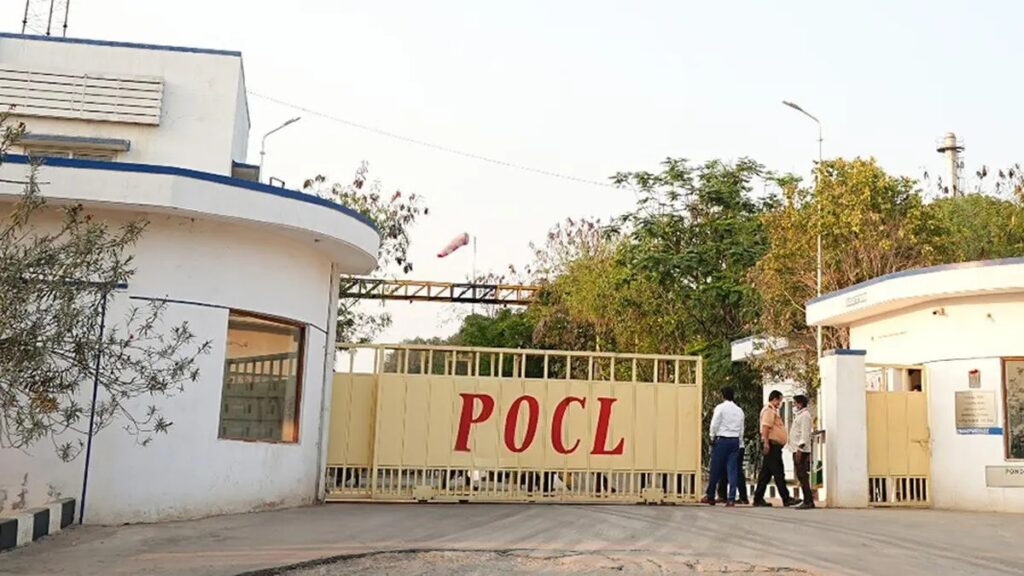
1. At a Glance – Blink and You’ll Miss the Numbers
₹3,881 crore market cap.
₹1,267 stock price.
Q3 FY26 sales of ₹776 crore, up 54.5% YoY.
Quarterly PAT of ₹37.6 crore, up a jaw-dropping 148% YoY.
Debt-to-equity at 0.05, which is basically “I owe you chai money” levels.
Pondy Oxides & Chemicals Ltd (POCL) is not trying to look sexy. It accidentally became sexy by recycling trash into money. While most commodity players cry about margins, POCL quietly smelted battery scrap, scaled volumes, raised capital at the right time, and walked into FY26 like a disciplined gym bro who suddenly discovered protein shakes.
Exports form ~57% of revenue, lead-acid batteries are the cash cow, and capacity expansion is no longer a PowerPoint fantasy—it’s actually producing metal. This quarter wasn’t a fluke; it was volume + capacity + balance sheet flex coming together.
Question for you: how many “boring recycling companies” do you know that grow profits 148% YoY?
2. Introduction – From Kabadiwala to Global Recycler
Pondy Oxides started in 1995, when recycling was not ESG, it was just jugaad. The company figured out early that battery scrap is not waste—it’s raw material wearing dirty clothes.
Fast forward to today: POCL is India’s largest secondary lead manufacturer, supplying lead and lead alloys to battery OEMs across the world. And no, this is not some tiny backyard smelter. We’re talking multiple plants, export-heavy revenues, global supplier networks, and a capex pipeline that most smallcaps can only tweet about.
What makes POCL interesting is not just growth—it’s controlled growth.
No reckless leverage.
No wild diversification into “AI + blockchain + hydrogen”.
Just metals, recycling, and scale.
And yet, despite being in a cyclical, commodity-linked business, POCL has quietly compounded profits and returns over the long term.
Now ask yourself: is this still just a commodity play, or has it evolved into a capacity-led manufacturing story?
3. Business Model – WTF Do They Even Do?
Think of POCL as a very sophisticated kabadiwala with export invoices.
Step 1: Buy scrap
Used lead-acid batteries, lead scrap, aluminium scrap, copper scrap—sourced from 270+ overseas suppliers and domestic channels.
Step 2: Smelt and refine
Battery
scrap → secondary lead → pure lead → specific lead alloys.
Same story for aluminium and copper.
Step 3: Sell to OEMs
Lead alloys go mainly to lead-acid battery manufacturers.
Copper and lead have strong export demand.
Plastics and aluminium cater mostly to domestic auto and industrial customers.
Step 4: Repeat at scale
Margins are thin, but volumes are massive. This is not a “pricing power” business—it’s an execution power business.
POCL also manufactures zinc metal and zinc oxide, but lead is the hero of this movie.
Simple question: if recycling demand rises globally and battery usage keeps growing, who benefits first—the miner or the recycler?
4. Financials Overview – The Quarter That Woke Everyone Up
| Metric | Latest Qtr (Dec FY26) | YoY Qtr (Dec FY25) | Prev Qtr (Sep FY26) | YoY % | QoQ % |
|---|---|---|---|---|---|
| Revenue (₹ Cr) | 776 | 502 | 635 | 54.5% | 22.2% |
| EBITDA (₹ Cr) | 58 | 25 | 54 | 132.0% | 7.4% |
| PAT (₹ Cr) | 38 | 15 | 36 | 148.0% | 5.6% |
| EPS (₹) | 12.31 | 5.39 | 11.66 | 128.3% | 5.6% |
This is not margin expansion magic. This is volume + capacity + operating leverage kicking in.
EPS Annualisation
Latest quarterly EPS (Q3 FY26) = ₹12.31
Annualised EPS = Average of Q1, Q2, Q3 × 4
Based on available quarterly trend, TTM EPS stands at ₹39.53, already reflected in reported numbers.
Witty takeaway: when a recycling company starts printing EPS faster than memes on Twitter, people suddenly call it “structural”.
5. Valuation Discussion – Fair Value, Not Fantasy
Let’s stay disciplined.
Method 1: P/E Based
TTM EPS: ₹39.53
Current P/E: ~32.7
Industry P/E: ~40
Fair P/E range assumption: 25–35
Fair value range = ₹990 to ₹1,385
