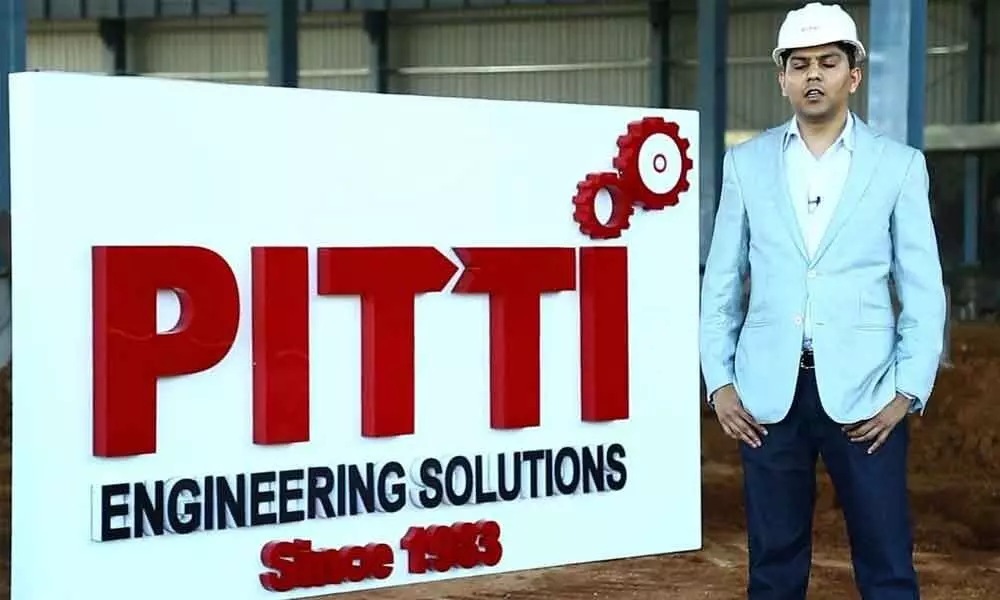
Pitti Engineering Ltd Q2 FY26 – When Motors Meet Margin Magic (and a ₹499 Cr Quarter Spins the Story Forward)
1. At a Glance
Pitti Engineering Ltd — the name might sound like a snack brand, but it’s India’s heavyweight champion in electrical laminations and motor sub-assemblies. This Hyderabad-based industrial dynamo just reported Q2 FY26 revenue of ₹499 crore, up 10% YoY, with EBITDA at ₹78 crore and PAT at ₹40 crore. Market cap? ₹3,467 crore. Current price? ₹921 (and still cheaper than a Kaynes Tech lunch). The company’s stock P/E of 32.3x sits comfortably below the industry’s 34.7x, like a disciplined student in a class full of overvalued show-offs.
Despite the recent slump of -31% in one year (ouch), Pitti has clocked a 47% return in 3 years and 86% in 5 years — the kind of CAGR that can make your SIP app blush. With a ROCE of 15.7%, ROE of 15.9%, and OPM of 17.1%, this midcap beast isn’t just turning metal — it’s turning heads. Oh, and there’s zero promoter pledge. Rare, right? Like honesty in election season.
So what’s cooking? Two acquisitions (Dakshin Foundry & Bagadia Chaitra), a ₹360 crore QIP war chest, a juicy order book of ₹800 crore, and expanding capacities that make one wonder — is this the Tesla of transformers or the L&T of laminations? Let’s find out.
2. Introduction
Some companies chase trends; others quietly manufacture the motors that power those trends. Pitti Engineering belongs to the latter — the unsung heroes behind India’s industrial drive. While most market darlings sell stories, Pitti sells stators, rotors, and precision components to everyone from ABB and Siemens to Tata and BHEL.
Founded in the days when “engineering” still meant grease under your fingernails, Pitti’s rise has been anything but flashy. Its growth story reads like a South Indian industrial film — slow burn, solid acting, no scandals, and a lot of heavy machinery.
The last few years have been transformative. Sales volumes jumped from 31,945 MT in FY22 to 42,305 MT in FY24, while the EBITDA per MT stayed robust at ₹42,008. It’s not glamorous, but it’s consistent — like that CA who files your taxes before the deadline every single year.
And now, post-acquisition and capacity expansion, Pitti is no longer just an OEM supplier. It’s a full-blown value-added engineering house. As of FY25, management aims for ₹1,900–2,000 crore in revenue and an EBITDA margin of ~15.5%. FY27 targets are even bolder: ₹2,400 crore topline and 16% margins.
Not bad for a company that literally cuts steel sheets for a living.
3. Business Model – WTF Do They Even Do?
Pitti Engineering’s business is beautifully boring — it manufactures the backbone of electrical machines: laminations, motor cores, die-cast rotors, and machined metal components.
Imagine this: every time a train moves, a wind turbine spins, or an industrial motor hums — there’s probably a Pitti component in there, silently doing its job without demanding “brand ambassador” status.
Their operations revolve around three key product lines:
Machined Components – Precision-fabricated metal parts and forged shafts for sectors like railways, power, mining, and oil & gas. Think of it as the industrial equivalent of a luxury car chassis.
Rotating Electrical Equipment – Laminations, motor cores, and die-cast rotors used in traction motors and generators — the mechanical heartbeats of heavy industry.
Sub-Assemblies & Tooling – High-value, ready-to-fit parts for OEMs like ABB, Siemens, Cummins, L&T, etc.
The secret sauce? Value addition. From plain laminations, Pitti has moved up the chain to fully finished stator frames, ready for winding into traction motors — especially useful for India’s Vande Bharat express expansion. The company claims to have executed 18 product development projects for Vande Bharat alone.
Domestic sales contribute 65%, exports make up 35%, and end-user diversification ensures resilience. Railways lead with 30%, followed by power generation (16%), industrial motors (11%), and mining/oil & gas (8%).
You could say — if India is the engine, Pitti is the rotor.
4. Financials Overview
Quarterly Comparison Table (₹ in Crores)
Metric
Q2 FY26
Q2 FY25
Q1 FY26
YoY %
QoQ %
Revenue
499
453
457
10.1%
9.2%
EBITDA
78
69
75
13.0%
4.0%
PAT
40
36
37
11.1%
8.1%
EPS (₹)
9.45
8.90
8.50
6.2%
11.1%
Annualised EPS = 9.45 × 4 = ₹37.8 At CMP ₹921, P/E = 24.4x (vs industry 34.7x).
The growth is modest but stable — no fireworks, just engineering precision. When others boast 100% topline growth followed by 90% crash, Pitti’s numbers look like a steady ECG.
5. Valuation Discussion – Fair Value Range
Let’s value this like grown-ups (not Telegram group analysts).
FY26E EBITDA = ₹310 Cr (annualised from ₹78 Cr) → EV/EBITDA = 13.3x Assuming fair multiple of 12–14x → EV range = ₹3,720 – ₹4,340 Cr After adjusting for net debt of ₹330 Cr, Equity Value ≈ ₹3,390–₹4,010 Cr → Fair Value per Share ≈ ₹900 – ₹1,060
Method 3: Simplified DCF (for the nerds)
Assuming 12% growth, 15% EBITDA margin, and 10% WACC → intrinsic value band roughly ₹950–₹1,150.
📘 Fair Value Range: ₹900 – ₹1,200 per share (For educational purposes only. Not investment advice. If your broker says “sure-shot multibagger,” run.)