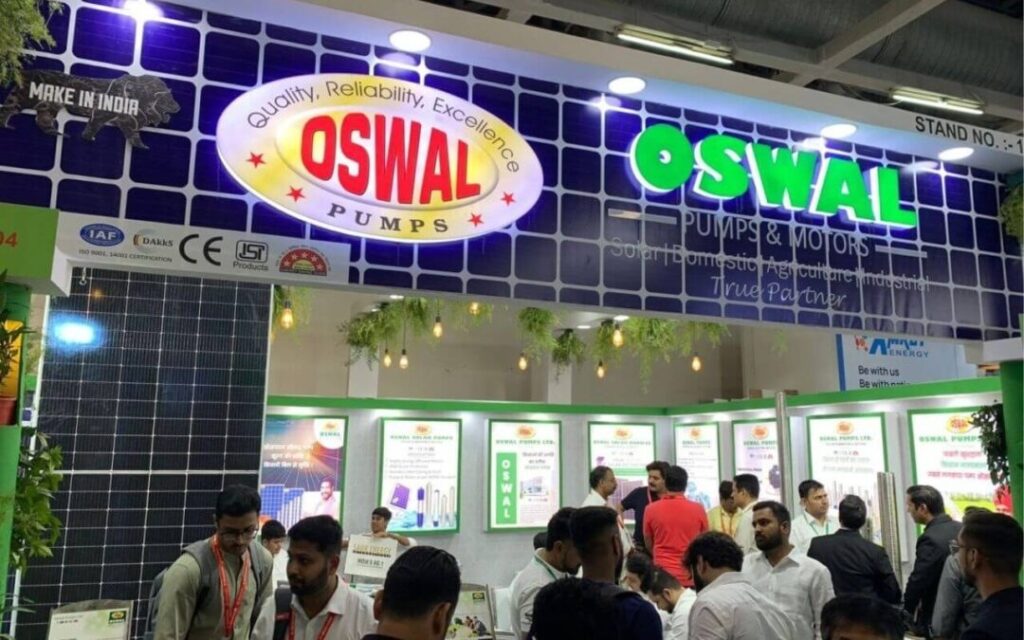
1. At a Glance
Oswal Pumps Ltd is what happens when government policy, solar dreams, and a vertically integrated factory floor decide to do bhangra together. Market cap sits at ₹4,323 Cr, the stock is currently trading near ₹379, and yes — that’s after a brutal -41.7% in 3 months and -52.9% in 6 months. Ouch. But fundamentals? They’re flexing. Q3 FY26 revenue ₹501 Cr (+32% YoY), PAT ₹93 Cr (+15.7% YoY), OPM ~26%, ROCE ~78%, ROE ~87% — numbers that usually make CFOs frame screenshots.
The twist: 87% of revenue comes from PM-KUSUM. Which means Oswal doesn’t just sell pumps — it sells patience, paperwork, and persistence. Add a 12.4x P/E against an industry cruising near 39x, and you’ve got a valuation that looks suspiciously sober for a stock with this kind of growth swagger. But then come the villains: debtors at 160 days, working capital days at 86, and negative operating cash flow in FY25. This is a solar success story with a cash-flow cliffhanger. Curious? You should be.
2. Introduction
Oswal Pumps wasn’t born in a solar lab with TED Talk dreams. Incorporated in 2003, it did the unsexy work first — pumps, motors, distribution — and only later strapped solar panels to the business model when India’s policy winds turned green. Fast forward to today, and Oswal is one of India’s fastest-growing vertically integrated solar pump manufacturers, supplying everything from solar modules to submersible pumps to turnkey systems under PM-KUSUM.
The company has supplied 0.23 million pumps out of the ~0.61 million installed under PM-KUSUM, translating into a ~38% market share. That’s not participation; that’s domination. And domination funded by the government is both a blessing and a bureaucratic endurance test.
Oswal raised ₹1,387 Cr via IPO and listed on June 20, 2025. The fresh issue of ₹897 Cr was earmarked for capex, subsidiary investments, debt repayment, and general corporate purposes — basically, growth with a safety helmet. Since then, revenues have exploded,
margins expanded, and the balance sheet has bulked up. But markets, being markets, noticed the working-capital bloat and slammed the brakes.
So the real question: is Oswal a solar compounder temporarily punished for cash-flow sins, or a policy-dependent rocket that needs constant government fuel? Let’s open the files.
3. Business Model – WTF Do They Even Do?
Imagine explaining Oswal Pumps to a farmer, a bureaucrat, and an investor — and all three nodding. That’s the business model.
Oswal designs, manufactures, and sells:
- Solar-powered pumps (submersible & monoblock)
- Grid-connected pumps
- Electric motors (induction & submersible)
- Solar modules
- Turnkey solar pumping systems under PM-KUSUM
This is vertical integration done properly. Motors? In-house. Pumps? In-house. Solar modules? In-house. Installation and commissioning? Also in-house or via empanelled partners. This matters because PM-KUSUM isn’t a product sale — it’s a project. And projects reward companies that control timelines, costs, and compliance.
Revenue-wise, turnkey solar pumping systems are the cash cow:
- Submersible turnkey: 66.6%
- Monoblock turnkey: 11.9%
That’s nearly 78% from turnkey execution alone.
Geographically, Maharashtra (44%) and Haryana (35%) lead, with smaller but growing footprints across UP, Rajasthan, and exports to 22 countries. Distribution has scaled aggressively to 925 distributors and 248 Oswal Shoppes.
Upcoming products like helical rotor pumps and industrial centrifugal pumps suggest Oswal wants to reduce its dependency on subsidy-driven agri demand. Smart move
