01 — At a Glance
New Kid On The Block. With A ₹2,910 Crore Order Book.
- 52-Week High / Low₹252 / ₹176
- IPO Price / Current₹256 / ₹244
- Full-Year FY25 Revenue₹345 Cr
- Full-Year FY25 PAT₹43.6 Cr
- Full-Year EPS (FY25)₹4.14
- Book Value (Latest)Not disclosed
- Dividend Payout0% (No dividend)
- Debt / Equity1.71x
- Order Book (Mar 2026)₹2,910 Cr
- Order Book / Sales~8.4x
IPO Auditor’s Note: Omnitech raised ₹583 crores in March 2026 and listed at ₹256 (bang on the IPO price). Within days, the market repriced it to ₹244, stripping away the IPO excitement. But here’s what matters: Q3 FY26 delivered ₹138 crore revenue (+96% YoY), ₹51 crore EBITDA margin at 37%, and ₹23 crore PAT (+173% YoY). Meanwhile, management announced a Weatherford MPA worth ₹920 crores. The stock is now at a P/E of 50.3x on FY25 annualised EPS, sitting on an order book that will take 5–6 years to convert. Expensive? Probably. Ambitious? Absolutely.
02 — Introduction
When Your Workshop Gets Listed On The Stock Exchange
Omnitech Engineering is what happens when your precision engineering shop becomes too successful to stay private. Started in 2006 by Uday A. Parekh (a man with 20+ years of experience in turning metal into components that actually work), it’s been quietly supplying safety-critical parts to Fortune 500 companies for nearly two decades.
The company makes turned, machined, and precision-engineered parts — cylinders, pistons, shafts, gearbox components — for industries that absolutely cannot afford to fail. Oil & gas (54% of revenue), motion control (27%), industrial equipment (16%). 74% of sales come from exports. Customer concentration: top 3 customers are 29.5% of revenue. Translation: They’re embedded deep in critical supply chains globally, but they’re also somewhat at the mercy of a few large OEMs who call the shots on everything from pricing to payment terms.
The IPO happened in March 2026, raising fresh capital to fuel growth at what management promises will be 35–40% CAGR. They’ve ordered new machines, started a facility in Chhapra, and just landed a ₹920 crore, 5-year contract with Weatherford. But here’s the rub: they’re already hitting machine capacity bottlenecks, their working capital cycle stretches 256 days (MOQ constraints on raw materials), and they’re leveraged at 1.71x debt-to-equity. For a company that just went public, there’s excitement. And there’s also legitimate friction.
Concall Clarity (Mar 2026): “We are more on only customized product solution… [top products] not contributing more than 7% of the revenue.” — Management confirming their anti-concentration strategy. They learned the hard way that depending on one product is a recipe for disaster. So they diversified. A lot. Which is good for resilience. Bad for simplicity. Also good for margins.
03 — Business Model: Precision. That’s It.
They Turn Steel Into Money. That Simple.
Omnitech is a contract manufacturer operating a “build-to-print” model. You (an OEM like Weatherford, Baker Hughes, Emerson, Siemens) send specifications. Omnitech manufactures to spec using CNC machines, vertical machining centers, and in-house capabilities like API threading, surface treatment, honing, deep-hole drilling, and welding. Then they test it, pack it, and ship it — often directly to the customer’s plant in the US, Europe, or Asia.
The moat? Long qualification cycles (18–24 months). Once you’re locked in as an “approved supplier,” switching costs are astronomical because quality certifications, process audits, and production validations take years. It’s the opposite of commoditised manufacturing. They’re not competing on who makes the cheapest part. They’re competing on who makes the part that won’t explode inside a turbine or a hydraulic system.
Materials = 30% of costs. Labour, depreciation, overhead = the rest. They source materials locally where possible (70% carbon steel, variability on alloys), hedge FX exposure through packing credit loans and forward contracts, and pass through raw material volatility to customers via price variation clauses. Job work (tolling) is less than 0.5% of revenue — kept minimal because customers demand full control over the manufacturing process.
Energy Sector54%Of 9M FY26 Sales
Motion Control27%Of 9M FY26 Sales
Ind. Equipment16%Of 9M FY26 Sales
Export Revenue~79%Mostly US, Europe
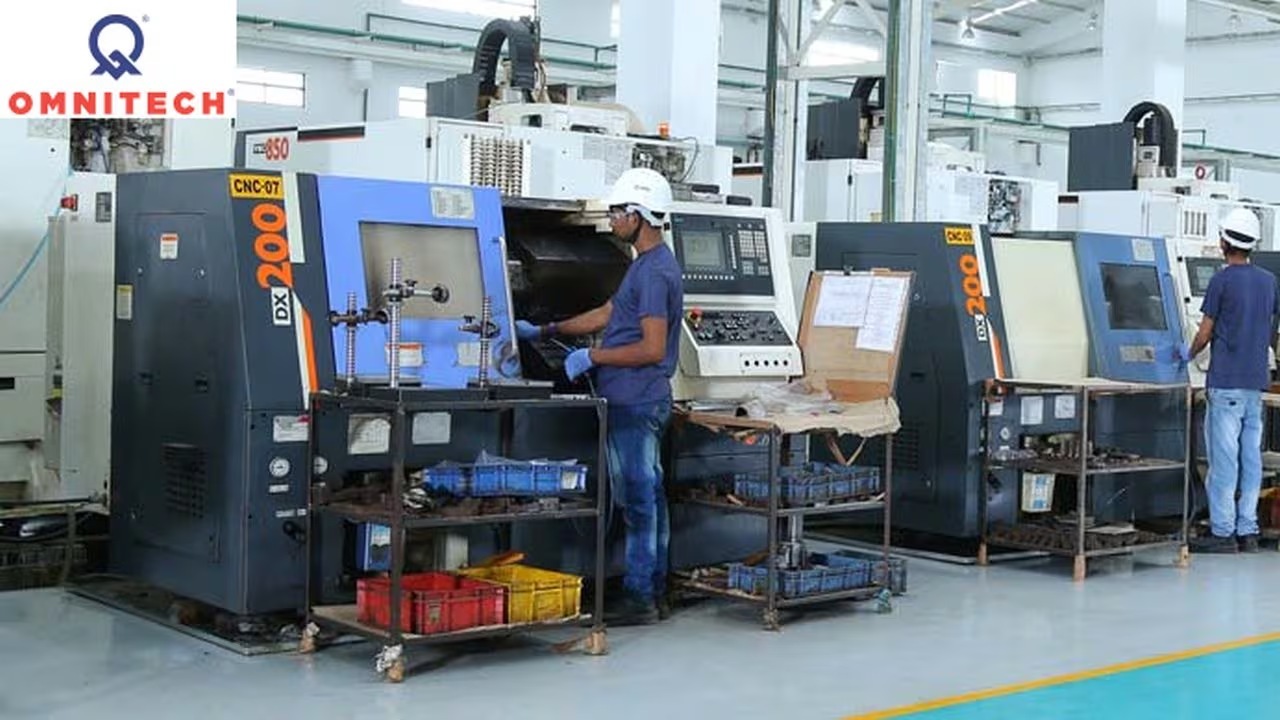
Manufacturing Supremacy: Omnitech has three facilities in Rajkot (~80,800 sq meters combined), ~300 km from Mundra Port. Three CNC/VMC machines per facility. Installed annualised capacity: 2.43 million machine hours + 7,200 MTPA fabrication. Recently added 40–50% capacity versus FY25. But guess what? Already hitting bottlenecks. Five to six specific machines are booked. Welcome to growth problems.
💬 Quick thought experiment: If your job is to tighten a bolt 10,000 times a day with micro-precision tolerances, would you want to work at Omnitech or play video games? Drop your take in the comments!
04 — Financials Overview
Q3 FY26: When Growth Looks Like This
Result type: Quarterly Results | Q3 FY26 EPS: ₹2.19 | Annualised EPS (Q3×4): ₹8.76 | Full-year FY25 EPS: ₹4.14
| Metric (₹ Cr) |
Q3 FY26
Dec 2025 |
Q3 FY25
Dec 2024 |
Q2 FY26
Sep 2025 |
YoY % |
QoQ % |
| Revenue | 138 | 71 | 128 | +95.7% | +7.8% |
| EBITDA | 51 | 24 | 43 | +112.5% | +18.6% |
| EBITDA Margin % | 37% | 34% | 34% | +300 bps | +300 bps |
| PAT | 23 | 8.4 | 23 | +172.6% | -0.4% |
| EPS (₹) | 2.19 | 0.80 | 2.17 | +173.8% | +0.9% |
What Just Happened: Q3 revenue nearly doubled YoY (₹138 cr vs ₹71 cr). EBITDA margin expanded 300 basis points to 37%. PAT jumped 173%. How? Mix improvement, operating leverage from new machinery ramping, and the Weatherford contract beginning to show up in the order book (though not yet full conversion). The annualised EPS from Q3 × 4 gives ₹8.76, but that’s misleading because Q3 benefited from project ramp. Better reference: use the 9M FY26 annualised run-rate. Nine months of FY26: ₹362.6 cr revenue (+54% YoY). Annualised: ~₹484 cr. Still solid growth, but not 95% every quarter.
05 — Valuation: Fair Value Range
Is ₹244 Fair After The IPO Cooldown?