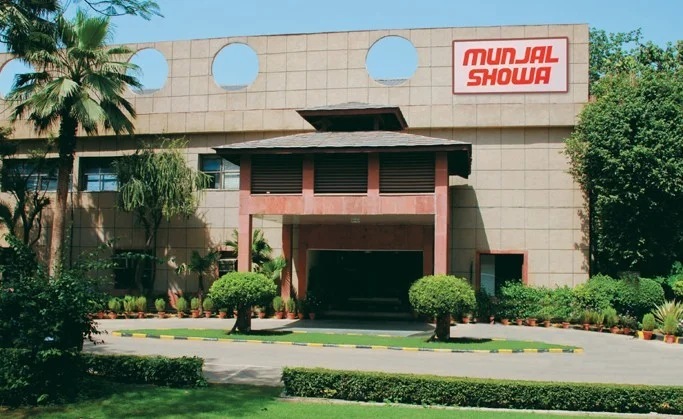
1. At a Glance
Munjal Showa Ltd just delivered a quarter that looks dramatic on paper and confusing in reality. Q3 FY26 revenue came in at ₹350 crore with PAT of ₹12.5 crore, translating into a jaw‑dropping 110% YoY profit growth. Sounds blockbuster, right? Now pause. Operating margin is still just ~4% for the quarter and barely ~2% on a trailing basis. This is a ₹496 crore market‑cap auto ancillary trading below book value (0.74x), paying a chunky 3.63% dividend yield, yet delivering ROE that would make a savings account feel smug. Debt is zero, cash keeps coming in and out politely, and one customer (Hero MotoCorp) still controls 80%+ of the revenue remote.
In short: cheap, cash‑rich, boring, and suddenly profitable — the exact kind of stock that makes value investors whisper and growth investors yawn. But should you care? Let’s investigate.
2. Introduction
Munjal Showa is that quiet uncle at the family wedding — always present, rarely loud, and nobody quite knows what he does, but somehow the bills get paid. Incorporated in 1985 and part of the Hero Group ecosystem, the company manufactures shock absorbers and suspension systems for two‑wheelers and four‑wheelers. It’s old‑school manufacturing with Japanese collaboration DNA (Showa / Hitachi Astemo), ISO certifications stacked like trophies, and factories in Gurugram, Manesar, and Haridwar.
The problem? The business peaked years ago. Revenue growth over the last decade is negative, margins have steadily compressed, and ROCE has collapsed from mid‑20s to near‑zero. Yet the company survives comfortably, pays dividends generously, and sits on a fortress‑like balance sheet.
So why is the market suddenly interested? Because Q3 FY26
showed profit growth north of 100%. The obvious question: turnaround or accounting optics? Let’s break it down slowly, without getting emotionally attached.
3. Business Model – WTF Do They Even Do?
Munjal Showa lives in one product bucket: shock absorbers. That’s it. No software, no buzzwords, no EV platform dreams. Just metal, oil, damping, and physics.
Product Mix
- Two‑wheelers: Rear cushions and front forks for Hero, Honda, Yamaha, etc.
- Four‑wheelers: Front struts, rear struts, window balancers for models like Swift, City, Celerio, Eeco.
Everything — literally everything — falls under one primary segment: suspension systems.
Customers
Hero MotoCorp alone contributes ~83% of revenue. Add Honda, Yamaha, Maruti, and a few EV startups, and you have the entire customer universe. Diversification exists in theory, not in revenue reality.
Collaboration Advantage
The Japanese collaboration helps with design and validation, but pricing power is still dictated by OEMs. This is a cost‑plus, volume‑dependent business. No brand premium, no pricing swagger.
If Hero sneezes, Munjal Showa catches a cold. Comfortable, but fragile.
4. Financials Overview
Quarterly Comparison Table (₹ Crore)
| Metric | Latest Q3 FY26 | Q3 FY25 | Q2 FY26 | YoY % | QoQ % |
|---|---|---|---|---|---|
| Revenue | 350 | 319 | 333 | 9.6% | 5.1% |
| EBITDA | 12 | 8 | 3 | 50%+ | 300%+ |
| PAT | 11 | 6 | 3 | 109% | 266% |
| EPS (₹) | 2.73 | 1.50 | 0.68 | 82% | 301% |
