01 — At a Glance
The Fake Leather King That The Market Has Somehow Not Noticed
- 52-Week High / Low₹630 / ₹435
- Q3 FY26 Revenue₹237 Cr
- Q3 FY26 PAT₹52.9 Cr
- TTM EPS₹40.8
- Annualised EPS (Q3 Avg)₹48.72
- Book Value / Share₹233
- Price to Book2.08x
- Debt / Equity0.01x
- OPM (Q3 FY26)25%
- ROCE20.7%
The One-Liner: Mayur Uniquoters just grew profit 77% YoY in Q3, is sitting on a negligible debt book like it’s some kind of financial ascetic, and trades at 12.2x P/E while ROCE blissfully floats at 20.7%. The export machine is humming. Margins are expanding. The only reason the stock hasn’t re-rated is that most Indians think “synthetic leather” is what they found in a Dharamshala market 15 years ago. Spoiler: it’s actually sophisticated engineering material that keeps Maruti, BMW, and Bata running.
02 — Introduction
Who Are These People And Why Should You Care About Fake Leather?
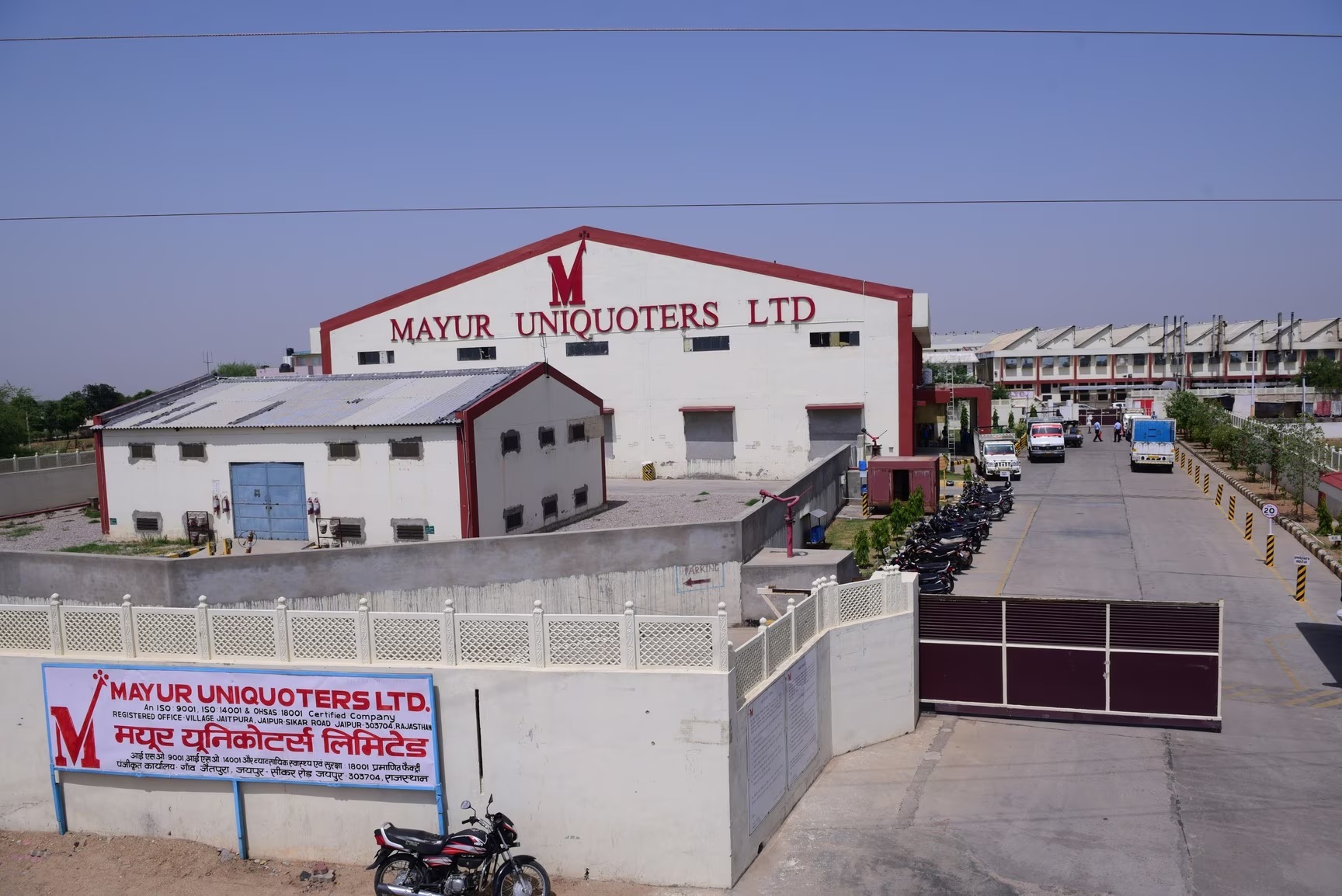
Mayur Uniquoters Limited, established in 1992, is proof that Jaipur is not just about pink buildings and lakeside hotels. This company manufactures synthetic leather — technical term: coated textile fabrics — which is essentially the plastic wrap of the fashion and automotive world. They make 400+ variants of the stuff.
Here’s the thing about synthetic leather: it’s everywhere, and you’ve touched it more times than you’ve touched a real leather item in your life. Your car seat? Synthetic leather. That Bata shoe you wore to your first office job? Synthetic leather. The seat cover of that Maruti you’re still paying EMI on? Synthetic leather. Mercedes-Benz and BMW approve their products. So do Maruti, Mahindra, and basically every automobile OEM that matters.
But Mayur is not just a commodity player making cheap knockoffs. The company supplies premium automotive OEMs in Europe and the USA. They have a 50+ year experience pedigree in the Poddar family business. They’ve got IATF 16949 certification (automotive quality gold standard), ISO certifications stacked higher than a Delhi Metro escalator. And they operate at operating margins of 23–25% — which is not exactly small-time.
Q3 FY26 (Dec 2025) is when things got spicy. Revenue rose 22% YoY. Profit rose 77% YoY. Exports are now 41% of the revenue pie and climbing. The PU (polyurethane) division, which was in “perpetual ramp-up mode,” is finally starting to make some noise. And the company is evaluating capacity expansion in South India and potentially overseas — because apparently, having one plant near Jaipur in 2026 is not a big enough flex anymore.
CARE Ratings Perspective (Nov 2025): CARE AA; Stable for long-term facilities. The company has “strong market position in the organised segment of polyvinyl chloride (PVC) coated fabric, and wide product portfolio with diverse industry applications… established and reputed clientele and product approvals from leading domestic and global automotive original equipment manufacturers (OEMs).” Translation: they’re not going anywhere, and neither are their margins.
03 — Business Model: WTF Is Synthetic Leather Anyway?
Plastic With A Degree. That’s The Business.
Mayur manufactures two main products: PVC-coated fabric and PU-coated fabric. The raw materials (plastics, resins, polymers) are crude oil derivatives. They buy them, coat them onto textile base fabrics in their Jaipur plants, and sell them to downstream customers who cut, shape, and glue them into finished products.
The revenue breakdown tells the story. Q3 FY26 exports were ₹97 crore (41% of revenue). Domestic was ₹140 crore. Within domestic: auto OEM ₹52 cr, replacement market ₹39 cr, footwear ₹40 cr, furnishing ₹6 cr. Translation: they don’t have one customer or one end-market. They’ve got Mercedes-Benz, Maruti Suzuki, Bata, Mahindra, and a thousand smaller customers all depending on them.
The moat is delicious. Once an automotive OEM approves your product, switching costs are nuclear. Getting approval from Ford, Chrysler, or Mercedes typically takes 2–3 years and a mountain of paperwork and testing. Mayur has approvals from all of them. That’s not luck — that’s 30+ years of delivery discipline and quality obsession.
PVC Capacity48.6Mlinear meters/year
PU Capacity5Mlinear meters/year
Exports41%of Q3 revenue
Dealers400+distribution network
The Hidden Flex: According to management on the Feb 2026 concall, they deliberately pursue higher-margin products over volume. “We are not interested in growing our business where our margins are very, very low… we focus a lot on the bottom line than focusing on the top line.” That’s the exact opposite of what every other Indian manufacturer says. Most would sell their grandmother’s kitsch decorations for volume. Mayur says: “Nah, we like money.”
04 — Financials Overview: The Explosive Bits
77% Profit Growth. Let That Sink In.
Result type: Quarterly Results | Q3 FY26 EPS: ₹12.18 | Annualised EPS (Q1+Q2+Q3)/3 × 4: ₹48.72
| Metric (₹ Cr) |
Q3 FY26
Dec 2025 |
Q3 FY25
Dec 2024 |
Q2 FY26
Sep 2025 |
YoY % |
QoQ % |
| Revenue | 237 | 195 | 238 | +21.6% | -0.4% |
| Operating Profit (OPM) | 59 | 46 | 59 | +28.3% | +0.0% |
| OPM % | 25% | 23% | 25% | +200 bps | +0 bps |
| PAT | 52.9 | 30 | 48 | +77.4% | +10.2% |
| EPS (₹) | 12.18 | 6.87 | 11.07 | +77.4% | +10.0% |
Translation for Humans: When your profit grows 77% in a quarter, something special is happening. Is it just FX gains? Is it a one-time fluke? Is it management juggling numbers like they’re at a circus? Let’s investigate. Other income (mostly FX gains) contributed ₹19 cr in Q3 FY26. But that’s only 36% of the PAT growth. The real story is: the company is selling more (revenue +22%), at better margins (OPM expanded 200 bps to 25%), to better customers (exports growing faster), and managing costs better. The FX tailwind is a bonus, not the main act.
💬 77% profit growth on 22% revenue growth — is Mayur’s margin expansion sustainable as exports ramp? Or will commoditized PVC pricing eventually pull them back? Comment your take.
05 — Valuation: What’s This Actually Worth?
Fair Value Range For A Company Nobody’s Heard Of But Everyone Uses