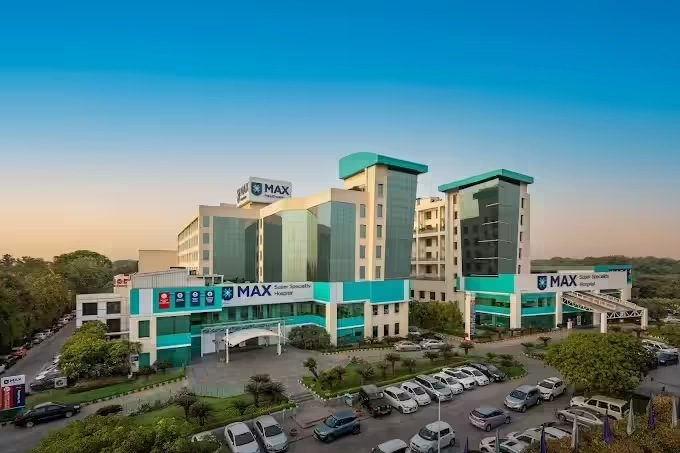
1. At a Glance
Max Healthcare Institute Ltd is what happens when Indian healthcare decides to go full corporate gym mode — bulked up, aggressively expanding, and flexing margins in front of the market. With a market cap of ₹1.01 lakh crore, Max is officially the most expensive hospital chain in the country by valuation, even if not by ego. The stock currently trades at ₹1,041, down ~8.3% in 3 months and ~16.4% in 6 months, reminding investors that even hospitals need periodic health check-ups.
Q3 FY26 numbers were solid but not blockbuster: Revenue ₹2,608 Cr (+10% YoY), EBITDA ₹648 Cr, and PAT ₹344 Cr (+17% YoY). Margins remain healthy with OPM ~26%, but the elephant in the ICU is capital intensity — debt has climbed to ₹3,275 Cr, up sharply from ₹913 Cr in FY22. The company is clearly in expansion mode, swallowing beds like protein scoops.
Key operational vitals look stable: ARPOB ₹78,000, Occupancy 76%, and EBITDA per bed ₹71 lakh in H1 FY26. Translation? Existing hospitals are sweating nicely, but new ones are still warming up. The big question: is this a growth story or a balance-sheet endurance test? Let’s scrub in.
2. Introduction
Hospitals are supposed to cure diseases. Max Healthcare, meanwhile, is busy curing India’s bed shortage — one expensive acquisition at a time. Over the last few years, Max has transformed from a respectable hospital operator into a full-blown healthcare empire with ambitions that scream, “Why stop at Delhi NCR when we can colonize North India?”
The business model is simple on paper: run premium hospitals, charge premium prices, keep occupancy high, and pray that depreciation doesn’t eat your soul. In practice, it’s a juggling act between pricing power, doctor talent, capital expenditure, and regulators who occasionally wake up with GST notices.
What makes Max interesting is not just scale but timing. India is aging, lifestyle diseases are booming, and quality private healthcare is no longer optional — it’s mandatory. Max is riding this wave aggressively, adding hospitals, labs, home care, and international patients like it’s building a healthcare version of Reliance.
But here’s the sarcasm-loaded caveat: hospitals are cash-hungry beasts. Every new bed needs land, equipment, staff, and years before reaching optimal occupancy. Max’s story is therefore not about if it can grow
— it’s about how much balance sheet pain investors are willing to tolerate while it grows.
So, is Max a disciplined healthcare compounder or a CAPEX-addicted bed hoarder? Let’s dissect.
3. Business Model – WTF Do They Even Do?
Max Healthcare is essentially a bed monetization machine.
At the core is the hospital network: 20 healthcare facilities with ~5,200 beds, mostly in North India. These are multi-specialty and super-specialty hospitals covering everything from cardiac surgeries to oncology, transplants, and neuro sciences. High ARPOB, strong brand recall, and doctor concentration do the heavy lifting.
Then comes Max@Home, the “we’ll come to your sofa” business. Home diagnostics, physiotherapy, dialysis, medicine delivery — basically hospital services without hospital parking trauma. It processes 3,000+ transactions daily, which is impressive, but still more brand extension than profit engine (for now).
Third pillar: Max Lab. Preventive diagnostics, pathology, and test processing with 580+ collection centers, 47 labs, and 11 lakh+ patients served as of Q2 FY26. Diagnostics is the least capital-intensive and most scalable part of healthcare, and Max knows it. This arm quietly improves ROCE optics while hospitals burn capital.
Add to that international patients from 13+ countries, research collaborations, academic programs, and a DNB factory producing future doctors. In short, Max isn’t just treating patients — it’s vertically integrating healthcare like an MBA case study.
The catch? Hospitals still account for the bulk of revenue and almost all the CAPEX. Everything else is seasoning.
4. Financials Overview
Quarterly Comparison Table (Consolidated, ₹ Cr)
| Metric | Latest Qtr (Q3 FY26) | YoY Qtr (Q3 FY25) | Prev Qtr (Q2 FY26) | YoY % | QoQ % |
|---|---|---|---|---|---|
| Revenue | 2,608 | 2,068 | 2,135 | 26.1% | 22.1% |
| EBITDA | 648 | 499 | 575 | 29.9% | 12.7% |
| PAT | 344 | 301 | 491 | 14.3% | -29.9% |
| EPS (₹) | 3.09 | 2.46 | 5.05 | 25.6% | -38.8% |
