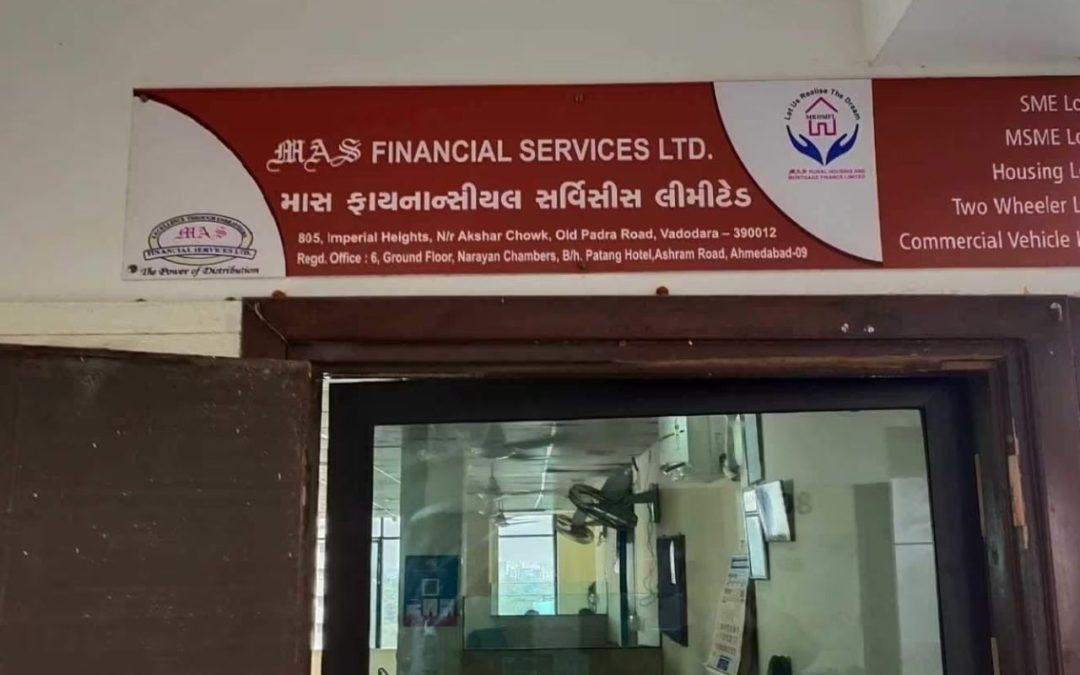
01 — At a Glance
The Unsung Lender: No Growth Hacking, Just Discipline
- 52-Week High / Low₹355 / ₹226
- Q3 Revenue (Cons.)₹507 Cr
- Q3 PAT (Cons.)₹95.6 Cr
- Q3 EPS (Cons.)₹5.08
- Annualised EPS (Q3×4)₹20.32
- Book Value₹155
- Price to Book1.90x
- Dividend Yield0.58%
- Debt / Equity3.53x
- 9M FY26 Growth18% YoY
The Auditor’s Reality Check: MAS Financial closed 9M FY26 with ₹480 crore quarterly revenue (+23.7% QoQ), ₹1,891 crore annual revenue run-rate (25.6% YoY growth), and a consolidated AUM of ₹14,641 crores. You haven’t heard of them because they don’t spend on brand building—they spend on underwriting and risk management. The stock returns -7.28% in three months. Meanwhile, management quietly set a target of ₹1 lakh crore AUM by 2036. “Boring” is the compliment they’d appreciate most.
02 — Introduction
Who Lends to Indians When Banks Say “No”?
Welcome to MAS Financial Services. You’ve probably never heard of them. That’s actually their business model.
Headquartered in Ahmedabad, this NBFC (non-banking financial company, for those keeping score at home) has been lending money to India’s underserved segments for 27 years. Not venture capitalists. Not tech entrepreneurs. Not crypto bros (thank goodness). They lend to the trader in your local market who wants to expand his shop. The 2-wheeler owner who needs a logistics vehicle. The small manufacturer in a 3-state radius you’ll never visit. The salaried person in tier-2 cities who walked into their branch because the bank rejected him in 3 minutes.
With 11.25 lakh active loan accounts across 208 branches and 215 partner NBFCs, MAS operates what they call a “hybrid distribution model.” Translation: we have branches AND we trust our NBFC friends to distribute. A portfolio of ₹14,600 crore—growing, modest, disciplined, profitable. No Instagram-worthy metrics. No “disruption” buzzword. Just lending.
The February 2026 concall revealed something interesting: management is openly dismissive of growth-at-any-cost lending. The MD said, “An enterprise is best run by the entrepreneurs who run for his life, not investors who run for food.” Translation: we’re not here to juice quarterly earnings. The company set a 10-year BHAG: ₹1 lakh crore AUM by 2036. They’re 14% of the way there. In real time, this company is choosing profitability and asset quality over explosive growth. In 2026 India, that’s almost rebellious.
Concall Insight (Feb 2026): Management explicitly stated: “Lending is a very serious business… not about creating exponential growths.” They aren’t chasing valuations. They’re chasing defaults-avoided. In the streaming era of Indian finance, MAS is the anti-meme.
03 — Business Model: Who Gets Loans Here?
Six Products. 15,500 Locations. One Philosophy: Underwrite Like Your Mom Was Co-Signer.
MAS Financial operates a diversified lending model across six product lines, each targeting a specific underserved segment. Think of it as a lending menu—pick your risk appetite.
Micro Enterprise Loans (MEL): Started in 1998, this is their legacy product. Average loan size: ₹82,000. Lend to retailers, traders, small manufacturers. Zero documentation in formal sense; what they look for is business cash flow and repayment history. AUM: ₹5,500+ crores. The bread and butter.
SME Loans: Bigger ticket, longer tenure. Average: ₹31.25 lakh. Collateral-backed, supply-chain secured, invoice discounting, business loans up to ₹5 crores. AUM: ₹4,900+ crores. This is where they aspire to reach 25–30% of total AUM by 2036 (currently 34% of consolidated). They’ve opened 27 specialized SME branches in tier-1 cities with explicit tech-enabled underwriting.
Wheels (2-Wheeler & CV): Two-wheelers: ₹77,000 average. Commercial vehicles (mostly used SRTO—small transport operators with 1–5 vehicles): ₹4.15 lakh average. Combined AUM ₹2,077 crores. The fintech crowd doesn’t touch used CV lending; MAS does it with 99.96% face-match verification (their concall literally bragged about this number—and they’re right to).
Salaried Personal Loans (SPL): ₹1.13 lakh average. AUM ₹1,185 crores. Why unsecured? Because they source via fintech DLGs (digital loan guarantees), keep customer LGDs (loss-given-default) lower, and use AI video PD (personal data/due diligence). Model-driven provision coverage: ~25%. The most “new economy” product in their book.
Housing (via subsidiary MRHMFL): ₹8.59 crores AUM. Average ticket ₹8.47 lakh. Rural and semi-urban focus. Growing 22% YoY. 101 branches. Management’s explicit plan: IPO within 5 years, make housing 15% of consolidated AUM by 2036.
Distribution DNA: 65% direct retail (208 branches + growing), 35% through 215+ partner NBFCs (RAC = Retail Asset Channel). The RAC is granularly monitored—monthly asset verification, geo exposure checks, live DPD monitoring. Management’s claim: “actual loss through RAC is less than 50 basis points.” If true, that’s spectacular risk management.
MEL Share40.6%Legacy Core
SME Share35.7%Growth Engine
Wheels Share15.1%Scaling Fast
Housing + SPL8.6%Future Mix
Concall Digest (Dhvanil Gandhi, Retail Head): “MEL average ticket size moving from ₹70–80k to ₹1.2–1.3L today; aspire toward ₹4–5L in 2–3 years.” Translation: they’re climbing the value curve without abandoning their core. SME embedded finance (EDI) pilot is running—ticket sizes ₹5 lakh, disbursal in 30 mins to 2 hours via payment platform partners. That’s basically fintech-lite.
💬 Drop a comment: What would you call a 27-year-old lending company that chose discipline over growth hacking? Boring genius? Or just boring?
04 — Financials Overview
Q3 FY26: The Numbers. Yes, They’re Boring. Yes, They’re Growing.
Result type: Quarterly Results | Q3 FY26 EPS (Cons.): ₹5.08 | Annualised EPS (Q3×4): ₹20.32 | FY25 Full-Year EPS: ₹17.11
| Metric (₹ Cr) |
Q3 FY26
Dec 2025 |
Q3 FY25
Dec 2024 |
Q2 FY26
Sep 2025 |
YoY % |
QoQ % |
| Revenue | 507 | 410 | 480 | +23.7% | +5.6% |
| Financing Profit | 133 | 109 | 123 | +22.0% | +8.1% |
| Financing Margin % | 26% | 27% | 26% | -100 bps | Flat |
| PAT | 93.32 | 77.6 | 91 | +20.3% | +2.6% |
| EPS (₹) | 5.08 | 4.23 | 4.98 | +20.1% | +2.0% |
The Real Story: Revenue up 23.7% YoY, but financing margin compressed from 27% to 26% (100 bps). Why? Because they’re deliberately scaling from partnership-led (cheaper, lazier sourcing) to direct retail (costly, smart underwriting). Higher opex on branch build-out, but management insists ROA remains at 2.75–2.85% even as they invest. That’s either discipline or delusion. Concall leaned hard on “discipline.” P/E recalculated: Full-year FY25 EPS ₹17.11 ÷ CMP ₹294 = 17.2x (screener shows 15.1x—likely using TTM). Annualised Q3 EPS ₹20.32 would put P/E at 14.5x. Either way, trading at a discount to industry median (16.5x) and certainly to peers like Bajaj Finance (30x). Why? Because they don’t have a brand moat yet. They have a business moat: discipline, risk management, and the ability to access underserved borrowers others miss.
05 — Valuation Discussion
What’s This Lending Business Worth? Three Methods, One Range.