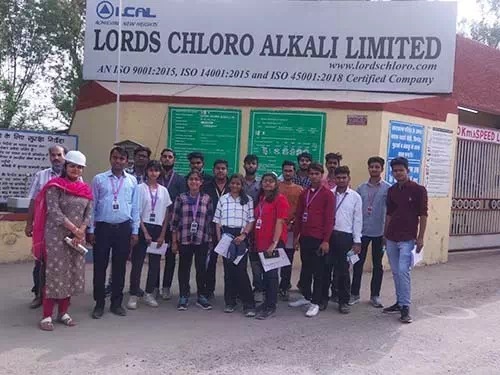
Lords Chloro Alkali Ltd Q1 FY26 – From Caustic Soda to Solar Dreams: 436% Profit Growth but ROE of a Fixed Deposit
1. At a Glance
Lords Chloro Alkali Ltd (NSE: LORDSCHLO, CMP ₹165, Market Cap ₹416 Cr) is the smallcap chemical cousin who shows up late to the family party but insists on announcing his “capacity expansion.” Incorporated in 1979, this Alwar-based player makes caustic soda, chlorine, hydrogen, hydrochloric acid, sodium hypochlorite, and chlorinated paraffin wax — basically the whole menu of things that can burn a hole in your hand and your P&L.
In the last quarter, sales hit ₹100 Cr (up 54% YoY) and PAT ₹10.4 Cr (up 436% YoY). The stock trades at a P/E of ~28, book value ₹72, with ROE at a sleepy 3.25% and ROCE at 5%. Debt is ₹132 Cr, debt/equity 0.73, promoter holding a healthy 74.7% (zero pledge, rare for a smallcap). But margins yo-yo like a Bollywood singer at a live concert — one year 28%, another year -3%.
2. Introduction
Imagine an old-school chemical factory in Rajasthan: giant chimneys, chlorine tanks, and a solar plant rising in the desert. Lords Chloro has been around since 1979, quietly supplying caustic soda to soap makers, paper mills, dye manufacturers, and edible oil refineries across North India. Basically, without these guys, half of Punjab’s detergent ads would fail.
But here’s the twist: while the company is 46 years old, it only recently migrated from NSE SME to the mainboard (2023). It’s like that middle-aged uncle who finally upgraded from Nokia 3310 to an iPhone. Now, with capacity expansions in chlorinated paraffin wax and plans for a 12 MW captive solar plant, they’re pitching themselves as a “future-ready chemical company.”
Investors, however, are scratching their heads: sales CAGR is barely 6% over 5 years, profits were negative in FY23, and yet the stock is up 22% in one year. Smallcap chemical stocks, like chemistry lab experiments, either explode or quietly fizzle. Which side of the equation is Lords Chloro on? Let’s investigate, detective-style.
3. Business Model – WTF Do They Even Do?
The business is simple: take salt and electricity, run electrolysis, and churn out caustic soda (lye or flakes), chlorine, and hydrogen. Then diversify into by-products like hydrochloric acid, sodium hypochlorite (a disinfectant), and chlorinated paraffin wax (used in plastics, rubber, and paints).
Their customer base is boring but stable: soap companies, paper mills, dyes and plastics makers, vegetable oil processors. Basically, if you’ve ever washed clothes, written on paper, or eaten chips fried in refined oil — Lords Chloro had a behind-the-scenes cameo.
Capacity:
Caustic soda – 210 TPD (targeting 300 TPD soon).
CPW plant – 20 TPD, expanding to 50, and now planning 100 TPD.
New sodium hypochlorite plant commissioned.
Solar: 12 MW captive plant in Rajasthan.
Translation: They’re trying to turn an old-school caustic soda shop into a green-energy-backed specialty chemical hybrid.
Question: Would you trust a caustic soda company to run a solar plant? Or is this just ESG lip-service for investors?