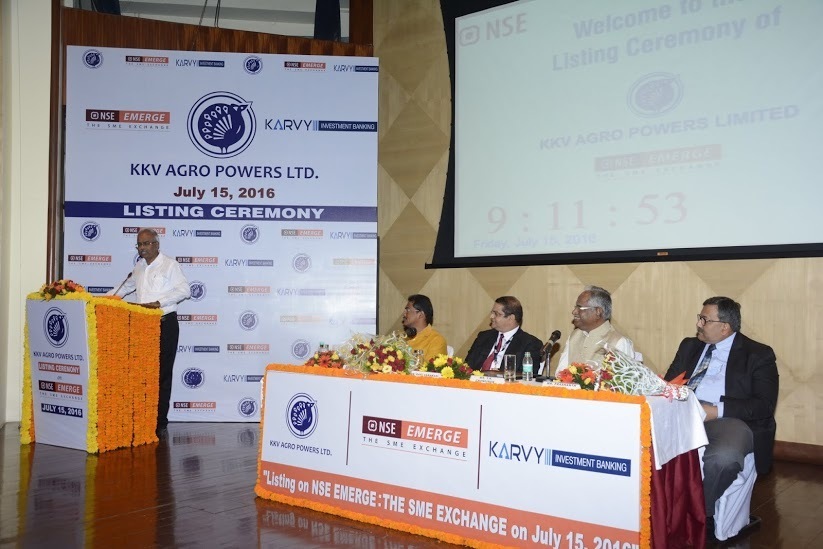
KKV Agro Powers Ltd is that rare Indian SME that wakes up every morning and asks itself: Should we sell electrons, gold coins, or farm produce today? With a market cap of ₹39.5 Cr, a current price of ₹634, and a P/E of 7.20, this stock looks cheap enough to make value investors rub their eyes and growth investors scratch their heads. The company just reported H1 FY26 results (period ended Sep 2025) with half-year sales of ₹348 Cr, PAT of ₹4.67 Cr, and a headline EPS of ₹74.89. Margins? Razor-thin like a freshly sharpened blade (OPM ~2% in the latest half). Returns? ROCE 10.9%, ROE 8.02% — not terrible, not party-worthy either. The three-month return is a sprightly +17.6%, while the one-year return sulks at -15.4%. Dividend yield sits at 0.72%, which is basically chai-biscuit money. If this company were a Bollywood movie, it would be a crossover film with too many plotlines and one surprisingly catchy song called “Low Valuation”.
2) Introduction — A Company With Multiple Personalities
Founded in 2012, KKV Agro Powers began life with green dreams — wind and solar power generation — and then decided to add bullion trading, jewellery retail, agriculture, and textiles just to keep life interesting. On paper, it develops, builds, owns, operates, and maintains utility-scale grid-connected wind and solar projects. In reality, the revenue engine today is precious metals, with electricity being the quiet, responsible cousin who pays the bills but doesn’t get invited to parties.
The company operates 9 wind power assets totaling 7,600 kW across Tamil Nadu and Andhra Pradesh, plus a 1,000 kW solar plant in Tirupur. Power generated in Tamil Nadu is largely for captive consumption by group companies, while Andhra Pradesh power is sold to the state government. On the side, KKV trades Renewable Energy Certificates (RECs) via IEX and PXIL through TATA Power Trading Company Limited — a sentence that sounds more exciting than the cash it actually throws off.
Then comes the glitter: bullion and jewellery. A retail gold outlet in Cumbum sells jewellery and bullion, with management eyeing more outlets across Tamil Nadu. Add agriculture and textiles, and you have a corporate thali where every compartment exists — but not every dish is equally tasty. Ready to dig in?
3) Business Model — WTF Do They Even Do?
Let’s break this down like we’re explaining it to a smart friend who skipped accounting class:
Renewable Energy: KKV owns windmills and a solar plant. Wind + sun = electrons. Electrons are either used internally or sold to the government. Margins here are steady but modest. This business is capital-heavy, predictable, and boring — which is exactly how lenders like it.
Bullion & Jewellery: This is the real volume driver. Sales & processing charges from precious metals contribute ~98% of FY22 revenue, while electricity contributes ~2%. Jewellery involves gold coin sales, bullion trading, purification charges, and retail jewellery sales. Turnover is huge, margins are wafer-thin, and working capital does gymnastics daily.
Agriculture & Textiles: These exist, they contribute, but they don’t dominate headlines. Think of them as the background dancers in a Shah Rukh Khan song — present, energetic, but not stealing the spotlight.
The result? Massive revenue numbers with tiny operating margins, which is why KKV can report ₹871 Cr TTM sales yet only ₹5.49 Cr PAT. Does this diversified model reduce risk or dilute focus? Depends on whether you like buffet dinners or Michelin tasting menus.
Result Type Lock: The latest official heading is “Half Yearly Results” for period ended 30.09.2025. This is HALF-YEARLY RESULTS. Annualised EPS = Latest EPS × 2.