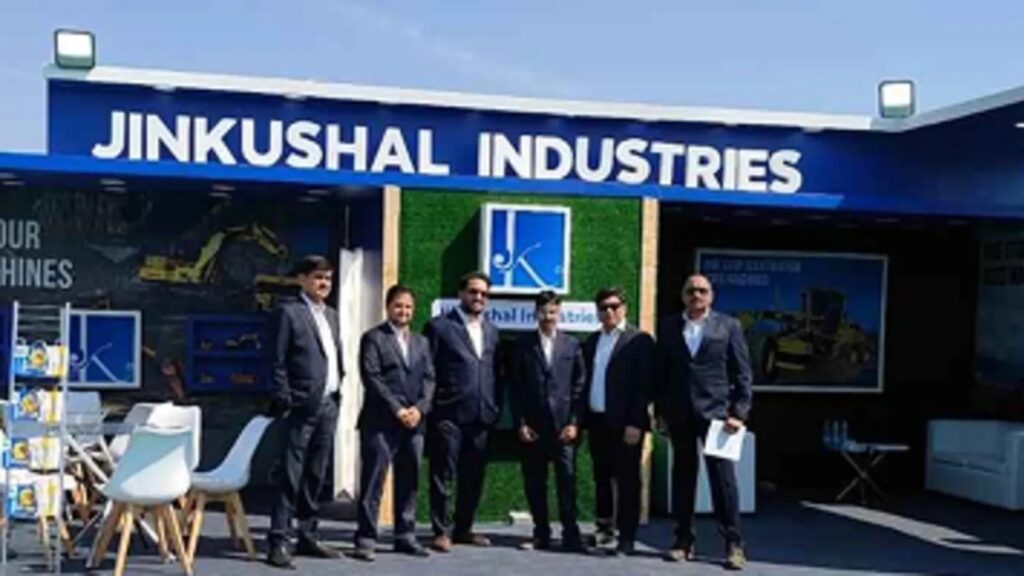
1. At a Glance – When the Export Engine Misfires
Jinkushal Industries Ltd is one of those rare Indian smallcaps that doesn’t sell to India at all. 99% exports, a ₹276 Cr market cap, a fresh IPO story, and a bold claim of being the largest non-OEM construction machinery exporter from India with 6.9% market share. Sounds like a LinkedIn flex already.
But then reality taps the shoulder.
The stock is down ~39% in 3 months, currently at ₹71.7, after touching ₹128 post listing. Latest quarter sales collapsed 76% QoQ, EBITDA margin went from positive swagger to -19.8%, and PAT came in at –₹9.87 Cr. Yet, the trailing P/E still sits at ~94x like nothing happened.
Balance sheet looks heavier after IPO: Debt ₹70 Cr, Net worth ₹153 Cr, ROE 28%, ROCE 23%, but cash flows remain allergic to positivity. Add client concentration (top 10 = 75%), Mexico dependence (74% revenue), and wafer-thin operating margins (OPM 2.8%), and you get a company that looks global on paper but fragile in execution.
So is this a temporary export hiccup or a structural business model problem? Let’s open the hood.
2. Introduction – From Export Rockstar to Quarterly Reality Check
Jinkushal Industries was founded in 2007, long before “Make in India” became a PowerPoint slogan. The company carved out a niche most Indian players didn’t bother with: exporting construction equipment without being an OEM.
Instead of manufacturing machines end-to-end, Jinkushal plays the global dealer + customizer + refurbisher. New machines, used machines, modified machines, accessorised machines—if it moves dirt, JKIPL will ship it somewhere.
The pitch is simple:
- Global buyers face long OEM waiting periods
- Emerging markets want cheaper, faster, flexible solutions
- Jinkushal sources, customises, refurbishes, and exports
And for years, this worked. Cumulative supply of 1,500+ machines, customers across continents, and in FY25, ₹381 Cr peak sales.
Then came FY26 Q3—and gravity.
Sales dropped to ₹43.9 Cr, operating losses emerged, and the market suddenly realised that being a trader in heavy machinery is very different from being a software exporter.
The IPO in Oct 2025 raised ₹116 Cr, mostly for working capital, not expansion. That alone tells you something. This is a business that eats cash before it earns margins.
So the real question is not “what do they do?” but “how stable is this model when one country sneezes?”
3. Business Model – WTF Do They Even Do?
Imagine Flipkart, but instead of phones, it sells excavators to Mexico.
That’s Jinkushal.
Vertical 1: New Customised Machines (61% revenue)
They source brand-new construction machines (non-OEM), modify them, add accessories, tweak specs, and ship them globally. Buyers like this because OEM lead times can run 6–12 months.
Jinkushal says: “Boss, give us specs, we’ll deliver faster.”
Margins? Thin. Working capital? Massive.
Vertical 2: Refurbished & Used Machines (34.5%)
This is where things get interesting—and risky.
Used machines are refurbished at:
- A 30,000 sq ft facility in Raipur
- 6 third-party centres in India
- 1 centre in UAE
This segment offers better pricing to customers, but:
- Quality control is key
- Inventory risk is real
- Cash is locked upfront
One wrong batch, and margins evaporate.
Vertical 3: Own Brand – HexL (4.5%)
This is the aspirational story.
HexL backhoe loaders, contract-manufactured in China, branded by Jinkushal, exported to North America and Africa. A repeat order of 100 machines (~₹42 Cr) sounds sexy, but execution is spread over 3 years. Not tomorrow morning.
HexL is the only segment that can theoretically deliver OEM-like margins. Today, it’s still a toddler.
So ask yourself: is Jinkushal a trader pretending to be a brand—or a brand still stuck in trading diapers?
4. Financials Overview – Numbers That Suddenly Forgot How to Behave
Quarterly Performance Table (Consolidated, ₹ Cr)
| Metric | Latest Qtr (Dec-25) | YoY Qtr (Dec-24) | Prev Qtr (Sep-25) | YoY % | QoQ % |
|---|---|---|---|---|---|
| Revenue | 43.93 | 182.87 | 72.82 | -76.0% | -39.7% |
| EBITDA | -8.72 | 13.14 | 7.03 | NA | NA |
| PAT | -9.87 | 12.35 | 4.45 | NA | NA |
| EPS (₹) | -2.21 | 858.99 | 1.15 | NA | NA |
Yes, those EPS numbers look insane because of equity restructuring pre/post IPO. Ignore EPS theatrics, focus on cash profits.
Commentary:
- This is not a “mild slowdown”. This is a full-blown revenue cliff
- EBITDA margin went from +7–10% to -20%
- Other income is still doing heavy lifting
- Core business bled this quarter
If this were a manufacturing
