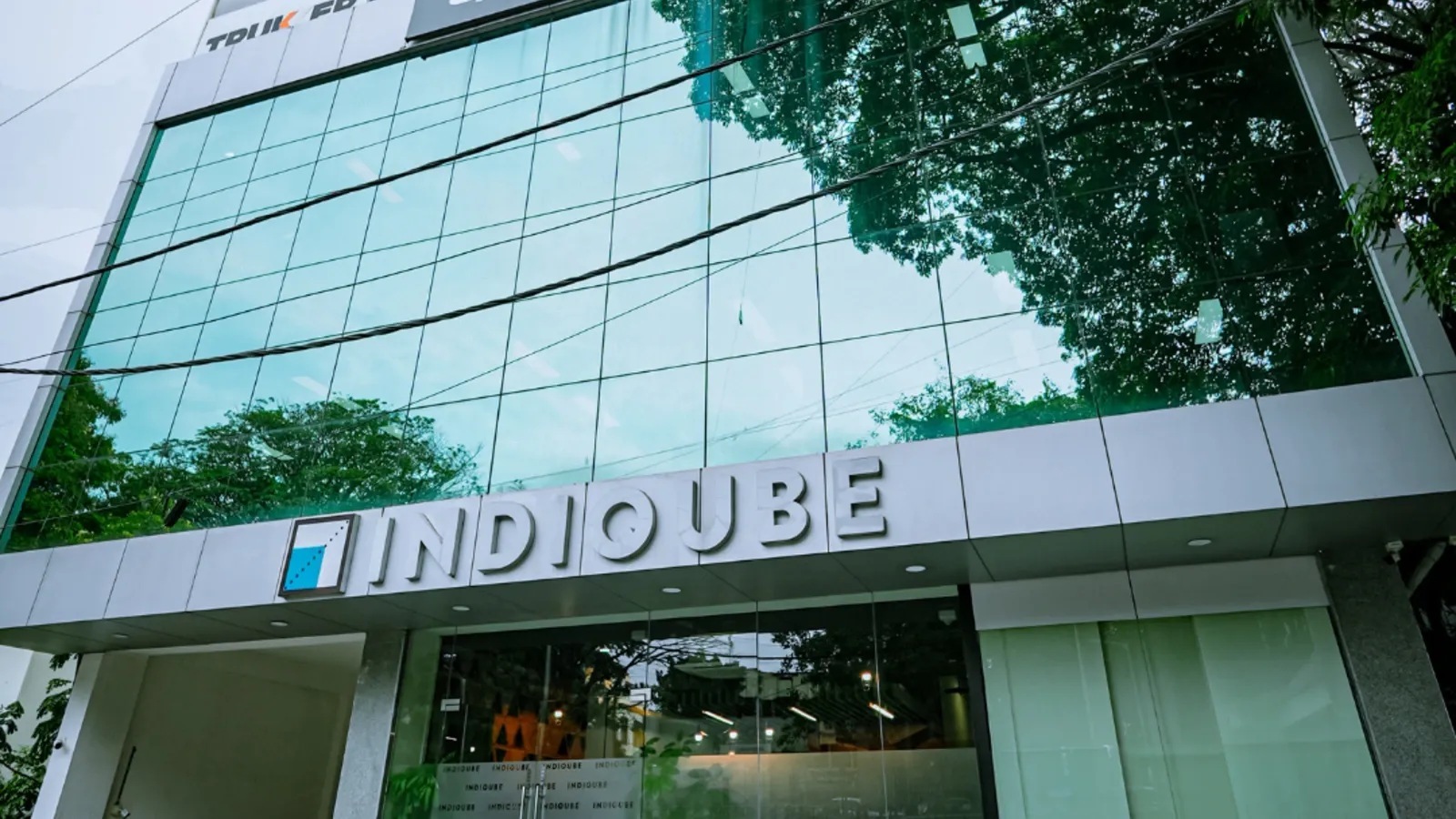
01 — At a Glance
The 105-Centre Empire That’s Still Figuring Out Profitability
- 52-Week High / Low₹244 / ₹135
- Q3 FY26 Revenue₹395 Cr
- Q3 FY26 PAT₹40 Cr
- 9M FY26 Revenue₹1,063 Cr
- 9M FY26 PAT₹95 Cr
- IPO Listing DateJuly 30, 2025
- IPO Raised₹604 Cr (Net)
- Debt / Equity8.67x
- ROE (Last Year)-234%
- AUM / Portfolio9.55 Mn Sq Ft
The Plot So Far: IndiQube just went public 8 months ago and posted record quarterly revenue of ₹395 crore in Q3 FY26. PAT “more than doubled” to ₹40 crore. Sounds like growth porn on a handout. Then you check the balance sheet and see ₹234% negative ROE, Debt/Equity of 8.67x, and ROCE of 4.76%. This is what happens when you list a capex machine pretending to be a business. The IPO raised ₹604 crore. Management has burned through capex like a college student with their parent’s credit card. We need to understand what’s actually happening here.
02 — Introduction
Welcome to the Workspace Wars. IndiQube Just Entered the Octagon.
Let’s level-set. IndiQube Spaces is not a new company — it was founded in 2015 as Innovent Spaces. They provide managed office spaces. Think of it as your corporate office, but you don’t own the building, don’t hire the security guy, don’t worry about the water cooler. You rent the keys, plug your laptop, and pretend you’re not working from your couch. The company grew aggressively through capex-fuelled expansion. By FY25 (March 2025), they operated 105 centres across 15 cities with 8.4 million square feet of managed workspace. Then they went to public via IPO in July 2025 and raised ₹604 crore.
Now, 9 months into FY26 (April 2025–December 2025), they’re posting record revenue — ₹1,063 crore in 9 months, up 37% YoY. Q3 revenue hit ₹395 crore, a quarterly record. PAT of ₹40 crore in Q3 is “more than double” YoY according to the press. The stock is down 38.5% from IPO. The company is burning cash on capex like it’s going out of style. Yet management’s tone on the concall is zen: “Scale-led growth, stable margins, everything is fine.”
This is a study in IPO euphoria meeting operational reality. The business model is elegant: lease buildings at a fixed long-term rate, subdivide them, rent to enterprises at premium rates, pocket the spread. But the financial statements read like a Shakespearean tragedy in progress. A ₹234% negative ROE. A Debt/Equity of 8.67x. And the auditors are sitting there with certified financial statements that technically say the company is profitable, while the balance sheet screams otherwise.
Let’s break down what’s actually happening.
Concall Clarity (Feb 2026): Management stated PAT “more than doubled” YoY in Q3, and 9M PAT is up 284% YoY. They also clarified that under Ind AS 116 accounting, lease liabilities on the balance sheet are “purely non-cash and notional in nature.” Translation: our GAAP numbers look awful because accounting rules force us to recognize future lease commitments as liabilities. But operationally, we’re fine. Investor confidence: not restored.
03 — Business Model: Rent It, Slice It, Sell It Pricy
The Workspace Arbitrage Machine (That Requires Infinite Capex)
IndiQube operates under four product verticals: IndiQube Grow (plug-and-play managed offices), IndiQube Bespoke (custom design-and-build), IndiQube One (value-added services), and IndiQube Cornerstone (property upgrades). But the real business? Lease buildings, subdivide them, rent to companies. 87.5% of revenue is workspace leasing. 12.5% is value-added services (VAS) — facility management, catering, transport, plantations, and asset maintenance.
The unit economics are straightforward: lock in a long-term lease from a landlord (typically 10–20 years), upgrade the property, and rent to enterprise clients at a premium. Client lock-in is 2–3 years with 5%+ annual escalation clauses. Management says occupancy is 84% (improving from 81% YoY), and mature centres (>12 months old) run at 85–90%. That sounds reasonable. But then you realise: they added 7.8 lakh sq ft in a single quarter, crushing occupancy temporarily. Growth-at-the-cost-of-metrics playbook, circa 2015–2020 Indian SaaS.
The signed portfolio (centres under letter of intent) is 3.26 million sq ft, expected to become operational over 18–24 months. That’s a capex commitment of probably ₹300–400 crore right there. Management guided for ₹462 crore of capex utilization from IPO proceeds alone. They’re now deploying capital faster than expected because real estate and fit-outs cost money, and they have money.
Geographically, 80% of the portfolio is in South India (Bangalore, Chennai, Pune, Hyderabad). Management calls this “not a concentration risk, but a strategic positioning.” That’s corporate speak for: “The talent is here, the GCC demand is here, and we’re too stubborn to diversify.” Fair enough — South India absorbed 80% of India’s commercial real estate demand in Q3. But concentration is concentration, no matter what name you give it.
Operational Centres105Cities: 15
AUM9.55MSq Ft
Portfolio Occupancy84%Q3 FY26
GCC Revenue Share56%Highest Concentration
Customer Mix Note: Management says “56% revenue comes from Global Capability Centres” (GCCs) even though only “40% of clients are GCCs.” This means one GCC client is worth almost 1.4x an average client. Top 5 clients are ~12% of revenue. The company explicitly avoids single-tenant buildings to manage concentration. Yet GCC concentration remains an unspoken risk — if a single GCC renegotiates terms or consolidates, you get a revenue cliff.
💬 Your company just went public. Your balance sheet has a D/E of 8.67x. You’re burning ₹180 crores of capex per half-year. Is this growth or financial engineering? Drop your thought!
04 — Financials Overview: The Story Behind The Headlines
Q3 FY26: Record Revenue. Profit? Also Up. But Wait…
Result type: Quarterly Results | Q3 FY26 PAT: ₹40 Cr | 9M FY26 Revenue: ₹1,063 Cr | 9M FY26 PAT: ₹95 Cr
| Metric (₹ Cr) |
Q3 FY26
Dec 2025 |
Q3 FY25
Dec 2024 |
Q2 FY26
Sep 2025 |
YoY % |
QoQ % |
| Revenue | 395 | 268 | 350 | +47.4% | +12.9% |
| Operating Profit | 237 | 158 | 208 | +50.0% | +13.9% |
| OPM % | 60% | 59% | 59% | +100 bps | +100 bps |
| Reported PAT (GAAP) | -17 | -14 | -30 | No Comp | +43% |
| Adjusted PAT* | 40 | 16 | 29 | +150% | +38% |
* Adjusted PAT excludes Ind AS 116 lease depreciation (RoU depreciation) & interest on lease liabilities. GAAP reported PAT is negative because Ind AS 116 forces recognition of non-cash lease obligations.
The Ind AS 116 Mess Explained: When India shifted to Ind AS (Indian Accounting Standards), companies had to recognize long-term operating lease commitments as Right-of-Use (RoU) assets and corresponding lease liabilities. For IndiQube, this means: they lease buildings for 10–20 years from landlords, but clients only lock in for 2–3 years. Under Ind AS, IndiQube must depreciate the 10–20 year RoU asset, creating a non-cash charge that wipes out reported PAT. But the actual lease commitment to the landlord is only 3.5 years or so (the lock-in period of their average client). This is why PAT looks negative (GAAP) but is positive (cash). Management pays actual income tax (~₹7.67 crore in FY25), proving cash profitability. The auditors signed off. Just a confusing mess for equity investors.
Let’s break down what’s real: Revenue is up 47% YoY, up 13% QoQ. Operating profit is up 50% YoY, and operating margins are stable at 59–60% — a healthy sign that the business isn’t just throwing bodies at scale. But reported PAT is -₹17 crore due to the Ind AS 116 accounting charge. If you adjust for the non-cash lease depreciation and interest (as management does), PAT is actually ₹40 crore, up 150% YoY. So yes, the business is profitable. No, the balance sheet doesn’t show it. Welcome to Indian accounting.
05 — Valuation Discussion: Fair Value Range Only
What’s This Workspace Empire Actually Worth? (Buckle Up)