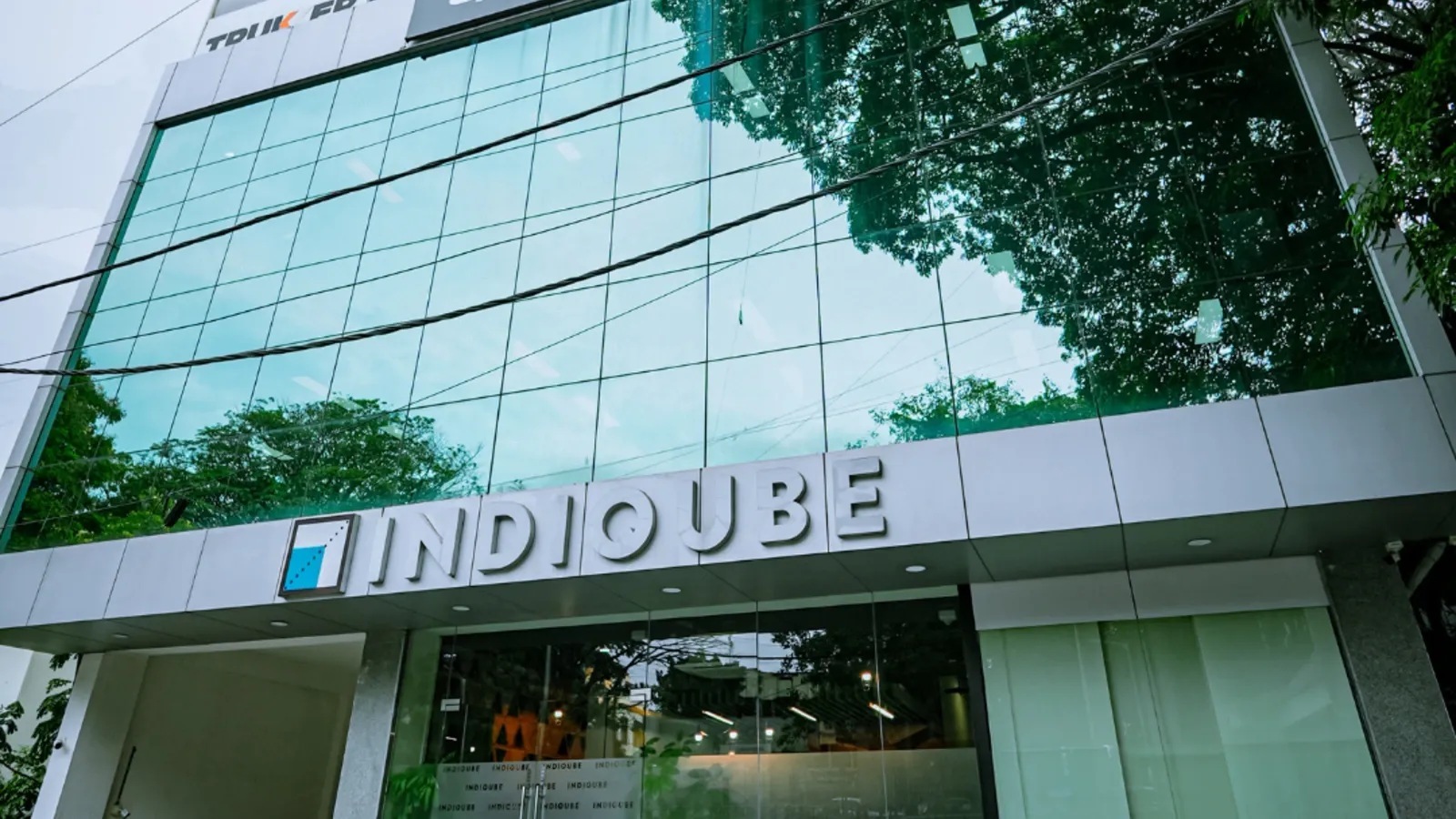
IndiQube Spaces Ltd Q2FY26 – ₹354 Cr in Sales, ₹28 Cr PAT, and 87% Occupancy: India’s Coworking Unicorn Learns to Pay Its Rent
1. At a Glance
If offices could talk, IndiQube would probably brag about how many seats it fills while conveniently ignoring its debt pile. As of Q2FY26, IndiQube Spaces Ltd reported ₹354 crore in revenue, ₹28 crore profit, and 87% occupancy across 9.14 million sq. ft. of managed space. That’s quite the empire for a company born in 2015 — one that started by subleasing space and now rents out “ecosystems for productivity” (also known as chairs and Wi-Fi).
With a market cap of ₹4,281 crore, stock price ₹204, and book value ₹26.2, the company trades at a price-to-book of 7.78x, which means investors are paying nearly eight times for every rupee of actual assets — the kind of premium usually reserved for brands that sell hope instead of balance sheets.
Debt stands at a wholesome ₹4,770 crore, making the debt-to-equity ratio 8.67, while ROE is a catastrophic -234%. Yet, the company’s EV/EBITDA at 13x shows the market believes in its future (or at least its marketing deck).
TL;DR: IndiQube has mastered the art of looking profitable at the EBITDA level and “innovative” at the PAT level.
2. Introduction – The New Age Real Estate Meets SaaS FOMO
When you can’t sell real estate, just rename it “workspace-as-a-service” — that’s IndiQube’s founding philosophy.
Born in 2015 out of Bengaluru’s start-up caffeine haze, IndiQube Spaces Ltd (IQSL) has reimagined traditional offices by offering “managed workspaces” — a fancy phrase for leasing out office buildings, sprucing them up with plants, and sprinkling buzzwords like “AI”, “sustainability”, and “MiQube tech platform”.
But here’s the kicker: IndiQube didn’t just rent spaces. It built a mini-ecosystem of office solutions — interiors, catering, facility management, tech-enabled door locks, even plantations (because oxygen is now a value-added service).
The company’s success formula?
Take a building that looks like a rejected mall.
Paint it, put in ergonomic chairs, and add an app.
Call it a “smart workspace experience”.
It’s a story of timing — in a post-pandemic India where hybrid work made everyone question cubicles, IndiQube became the bridge between chaos and corporate consistency. But while its revenue has grown 4.4x in 3 years, its balance sheet looks like it went through a real estate bender.
Still, who cares about numbers when your decks say “disrupting workspace ecosystems”?
3. Business Model – WTF Do They Even Do?
IndiQube isn’t your typical landlord. It’s the manager of dreams, desks, and debt.
Here’s the breakdown —
a) Workspace Leasing: They lease full buildings (the “Hubs”) or smaller satellite offices (the “Spokes”) in high-demand micro-markets. These are leased from landlords and then sub-leased to corporates — the old “rent and re-rent” game, but with coffee machines and branding.
b) Workspace Enhancement: Interiors, amenities, and sustainable features — think of this as the “Instagram filter” for old offices.
c) Value-Added Services (VAS): Facility management, catering, transport, plantations, and tech tools. Basically, if your office light bulb fails, IndiQube sends an app notification.
d) Backward Integration: They refurbish and upgrade old buildings (IndiQube Cornerstone), turning dusty properties into revenue machines.
e) Forward Integration: The “MiQube” platform — IoT-driven office management tech, because every Indian company now needs to sound like a SaaS play.
f) Verticals like Grow, Bespoke, and One:
Grow gives plug-and-play setups.
Bespoke offers custom-built offices.
One handles B2B/B2C services for clients.
In short: IndiQube leases real estate, upgrades it, fills it, manages it, and then sells it as an experience. Or, as their investor pitch might say — “India’s leading tech-enabled workspace platform with sustainable scalability and revenue visibility.”
4. Financials Overview
Metric
Latest Qtr (Sep’25)
YoY Qtr (Sep’24)
Prev Qtr (Jun’25)
YoY %
QoQ %
Revenue
₹350 Cr
₹252 Cr
₹309 Cr
38.8%
13.3%
EBITDA
₹208 Cr
₹145 Cr
₹188 Cr
43.4%
10.6%
PAT
₹-29.9 Cr
₹-53 Cr
₹-37 Cr
43.1%
19.2%
EPS (₹)
-1.42
-2.01
-1.76
—
—
Commentary: EBITDA is flexing at ₹208 crore with a 59% margin — strong enough to impress venture capitalists but not auditors. PAT is still negative, but the loss is narrowing. In short, IndiQube’s earnings are like your gym plan — improving, but still not fit.
5. Valuation Discussion – The Great Desk Discount
Let’s play valuation bingo.
P/E Method:
EPS (TTM) = -₹6.8 → P/E not meaningful.
EV/EBITDA:
EV = ₹8,560 Cr; EBITDA (FY25) = ₹617 Cr → EV/EBITDA = 13.8x If peers like NESCO trade around 23x and Smartworks around 12x, IndiQube sits in the midrange.
DCF (Simplified):
Assuming free cash flow of ₹400 Cr (FY25 ops ₹612 Cr minus reinvestments), with 10% WACC and 5% terminal growth → Fair Value Range ₹180–₹230
📜 Disclaimer: This fair value range is for educational purposes only and not investment advice.
6. What’s Cooking – News, Triggers, Drama
IPO Mania (July 2025): Fresh issue + OFS = ₹700 Cr raised. Net proceeds of ₹604.46 Cr — ₹462.65 Cr for new centers, ₹93.03 Cr for debt repayment, ₹48.77 Cr for general