01 — At a Glance
The South’s Favorite Milk Heist: Buying Butter in a Drought That Doesn’t Exist
- 52-Week High / Low₹542 / ₹294
- Q3 FY26 Revenue₹1,119 Cr
- Q3 FY26 PAT₹34.6 Cr
- TTM EPS₹17.71
- Book Value / Share₹112
- Price to Book2.75x
- ROCE25.3%
- Debt to Equity0.21x
- OPM (9M FY26)6.6%
- 3M Return-32.4%
Flash Summary: Heritage Foods Q3 FY26 delivered PAT of ₹34.6 crore, but here’s the thing—that was the result of a milk shortage so severe the company bought butter from external markets at inflated prices. Procurement volumes fell 9% YoY, the first decline in three years. Margins got squeezed like actual dairy cows. Yet somehow, CRISIL upgraded the company to AA-/Stable in March 2026, and the stock is down 32% in three months anyway. Welcome to South Indian dairy reality.
02 — Introduction
The Milk Cartel Nobody Talks About But Everyone Drinks
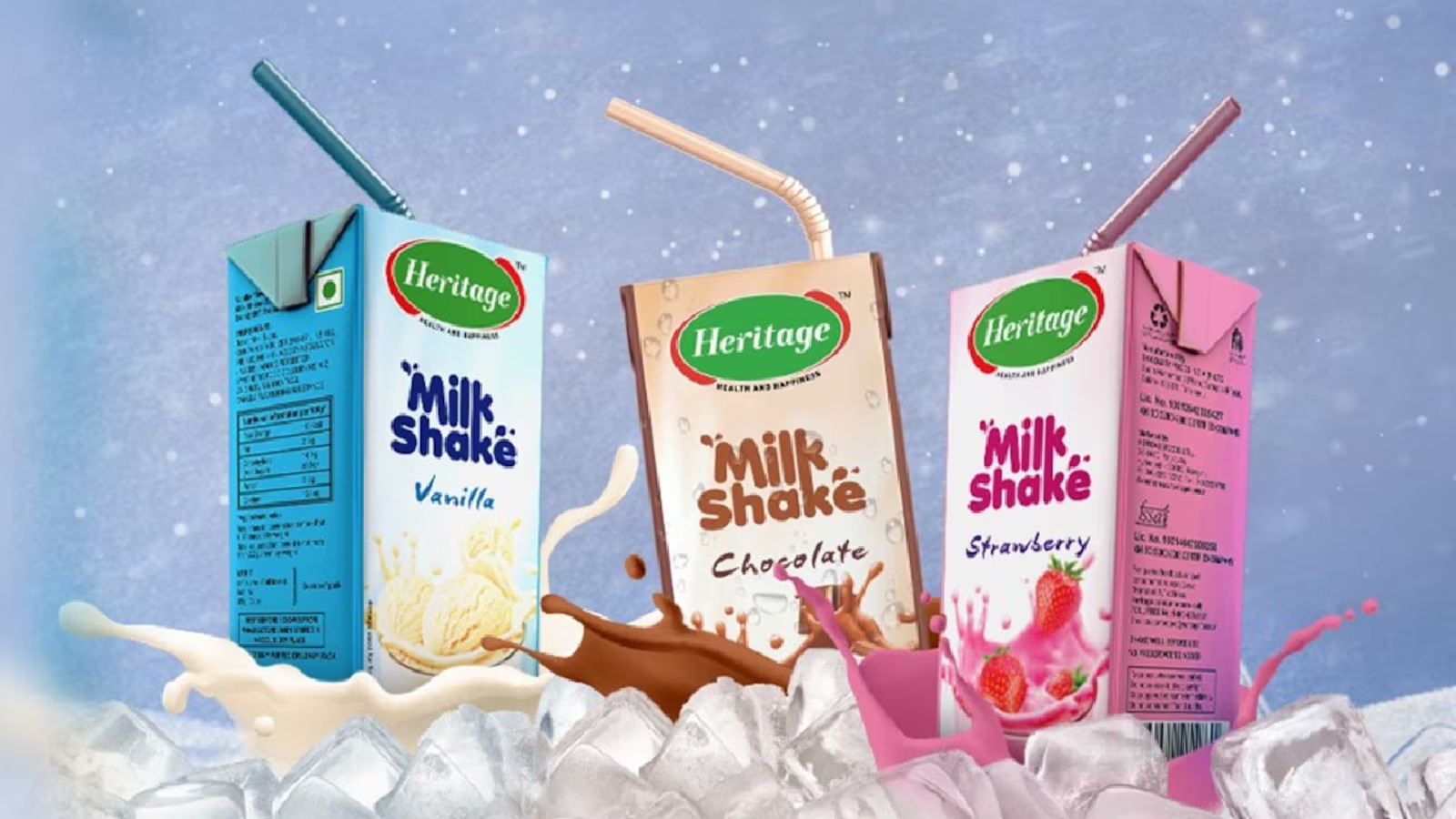
Heritage Foods is a Hyderabad-based dairy giant that quietly supplies milk, yogurt, ice cream, and paneer to 19 states across India. If you’ve ordered milk on Blinkit at 11 PM, there’s a decent chance it came from one of Heritage’s 18 processing plants scattered across South and West India. They procure milk from 9 states, run 859 Heritage Parlors (think Starbucks for milk people), and maintain a distribution network that touches 205,000 retail outlets daily. Not bad for a company most mainstream investors have never heard of.
The business model is deceptively simple: buy milk from farmers at variable rates, process it, add value through yogurt/paneer/ice cream, and sell it across India. The trouble? Milk prices are determined by farmers, the weather, global butter prices, and apparently the migration patterns of monsoon systems in Andhra Pradesh. Q3 FY26 was the quarter where all four variables conspired against you.
Management used the phrase “unusual industry supply environment” at least five times in the concall—which in English translates to “we got absolutely hammered by milk prices but are putting a brave face on it.” Milk procurement costs were up 9% YoY while the company could only raise consumer prices by 4.9% in liquid milk. The math doesn’t work, and it showed.
The Concall Bombshell: “For the first time in two years, even during flush [harvest season], the company had to do bulk butter purchases at elevated market prices in November.” This is like a vegetarian restaurant buying pre-cooked steaks. Heritage’s margin degradation wasn’t a choice—it was operational necessity dressed up as supply chain management.
03 — Business Model: WTF Do They Even Do?
They Turn Cows Into Rupees. And This Quarter, They Paid Extra for the Conversion.
Heritage Foods operates three parallel cash flows: dairy products (the main event), renewable energy (11.7 MW capacity, largely irrelevant), and animal feed via its subsidiary Heritage Nutrivet (which is basically buying cattier feed stocks and selling them to farmers). The dairy business is where the action is—and where the pain lives.
The core structure: 41.3% promoter stake (Nara family), 58.7% public and institutional float. They procure 17.2 LLPD (lakh liters per day) of raw milk, and after processing losses, sell about 11.5 LLPD of processed milk. The remainder gets processed into value-added products (VAPs)—curd, paneer, ghee, ice cream, buttermilk. VAPs were 38% of revenue in Q3 vs 33.8% last year. This “premiumization” sounds great until you realize it’s driven by necessity (margin compression forcing a pivot to higher-margin products) rather than demand luxury.
Their latest pivot: ice cream. A ₹220 crore greenfield plant was just commissioned in March 2026 (Shamirpet, Hyderabad) with 24 million liters annual capacity. They expect to scale ice cream revenues from current ₹110 crore to ₹500-600 crore in 6-7 years. That’s a 5x bet on a frozen dairy product in an increasingly competitive Indian market. The concall language was careful: “very profitable at EBITDA level, but new asset depreciation means at least a year or two for profitability to normalize.” Translation: it’ll destroy EPS for 24 months.
Fun fact from the concall: the company has “farmer-first philosophy” and provides “timely payments, feed support, engagement.” Farmers are the supply bottleneck, and Heritage treats them like venture capital investors—because essentially, they are. The better you pay farmers, the more milk they produce. Q3 proved what happens when you don’t: procurement volume goes into reverse.
04 — Financials Overview
Q3 FY26: The Numbers That Tell a Story of Margin Agony
Result type: Quarterly Results | Q3 FY26 EPS: ₹3.73 | Avg Q1–Q3 EPS: (₹4.37+₹5.50+₹3.73)/3 = ₹4.53 | Annualised EPS: ₹18.12
| Metric (₹ Cr) |
Q3 FY26
Dec 2025 |
Q3 FY25
Dec 2024 |
Q2 FY26
Sep 2025 |
YoY % |
QoQ % |
| Revenue | 1,119 | 1,034 | 1,113 | +8.24% | +0.54% |
| Operating Profit | 63 | 72 | 77 | -12.5% | -18.2% |
| OPM % | 6.0% | 7.0% | 7.0% | -100 bps | -100 bps |
| PAT | 34.6 | 43.0 | 51.0 | -19.6% | -32.2% |
| EPS (₹) | 3.73 | 4.64 | 5.50 | -19.6% | -32.2% |
Margin Squeeze Visualized: Procurement costs up 9% YoY (average ₹45.57/liter), but liquid milk pricing up only 4.9%. Result: gross margin on milk itself fell by about 12% quarter-on-quarter. This is what happens when you’re a price-taker on input (farmer decides milk price) and a price-giver on output (retailers and customers dictate shelf prices). The concall literally said “brought down the gross margin in milk itself by about 12%.” Management softly hoped for price normalization around May 2026—which is in the future, and therefore not today’s problem. Very convenient.
💬 When a company’s biggest cost input (raw milk) is set by monsoon rainfall and farmer sentiment, how do you even value it? Is Heritage doomed to margin oscillation forever, or is there structural change happening? Drop your take in the comments.
05 — Valuation: Fair Value Range
What Does a ₹2,872 Cr Dairy Company Actually Cost?
Method 1: P/E Based
TTM EPS = ₹17.71. Annualized Q1-Q3 EPS = ₹18.12. Dairy industry median P/E = 24.6x. But Heritage is suffering margin headwinds, so a 15-18% discount is justified. Fair P/E band: 20x–21x.
→ 20x × ₹18.12 = ₹362.4 21x × ₹18.12 = ₹381.5
Range: ₹362 – ₹382
Method 2: Price to Book Value
Book Value = ₹112. Current P/BV = 2.75x. For a 20% ROE dairy company with strong distribution, a 2.2x–2.6x P/BV range is reasonable, reflecting near-term margin pressure but long-term recovery potential.
→ 2.2x × ₹112 = ₹246.4 2.6x × ₹112 = ₹291.2
Range: ₹246 – ₹291
Method 3: EV/EBITDA (Forward Basis)
9M FY26 EBITDA ≈ ₹262cr (annualized ~₹349cr). Enterprise Value = Market Cap + Net Debt ≈ ₹2,872cr + ₹(-90cr) = ₹2,782cr. Current EV/EBITDA ≈ 8.0x. Dairy peers trade 9-11x. For a company with margin recovery momentum, 10-12x is fair on normalized earnings.
EV at 10-12x implies fair value range ₹350–₹420 per share.
Range: ₹350 – ₹420
Consolidated View: Across all three methods, fair value clustering around ₹350–₹380 emerges. At ₹309, Heritage is trading at a 10-15% discount to the lower end of reasonable valuations. The discount partly reflects real margin compression, but also structural disbelief that dairy margins will ever recover. The concall’s discussion of “farmer-first philosophy” and price pass-through suggests management believes margin recovery is coming. Execution risk remains high.
⚠️ EduInvesting Fair Value Range: ₹350 – ₹420. This fair value range is for educational purposes only and is not investment advice. Please consult a SEBI-registered investment advisor before making any financial decision.
06 — What’s Cooking: News, Triggers & Drama
Ice Cream Gamble, Rating Upgrades & The Defamation Suit Nobody Expected