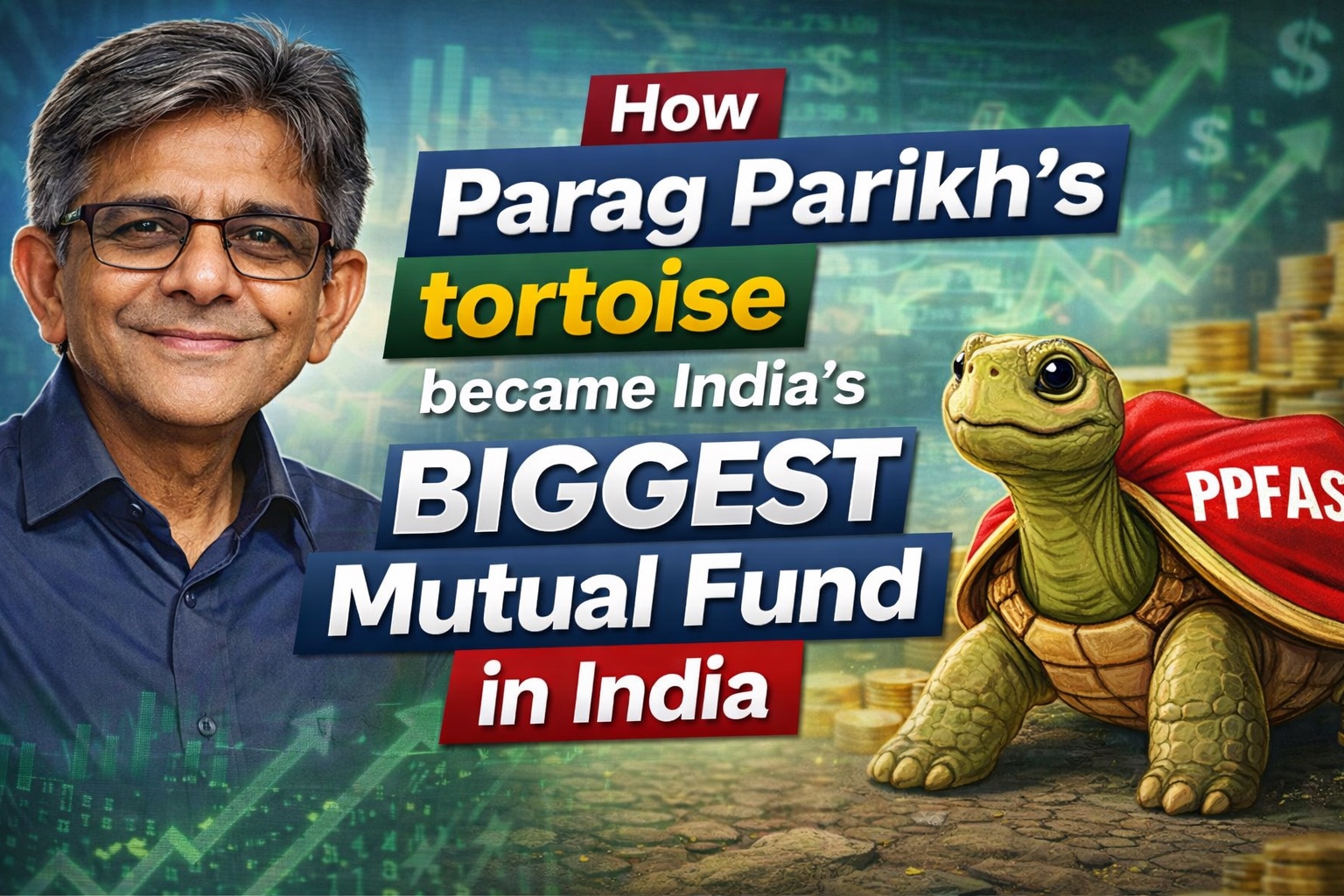
Parag Parikh — A man who believed in reading, research, and the slow accumulation of knowledge
The Parag Parikh Flexi Cap Fund became the first actively managed mutual fund scheme in India to cross ₹1 trillion in AUM in May 2025 — a vindication of every contrarian bet the founder ever made. This is the full story.
A broker’s card bought with a mother’s jewellery
A broker’s card bought with a mother’s jewellery
Parag Parikh was born on February 12, 1954, in Mumbai into a Gujarati family. Stricken with polio as a child, he overcame physical adversity to earn a Master’s degree in Commerce and Economics from the University of Bombay. He enrolled in an entrepreneurship management course — and later joked that his was the only project to fail in the class.
The pivotal turn came through Chandrakant Sampat, a legendary Indian value investor often called “India’s Warren Buffett” and a family friend. When Parikh’s early business ideas hit walls of bureaucratic red tape, Sampat offered a radical suggestion: the stock market was a way to participate in great businesses without dealing with raw material shortages and regulatory headaches. Parikh later said, “Whatever I am is because of him; he was my inspiration to enter the capital markets.”
In 1979, Parikh entered equity markets as a sub-broker on the Bombay Stock Exchange — an arena then dominated by insider tips and speculative trading. He brought something alien to that world: research and methodology. By 1983, he decided to buy his own BSE membership card, which cost lakhs of rupees. His wife Geeta and his mother sold their jewellery to fund the purchase. His mother asked for just one thing in return: a vacation every year if the business did well. Parikh kept that promise for the rest of his life.
After India’s economic liberalization in 1991 opened markets to foreign institutional investors, Parikh’s command of English and research-driven approach gave him a unique edge over local brokers who communicated primarily in Gujarati or Hindi. When Julian Robertson, founder of the legendary Tiger Management hedge fund, visited Mumbai to explore Indian opportunities after 1992, Parikh was the only broker invited for the meeting. PPFAS became one of the first Indian brokerages to establish a formal equity research desk and publish detailed research reports — a practice virtually unheard of in India’s “mom-and-pop” brokering culture.
Building an intellectual foundation
Building an intellectual foundation at Harvard and beyond
Parag Parikh Financial Advisory Services Limited was formally incorporated on December 12, 1992 (the 1983 date refers to when broking operations began with the BSE membership). From 1994 to 1996, Parikh attended a management program at Harvard Business School, deepening his intellectual framework. In 1996, PPFAS launched the Cognito Portfolio Management Scheme (PMS), one of India’s earliest SEBI-registered portfolio management services, applying value investing and behavioral finance principles to active money management.
The dot-com bubble of the late 1990s became Parikh’s defining contrarian moment. While euphoria swept Indian markets and technology stocks soared, he refused to participate. He urged clients to sell their tech holdings and instead buy old-economy stocks trading at single-digit price-to-earnings ratios with high dividend yields. Clients left in droves. He suffered — not because he invested in overvalued stocks, but because he wouldn’t. When the bubble burst, his conviction was vindicated.
This experience drove Parikh deeper into behavioral finance, the academic discipline studying how psychological biases distort investment decisions. He studied the work of Daniel Kahneman, Nassim Taleb, Charlie Munger, Richard Thaler, and Hersh Shefrin. By 2001, behavioral finance had become the intellectual backbone of PPFAS’s investment approach. In 2003, he became a Certified Financial Planner, further professionalizing his advisory credentials.
Parikh channeled his thinking into two books that became foundational texts for Indian retail investors. Stocks to Riches: Insights on Investor Behaviour (Tata McGraw-Hill, 2005/2006) dissected psychological traps — loss aversion, regret aversion, herd mentality, mental accounting — using real Indian market examples. Now in its sixth reprint, it remains a bestseller. His second book, Value Investing and Behavioral Finance: Insights into Indian Stock Market Realities (2009), written in the aftermath of the global financial crisis, earned praise from Hersh Shefrin himself, who wrote: “Parikh’s book will help you understand how vulnerable most investors are to psychological influences.” He also delivered a 14-lecture series on behavioral finance at the Goa Institute of Management.
The mutual fund journey
Why Parikh surrendered his broking licence to start a mutual fund
The transition from brokerage and PMS to mutual fund was driven by a deeply held conviction: that value investing should be accessible to ordinary Indians, not just the wealthy. When SEBI raised the minimum PMS investment threshold from ₹5 lakh to ₹25 lakh, Parikh’s core retail investor base was effectively cut off. A mutual fund — with no minimum investment requirement — was the answer.
The regulatory journey took years. PPFAS Asset Management Private Limited was incorporated on August 8, 2011. The trust company followed. On October 17, 2012, PPFAS Mutual Fund was registered with SEBI under registration code MF/069/12, becoming the 50th registered mutual fund in India and the only new registration that year. On May 24, 2013, the flagship scheme — PPFAS Long Term Value Fund — launched with a NAV of ₹10 per unit. Rajeev Thakkar, who had joined PPFAS in 2001, served as lead fund manager; Raunak Onkar, who joined as a research trainee in 2008, managed the overseas securities allocation.
On March 14, 2014, PPFAS surrendered its NSE broking membership entirely. SEBI regulations prohibited an AMC from routing more than 5% of aggregate trades through any single broker, including its own sponsor, making the broking business fundamentally incompatible with the new mutual fund structure. Parikh was burning bridges — by design.
The fund launched with several features that were radical by Indian mutual fund standards. It offered only a growth option — no dividend option — to force compounding. It imposed a 2% exit load for redemptions within one year, deliberately discouraging short-term investors. Most distinctively, it could allocate up to 35% of its corpus to international equities, making it one of the first Indian mutual funds to directly invest in overseas stocks rather than through expensive feeder fund structures.
Investment philosophy
A philosophy built on tortoises, cash, and global stocks
PPFAS’s investment philosophy was — and remains — unusual in nearly every dimension. The fund’s logo is a green tortoise, which Parikh chose deliberately: “Just as a turtle stands for longevity, we stand for the long term. A hard shell protects a turtle. Our hard shell is Rule No. 1 — Do not lose money.” He called his core principle the “Law of the Farm”: “You cannot sow something today and reap tomorrow. A seed has to go through different seasons before it turns into a fully grown tree.”
The international equity strategy was perhaps the most visionary element. As early as 2009, Parikh presented data showing US-listed stocks were “far more attractive than Indian ones” — Nestlé India traded at 45 times earnings while Nestlé’s parent ADR in the US traded at just 17. He argued that concentrating entirely in Indian markets exposed investors to country-specific risks (political turmoil, drought, policy shocks) and that India represented only 2-3% of global market capitalization. By investing directly in companies like Alphabet, Microsoft, Amazon, and Meta within a domestic equity fund structure, PPFAS offered Indian retail investors something no other fund house did. The international exposure proved protective during demonetization in 2016, the 2018 market selloff, and the COVID-19 crash.
Equally distinctive was PPFAS’s willingness to hold large cash positions when markets looked expensive. The fund’s stated philosophy declares: “We do not consider the possession of a comfortable bank balance a cardinal sin.” At various points, cash holdings reached 15-22% of the portfolio — an all-time high of nearly ₹14,000 crore by mid-2025. Most Indian fund managers, incentivized to be fully invested, would never accept the short-term underperformance that cash drag creates. PPFAS explicitly required both fund managers and investors to have what they called the “capacity to suffer.”
The “skin in the game” commitment was equally aggressive. Rajeev Thakkar invested more than ₹7 crore of personal money in the fund when AUM was just ₹664 crore — representing over 1% of the entire scheme. By January 2024, insiders held ₹392.73 crore in the Flexi Cap Fund alone. The fund’s website prominently states: “We have invested too!” Parikh famously claimed the PPFAS office had no computer terminals or TV screens for watching stock prices, saying: “Watching prices going up and down is just entertainment and totally unnecessary.”
In November 2014, PPFAS held the first-ever unit holders’ meeting in Indian mutual fund history — a Berkshire Hathaway-style gathering where the investment team explained decisions and fielded direct questions. This became an annual tradition and remains unique in the industry.
The tragedy
A death in Omaha and the test of a lifetime