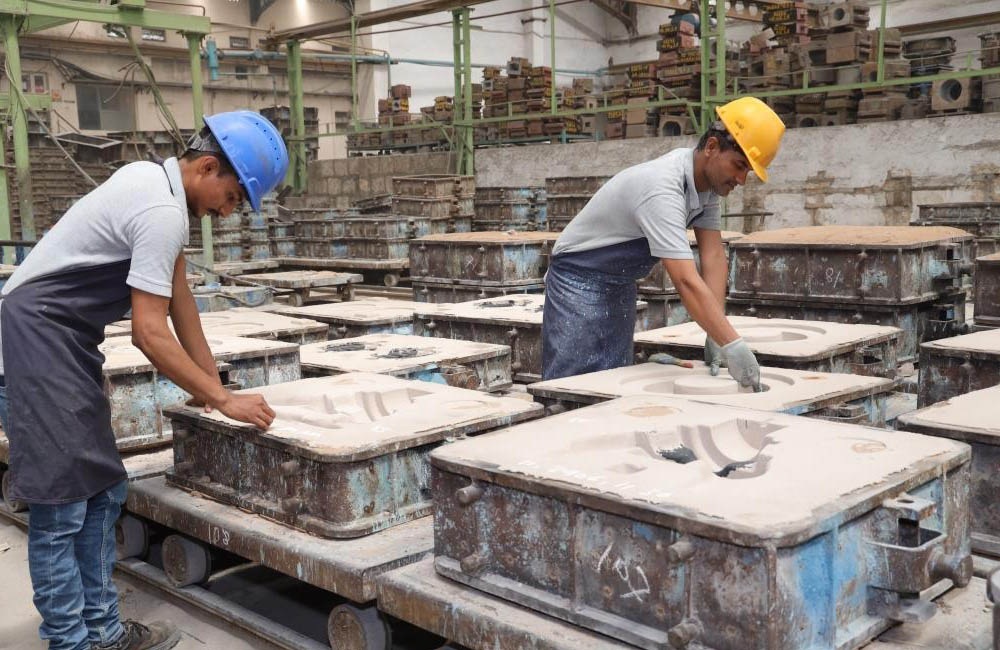
Gujarat Intrux Ltd is one of those classic “how did this even reach here?” BSE smallcaps. Market cap around ₹155 Cr, stock chilling near ₹451, dividend yield screaming 5.5%, and absolutely zero debt. In a market where companies borrow money just to announce they are thinking of borrowing more, Intrux is quietly paying dividends like a retired government officer.
Latest quarter (Dec 2025) numbers? Sales ₹20.45 Cr (+24% YoY), PAT ₹3.75 Cr (+38%), OPM 24%, EPS ₹10.92 for the quarter alone. Annualise that and you suddenly realise why the P/E of ~14x looks suspiciously cheap compared to industry average 22x.
This is not a flashy EV story, not AI, not defence hype. This is molten metal, sand casting, valves, pumps, earth-moving equipment and old-school foundry work — the kind that actually prints cash when cycles turn right. Question is: is this just a lucky quarter or a structurally improved business? Let’s put on the auditor’s helmet.
2. Introduction – From Scrap Trader to Cash Machine
Gujarat Intrux started life in 1992 dealing in copper and brass scrap. Yes, scrap. Then copper prices decided to behave like crypto, management panicked (or got smart), and the company pivoted into sand casting and investment casting. That pivot is the single most important event in its corporate life.
Fast forward to FY25–FY26, Intrux is manufacturing stainless steel, alloy steel and non-alloy steel castings used in valves, pumps and earth-moving equipment. Translation: boring products, essential demand, low drama customers.
Revenue is no longer random. Margins are no longer accidental. ROCE has climbed to 22%, ROE ~17%, and cash flows are finally behaving like cash flows and not accounting poetry.
But here’s the catch — this is still a ₹65–67 Cr annual revenue company. One bad customer, one raw material shock, one delayed export order, and numbers wobble. So while the recent performance is impressive, this is not a set-and-forget story. It’s a monitor closely with popcorn story.
Before we crown it a hidden gem, let’s understand what exactly they do.
3. Business Model – WTF Do They Even Do?
Imagine a giant furnace, molten metal, sand moulds, and a team that has been doing this since before LinkedIn existed.
Core operations:
Manufacturing steel and alloy steel sand castings
Single-piece weight capability up to ~2,200 kg
Associated investment casting facility with ~3,000 MT annual capacity
FY22 actual production: ~1,071 MT (so yes, capacity headroom exists)
End-use industries:
Valves (industrial fluids don’t care about startups)
This is classic B2B industrial manufacturing. No brand recall, no Instagram ads, no D2C nonsense. Orders come from OEMs who care only about quality, delivery, and price — not your logo redesign.
Exports contribute ~52% of revenue, which helps margins but also exposes the company to currency cycles and global industrial demand.
The business is simple: Get orders → melt metal → cast → ship → collect money → repeat.
The magic lies in execution discipline, cost control, and not doing stupid capex at the top of the cycle. So far, management seems to be behaving.
Now let’s look at numbers, because vibes don’t pay dividends — cash does.
4. Financials Overview – The Numbers Don’t Lie (Mostly)
Quarterly Comparison Table (₹ Crore)
Metric
Latest Qtr (Dec’25)
YoY Qtr (Dec’24)
Prev Qtr (Sep’25)
YoY %
QoQ %
Revenue
20.45
16.45
16.37
24.3%
24.9%
EBITDA
4.96
3.62
3.50
36.9%
41.7%
PAT
3.75
2.71
2.63
38.4%
42.6%
EPS (₹)
10.92
7.89
7.66
38.4%
42.6%
Commentary: Margins expanded, profits exploded, and EPS jumped like it drank Red Bull. This is not just revenue growth — this is operating leverage kicking in. Question to readers: Is this margin sustainable or peak-cycle sugar rush?
Annualised EPS (Q3 rule): Average of Q1, Q2, Q3 EPS