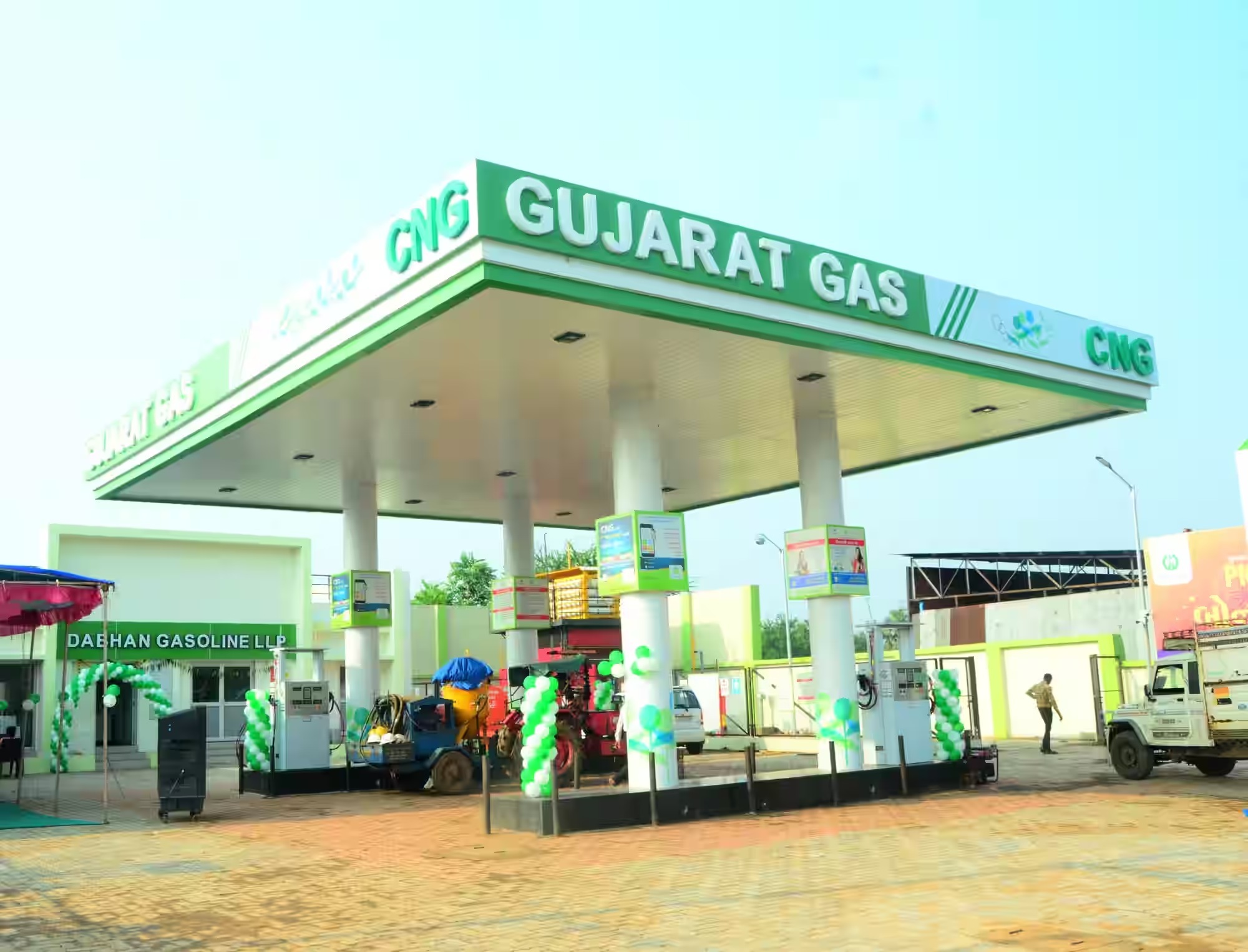
Gujarat Gas Ltd Q2FY26 – “3,979 Cr Revenue, 281 Cr PAT, and One Corporate Merger to Rule Them All!”
1. At a Glance
Imagine a PSU that sells gas faster than your scooter gulps it — that’s Gujarat Gas Ltd (GGL), India’s largest city gas distributor and the proud offspring of the Gujarat State Petroleum family. At ₹404 a share and a market cap of ₹27,808 crore, the stock smells like methane and monopoly power. The company clocked ₹3,979 crore revenue and ₹281 crore PAT in Q2FY26 — a small burp compared to Q1’s ₹328 crore, but hey, gas isn’t always steady. The OPM held around 12%, while the net margin simmered at 7%.
The stock’s P/E of 24.9x and ROE of 14.2% suggest a comfortable middle-aged PSU – not too risky, not too exciting, and with a dividend yield of 1.44% just enough to remind you it’s alive. Despite being nearly debt-free (₹150 crore debt, debt-to-equity 0.02), it still managed a -9% profit contraction YoY. But the real sizzle? A mega merger scheme with GSPC, GSPL, and others – promising to turn the Gujarat gas ecosystem into an integrated energy beast by FY26-end.
Will it become the Reliance of gas? Or another bureaucratic pipeline of paperwork? Let’s light it up.
2. Introduction
Welcome to the land where gas pipelines run smoother than government paperwork — Gujarat Gas Limited (GGL). Formerly GSPC Distribution Networks, now a full-grown PSU prodigy under Gujarat State Petronet Ltd (GSPL, 54% holding). The company is to natural gas what Amul is to milk in Gujarat — omnipresent, dependable, and quietly profitable.
GGL isn’t your flashy, volatile Adani Total Gas — it’s the old reliable distributor that quietly serves millions of homes, industries, and autos across Gujarat and beyond. From Ahmedabad’s CNG autos to factories in Dahej, from domestic kitchens to industrial furnaces, GGL’s gas is literally fueling half the state’s economy (and, indirectly, the patience of its citizens during winter).
In Q2FY26, GGL recorded revenue of ₹3,979 crore and PAT of ₹281 crore, down from ₹328 crore in Q1FY26 — a mild QoQ decline thanks to fluctuating industrial demand and natural gas prices. Yet, the company continues to post a solid ROCE of 19.5%, reminding everyone that boring businesses often make the most dependable profits.
The cherry on top? An ongoing mega merger with GSPC, GSPL, and others — imagine all of Gujarat’s state-owned gas babies fusing into one “Mega Energy Samrat.” If this scheme goes through by FY26, Gujarat Gas may soon control a unified supply-to-burner chain.
3. Business Model – WTF Do They Even Do?
Let’s break down Gujarat Gas’s business — because, honestly, most people only remember it when refilling their CNG tanks.
GGL operates in the City Gas Distribution (CGD) business — it buys natural gas (from domestic sources or imported LNG), compresses or pipes it, and sells it as CNG (for vehicles) or PNG (for homes, industries, and commercial setups).
The business splits roughly as follows (Q3FY24 data):
Industrial PNG – 60.5% of total volume (the real cash cow)
CNG – 30% (fuel for vehicles and autos)
Domestic PNG – 8% (your stove)
Commercial PNG – 1.5% (restaurants and malls)
It operates 817 CNG stations, 38,100+ km of pipelines, and services over 21 lakh domestic connections — all this across 6 states and 1 UT.
Think of GGL as a middleman between the giant gas producers (like ONGC, GSPC, and imported LNG terminals) and the final user. It buys gas at wholesale prices and distributes it through its massive pipeline network. The trick is in managing margins — when global LNG prices fall, OPMs soar; when they rise, margins squeeze like your stomach during an Adani Total Gas rally.
And now, with the government’s push for cleaner fuels, CNG/PNG adoption is expanding rapidly in Tier-2 and Tier-3 cities. That means more meters, more customers, and more excuses for GGL to keep those steady dividends rolling.
Commentary: The Q2 numbers look like a mild indigestion – small volume growth but pressure on margins. Revenue’s up slightly YoY, but PAT’s down due to higher input gas cost and lower industrial demand. Still, a 12% OPM in a regulated gas market isn’t bad — it’s like finding clean plates in a hostel mess.
5. Valuation Discussion – Fair Value Range (Educational Purpose Only)
Let’s crunch some gas-driven math.
a) P/E Method
EPS (TTM): ₹16.2
Industry P/E: ~19x
GGL trades at: 24.9x
So, fair P/E range = 19x–23x → Fair value range = ₹308 – ₹372/share
b) EV/EBITDA Method
EV = ₹27,598 Cr
EBITDA (TTM) = ₹1,797 Cr → EV/EBITDA = 15.3x Industry average ~13x
Fair EV = 13 × 1,797 = ₹23,361 Cr → Fair value ≈ ₹330/share
c) DCF (Simplified)
Assume FCF of ₹1,000 Cr, growth 5%, discount 10%. Fair value ≈ ₹21,000 Cr EV → ₹310–₹350/share equity value.
📘 Educational Fair Value Range: ₹310–₹370/share. Disclaimer: This range is purely for educational purposes and not investment advice. Please don’t mortgage your house based on this.
6. What’s Cooking – News, Triggers, Drama
Welcome to the Gujarat Gas soap opera. The Q2FY26 results came with multiple plotlines:
Mega Merger Saga: GGL shareholders approved a Composite Scheme of Amalgamation involving GSPC, GSPL, Gujarat Energy, and Gujarat Gas. The Ministry of Corporate Affairs (MCA) greenlighted the scheme in Sep 2025, and completion is expected by Q4FY26. Once done, Gujarat Gas becomes part of a vertically integrated energy empire — gas sourcing, transmission, and distribution under one roof. Basically, “Gas Avengers: Gujarat Edition.”
Leadership Shuffle: In November 2025, Pankaj Joshi (IAS Retd.) resigned as Chairman (due to superannuation), replaced by Manoj Kumar Das, a promoter-nominee. The bureaucratic baton has officially changed hands — new driver, same government vehicle.
Operational Highlights:
Contracted 0.50 mmscmd of domestic gas for 4 years.
Added 0.43 mmscmd of new industrial customers.
Rolled out Smart Meters at GIFT City, because even gas bills want to look futuristic.
Credit Rating Update: CARE reaffirmed AAA; Stable / A1+ for ₹2,900 crore. Translation: They’re so creditworthy they could borrow from themselves.
So, drama level = low; execution level = steady; merger potential = spicy.