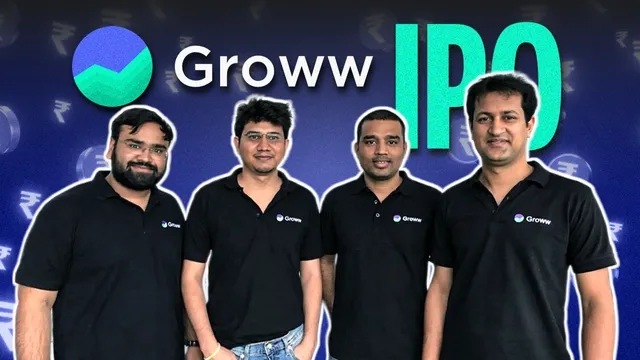
If Indian fintech were a Bollywood franchise, Groww just bought the multiplex. The Bengaluru-based app, run by the fab four — Lalit Keshre, Harsh Jain, Ishan Bansal and Neeraj Singh — is marching to Dalal Street with a ₹ 6,632 crore blockbuster IPO. That’s right — ₹ 1,060 crore fresh equity plus a ₹ 5,572 crore promoter exit buffet (Offer for Sale). Price band: ₹ 95–₹ 100 per share. Lot size: 150 shares. Minimum ticket: ₹ 15,000 — the cost of your annual mutual-fund regret.
The subscription window ran Nov 4 – Nov 7 2025, with allotment on Nov 10 and listing slated for Nov 12. The show opened with anchor investors pumping ₹ 2,984 crore on Nov 3. Result? A 6.35× overall subscription, with retail investors out-screaming even Virat Kohli fans (7.65×). Market cap at issue price: ₹ 61,735 crore. PAT for FY25: ₹ 1,824 crore. Post-issue P/E? 40× — because apparently, fintechs grow faster than logic.
2. Introduction
Remember when investing meant an HDFC agent dropping off a 47-page SIP form at your doorstep? Groww turned that ritual into a swipe-and-scroll experience. The company, legally known as Billionbrains Garage Ventures Ltd., is India’s digital investing playground — part brokerage, part wealth app, part social-media flex.
Founded in 2017 by four ex-Flipkart guys who clearly didn’t get enough stock options, Groww today claims to serve crores of young investors who think SIP is a gym supplement. The app lets you buy mutual funds, stocks, F&O, ETFs, digital gold, and even U.S. equities, all while showing confetti when your order executes.
Now they’re IPO-ing themselves — the ultimate meta moment: an investing platform asking you to invest in it. The Rs 6,600-crore offer is a mix of new capital (for cloud servers and marketing) and old shareholders cashing out (for Tesla shares, presumably). Behind the memes lies a serious business with 45% YoY revenue growth and 327% PAT surge in FY25.
But are we paying for a fintech rocket or a hot-air balloon? Let’s open the hood.
3. Business Model – WTF Do They Even Do?
Groww isn’t a bank, nor a mutual-fund house (well, it has one now), nor a crypto exchange (thank God). It’s a direct-to-consumer digital investment platform that makes money from:
Broking services: equity & derivatives trading via Groww Broking.
Mutual fund distribution: commission-based earnings.
Margin Trading Facility (MTF): lending against stocks, regulated through its NBFC subsidiary GCS.
Groww AMC: asset-management arm offering its own mutual-fund schemes.
Ancillary features: digital gold, U.S. stocks, algorithmic trading, NFO subscription, and credit products.
Translation: they earn a mix of brokerage fees, lending income, fund commissions, and subscription-style revenues.
As of June 2025, Groww had 1,415 employees — mostly engineers coding your buy orders and customer-support folks apologizing for your KYC selfies. Their mission? Make investing “as easy as ordering chai online.”
The moat? Brand loyalty and app addiction. Users rarely uninstall a platform that also tracks their losses.
4. Financials Overview
Source table
Metric
Latest Qtr ( Jun 25 )
YoY Qtr ( Jun 24 )
Prev Qtr ( Mar 25 )
YoY %
QoQ %
Revenue (₹ cr)
948.47
1,047.58
4,061.65 (FY total)
-9.4%
N/A
EBITDA (₹ cr)
418.75
482.66
2,371.01 (FY total)
-13.2%
N/A
PAT (₹ cr)
378.37
338.01
1,824.37 (FY total)
+11.9%
N/A
EPS (₹)
0.61 (≈ 2.45 annualised)
0.55
3.01 (FY 25 EPS)
+11%
N/A
P/E = 100 ÷ 2.45 ≈ 40.8× (Post-issue)
So yes, profits exist. Margins shine at 59% EBITDA and 45% PAT, which makes even cement companies blush. Still, fintech revenues can swing faster than Nifty Next 50.
5. Valuation Discussion – Fair Value Range Only
Let’s triangulate Groww’s worth using three classroom-friendly metrics:
EV/EBITDA ≈ 26× If peers (Zerodha’s shadow value ~22×) are a guide, fair range ~₹ 85 – ₹ 110.
(c) DCF Method (simplified) Assume 25% CAGR in free cash for 5 years, terminal growth 5%, discount rate 12%. → Implied fair range ₹ 90 – ₹ 115.
🧾 Educational Disclaimer: This fair-value range (₹ 85 – ₹ 115) is purely illustrative and not investment advice. Do your own homework — or better, use Groww itself to compare with mutual funds ironically