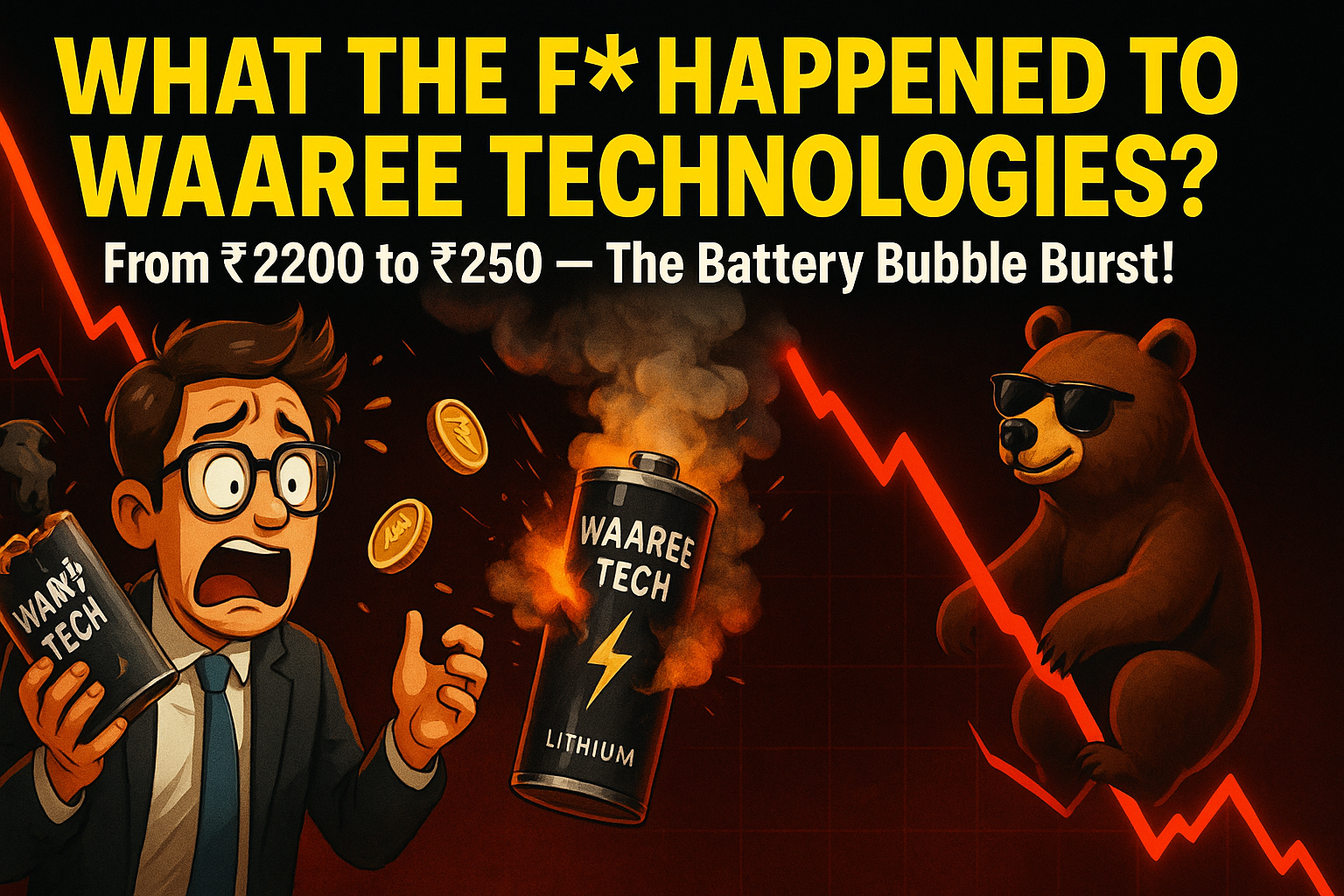
What the Fuck Happened with Waaree Technologies Stock, and What Does It Teach Us?
1. The Wild Ride of Waaree Tech: Battery Maker or Hype Machine?
Waaree Technologies Ltd (BSE: 539337) has given investors a story crazier than a Bollywood plot. This tiny lithium-battery company’s stock went from obscurity to a 4,185% gain in 3 years – turning a ₹10k punt in Jan 2021 into ₹4.28 lakh by Jan 2024. Then karma struck: from an all-time high of ₹2,209 in April 2024, it imploded ~78% by year-end 2024, and has kept falling to about ₹250 now. In short, it skyrocketed like a lithium-ion cell on overcharge and then crashed harder than a phone battery in Arctic winter. This 15-point autopsy will dissect what the hell happened – with a dose of humor, of course.
2. From H.K. Trade to Li-ion: Understanding the Business Model
Once upon a time, Waaree Technologies was known as H.K. Trade International – a nondescript trading firm founded in 1993. In January 2019, it rebranded to ride the green energy wave. Today, it claims to manufacture and trade lithium-ion batteries and related products: think battery packs for e-bikes, e-rickshaws, forklifts, telecom UPS systems, and other EV applications. Essentially, they’re in the “battery business” – assembling cells into packs and trading battery components. It sounds promising (batteries are the new oil, right?), but keep in mind this is a small-cap player, not a Tesla Gigafactory. Scale is modest and competition is fierce. The Waaree group (famed for solar panels under unlisted parent Waaree Energies) presumably injected this battery division into the listed shell in 2019, hoping to create a specialized energy storage arm. The ambitious storyline: become a leading domestic battery supplier riding India’s EV revolution. The reality: so far, more sizzle than sausage.
3. Rocket-Fueled Rally: 4,100% in Three Years 🚀
If you enjoy roller coasters, Waaree Tech’s stock chart was a dream. From just ₹20.4 in early 2021, it zoomed to ~₹874 by Jan 2024. That’s a 41x return – enough to mint multi-baggers galore. Month after month, it kept climbing: 54% up in Dec 2023 alone, then another 21% in just the first days of Jan 2024. In fact, the stock hit a then-record high of ₹874 on Jan 4, 2024. It rarely took breathers – nine out of twelve months in 2023 had positive returns, six of those with double-digit gains. The media hailed it as a multibagger; after all, in one year it was up ~429%. Drivers for this euphoria? Well, beyond a sexy story (lithium batteries! EVs!), there was some growth: the company’s Sep 2023 quarter income jumped ~80% YoY to ₹13.7 crore (versus ₹7.6 cr a year ago). Of course, it still made a ₹2 crore loss that quarter – but who cares about profits when you’re selling the future, right? Sarcasm aside, investors were clearly high on optimism. The tiny float (more on that later) and relentless demand sent the price vertical. It was as if every trader on Dalal Street suddenly believed Waaree Tech would morph into an EV battery behemoth overnight. Spoiler: it didn’t.
4. Overdrive to All-Time High: +401% in 5 Months
Just when you’d think the rally had peaked, Waaree Tech found a higher gear. From ₹441 in Nov 2023, the stock went parabolic to ₹2,209 by April 19, 2024 – a 401% jump in five months. That April, it hit its all-time high of ₹2,209.40. The frenzy was unreal: hitting upper circuit after circuit like it was some meme stock on steroids. At that peak, the company’s market cap was ~₹2,380 crore – for a firm with annual sales under ₹30 crore! Valuation gravity had clearly left the chat. Possibly contributing to this final blow-off: news and speculation around the Waaree group’s solar business IPO and expansion plans were swirling, and many punters conflated anything “Waaree”-branded as the next big green energy play. (One Moneycontrol interview about Waaree Energies raising ₹2,000 crore IPO even caused confusion – folks mistook it as if Waaree Tech would benefit, prompting clarifications by another Waaree entity.) In essence, greed was fully in charge. Latecomers piled in at absurd prices, afraid to miss the “next Tesla of India” – never mind that Waaree Tech’s actual battery business was minuscule. As any physicist (or market veteran) will tell you: what goes up that fast eventually comes down hard. And oh boy, it did.
5. Icarus Moment: The Crash and Burn
After April 2024, reality bit with a vengeance. The stock, having flown too close to the sun, plunged into a nosedive. By Dec 2024 it was locked in 5% lower circuits for days, sliding to ₹482 – its then 52-week low. In just 8 months from the peak, 78% of the market cap evaporated. Talk about a hangover! And the pain didn’t stop there. Through 2025, Waaree Tech drifted further down; as of now (Nov 2025) it scrapes around **₹243-250 – nearly 90% below the peak. Essentially, if you bought near ₹2200, you’ve lost so much money that even your grandkids would feel it. The crash was accelerated by low liquidity and panic selling – with such a small float, once sentiment flipped, there were few buyers to absorb the stampede of sellers. The stock even got moved to the BSE’s “MT” trade-to-trade segment (gross settlement) to curb speculative churn, meaning you couldn’t even day-trade out easily. Add a dash of margin calls and you get a cascading collapse. In two weeks of Dec 2024 alone, it slid 36%. For many investors, this was a classic round-trip from euphoria to despair. The ones who actually made money were those who sold on the way up; everyone else was left holding a very expensive bag. As the saying goes, “Markets take the stairs up and the elevator (or maybe free-fall ride) down.” Waaree Tech’s elevator cable snapped.
6. Who’s Holding the Battery? – Promoters and Shareholders
Let’s peek at the ownership. Promoters (the Doshi family) consistently held about 58.8% stake throughout this saga. Notably, they did not pledge or significantly sell shares during the hype – no signs of the founders dumping at the top (either commendable conviction or a missed opportunity to cash out, depending on your perspective). The remaining ~41.2% is public shareholding, almost entirely retail investors. There were virtually no institutional investors – no mutual funds, no banks, no big FIIs. It was a pure retail party, which explains a lot about the volatility. When a stock’s free-float (~42% of ~1.08 crore shares) is in the hands of thousands of individuals trading on emotion, you get fireworks both ways. During the peak, enthusiasm fed on itself (no sober institutional anchor to yell “calm down, folks”). And during the crash, there was no bottom-fisher with deep pockets stepping in – just terrified smallholders stampeding for the exit. One interesting tidbit: promoters’ shares were under lock-in until April 2025, a legacy of SME listing rules. That means they literally couldn’t sell a chunk of their holding until after the stock had already cratered. Tough luck for them – on paper their net worth soared into the hundreds of crores at the peak, only to shrink back as they watched helplessly. Summing up, Waaree Tech’s shareholder base was the perfect recipe for a momentum boom and bust: high insider ownership, low float, no smart money – just momentum-chasing retail. The last ones in got toasted.
7. Financials: Big Dreams, Bigger Losses (By the Numbers)
Time to pop the hood on the financial engine (or perhaps clown car) powering Waaree Tech. The revenue and profit figures reveal a company still finding its footing:
Financial Snapshot (Standalone) – ₹ in crore (Year ending March)
Fiscal Year (FY)
Revenue from Operations
Net Profit (Loss) After Tax
FY2019-20 (FY20)
0.00
(₹0.24) cr (loss)
FY2020-21 (FY21)
0.00
(₹0.24) cr (loss)
FY2021-22 (FY22)
13.13
₹0.18 cr profit
FY2022-23 (FY23)
29.40
(₹1.1) cr loss (est.)
FY2023-24 (FY24)
28.55
(₹7.50) cr loss
FY2024-25 (FY25)
10.24
(₹5.65) cr loss
(Note: Figures in ₹ crore. FY20-21 had negligible operations pre battery-business; FY23 PAT estimated from PBT –₹1.48 cr and deferred tax credit.)
As shown, sales exploded in FY22 after the Waaree group’s battery business kick-started – from virtually zero to ₹13.13 crore. FY23 saw further growth to ₹29.4 crore (a 2.2× jump) as the company ramped up trading/assembly of batteries. So far, so good… except notice the profit line: FY22 managed a token ₹0.18 cr profit, but FY23 slipped to a ₹1+ cr loss. Then came FY24: revenue stagnated at ₹28.5 cr (slightly down), and losses ballooned to ₹7.5 cr. That’s a -26% net margin – basically, for every ₹100 of battery they sold, they burned ₹26. Ouch. And FY25 delivered the coup de grâce: revenue collapsed 64% to ₹10.24 cr (management practically switched off the business) but still logged a ₹5.65 cr loss. Yes, they shrank operations drastically yet couldn’t even break even – net margin was around -54%. In summary, Waaree Tech’s financial performance peaked in FY23 and then did a U-turn. The top line went off a cliff in FY25, and profitability was never really there to begin with. This disconnect – soaring stock vs struggling P&L – is at the heart of “WTF happened.” Investors were pricing in a far rosier future than these numbers ever justified.
8. Growth Without Profit: When More Sales = More Loss
An ironic twist in Waaree Tech’s tale: at one point its revenue was growing fast, but profits were plunging. Case in point – the Sep 2023 quarter that excited everyone: sales jumped ~80%, yet the company swung from a small ₹0.15 cr profit to a ₹2 cr loss YoY. In other words, the more batteries they sold, the more money they lost! This suggests operational inefficiencies or poor pricing – perhaps they slashed margins to win business, or costs (materials, manufacturing, R&D) ballooned beyond control. The lithium battery industry is no goldmine for tiny players; cells are often imported, competition is intense, and technology changes rapidly (today’s cutting-edge cell is tomorrow’s obsolete junk). Waaree Tech’s experience reflects that. Its gross margins likely got squeezed badly in FY23-FY24 as input costs rose or they had to discount to compete. Meanwhile, fixed costs like employee expenses and depreciation on whatever production setup they have were eating into the meager gross profit. By FY24, every ₹1 of revenue came with ₹1.35 of expenses (₹38.8 cr expenses on ₹28.9 cr revenue). That’s a recipe for red ink. The company acknowledged as much in its annual report: operating in a price-sensitive market with rapidly evolving tech is “challenging,” and one must constantly update tech and materials. Translation: “We’re in a tough business and might be outgunned by bigger or cheaper players.” No surprise, profits went kaput. The lesson here is simple – revenue growth is only good if it eventually leads to profits. Waaree’s hype train was running on the fumes of top-line growth, but under the hood the engine was leaking oil like crazy. Once that growth stalled in FY25, there was nothing left to justify optimism – just hefty losses and shrinking sales. It was as if the company hit an air pocket: instead of scaling up to profitability, it scaled up and then scaled right back down to survive.
9. Balance Sheet: Borrowed Juice and a Low Battery Warning
How financially healthy (or sick) is Waaree Tech? The FY25 balance sheet paints a worrisome picture. The company’s net worth has turned negative – shareholders’ funds were –₹1.91 crore as of Mar 31, 2025. Yes, negative. The accumulated losses have wiped out the equity. This is the corporate equivalent of an overdrawn bank account. On top of that, Waaree Tech is relying on short-term borrowings to keep the lights on. Short-term debt stood at ₹17.66 crore (mostly loans, presumably to fund working capital since they have to buy battery cells/inventory upfront). Against this, cash and bank balances were a measly ₹1.96 crore. So debt far exceeds cash; the current ratio is likely sub-1, indicating possible liquidity strains. The company claims to be a going concern, but effectively it’s dependent on either the promoter group or friendly financiers to roll over that debt. Notably, interest costs are surprisingly low – only ₹0.09 cr finance cost in FY25 – suggesting these loans might be from promoters or an associate at concessional (or zero) interest, acting as quasi-equity. If so, good on them for support, but it’s not a sustainable structure long-term. Total liabilities (~₹21.24 cr) exceed total assets (~₹19.50 cr). Most assets are current (inventory ₹3.12 cr, receivables practically nil, loans & advances ₹5.16 cr – possibly advances to suppliers? – and cash ₹1.96 cr). They do have some deferred tax asset (₹4.72 cr) parked from accumulated losses, but that’s only valuable if they turn profitable eventually. The takeaway: Waaree Tech’s balance sheet is weak and “running on low charge.” Negative net worth and dependence on short-term funding mean any further stress could tip it over. It’s a stark contrast to the multi-crore market cap extravaganza we saw at the peak. Essentially, the stock market was valuing this company like a Ferrari while its balance sheet was more Pinto. If the promoters hadn’t been holding the jumper cables (loans) ready, this battery might have gone flat already.
10. Management’s Battery Dreams vs Hard Reality
What does the company’s management have to say for themselves? In the latest annual report (FY24), they sounded cautiously optimistic. They pointed to the huge opportunity in EVs and energy storage: “The EV push by the government and C&I/Grid scale storage will provide good business opportunities to the company.” They also noted they had acquired a battery business and were bullish on achieving “considerable business in future.” In plain English, management is saying: “We have the right tailwinds; demand is coming, so fingers crossed!” However, in the very next breath, they concede some sobering realities. They admit the market is highly competitive and price-sensitive, and it’s challenging to firmly establish our footing. They worry about adverse policy changes, tech obsolescence (“obsolescence has become the order of the day”), and the need to constantly upgrade technology and products. That’s a lot of ways to say: “We’re in a tough fight and we might get our butts kicked if we’re not careful.” This mix of bullish vision and candid risk acknowledgment is interesting. It basically mirrors the stock story: big dreams tempered by harsh reality. Management’s strategy seems to hinge on the EV revolution eventually lifting all boats – including their tiny dinghy. They aren’t wrong that the macro trend (EV adoption, battery storage) is favorable. But can Waaree Tech capitalize on it before it runs out of cash? So far, execution has lagged aspiration. The lack of any proprietary tech or IP is glaring – they’re essentially assembling/trading in a space where giants play. To their credit, the company hasn’t tried to mislead investors with false bravado; their AR openly lists the challenges and “normal industry risk factors.” No wild promises of turning unicorn overnight. Yet, the stock market, in its manic phase, clearly ignored the fine print. The management might have been thinking 5-10 years ahead in a best-case scenario, but traders were acting like the gold rush was here and now. In short, Waaree Tech’s leadership knows the score – opportunity is knocking, but so are many competitors – and the journey will be uphill. Unfortunately, Mr. Market in 2023 priced the stock as if victory was assured. Oops.
11. Valuation: From Outrageous to Merely Absurd
During the peak bubble, Waaree Tech’s valuations defied all logic (and gravity). Consider this: at ₹2,200+ per share, it traded at Price-to-Sales