01 — At a Glance
The Lab Diamond Company That’s Building Stores Like It Owns Money
- 52-Week High / Low₹444 / ₹251
- TTM Revenue₹941 Mn
- TTM PAT₹157 Mn
- Full-Year EPS₹14.15
- Q3 FY26 EPS₹6.06
- Book Value₹90.5
- Price to Book3.22x
- Dividend Yield1.03%
- Debt / Equity0.02x
- QIP Raised Aug 2025₹202 Cr
Auditor’s Note: Goldiam closed Q3 FY26 with ₹3,200 Mn quarterly revenue (+18% YoY), ₹684 Mn profit (+37% YoY), and an order book of ₹1,800 Mn. Lab-grown diamonds account for 90.5% of export sales. The company just raised ₹202 crore via QIP at ₹330/share, and stock trades at ₹291. The stock is down 30% in a year. Hedge funds and retail investors are truly the two sides of the same confused coin.
02 — Introduction
Turns Out, Lab Diamonds Are Booming Everywhere Except In Your Portfolio
Goldiam International is a company that took the world’s largest luxury-spending obsession — diamonds — and said, “What if we just… grew them in a lab?” And the beauty is, nobody can tell the difference anymore, except that one costs ₹8,000–10,000 per carat and the other costs three times that.
Founded in 1986, Goldiam manufactures lab-grown diamond (LGD) jewelry and ships it globally, with 95% revenue from the USA. They’re not trying to be Tiffany. They’re the B2B supplier who keeps Tiffany stocked, who supplies American department stores, and who now controls a growing slice of the US diamond wedding market.
Q3 FY26 numbers are crisp: ₹3,200 Mn revenue, ₹908 Mn EBITDA, ₹684 Mn PAT. That’s +37% YoY profit growth on top of prior quarter blows. Management came on the concall and basically said, “US holiday demand crushed it again, tariffs are not killing us (we cast in the USA now), LGD prices have stabilized, and we just signed ₹800 crore in new orders for the next few months.” The stock responds by falling 4.82% that day. Classic.
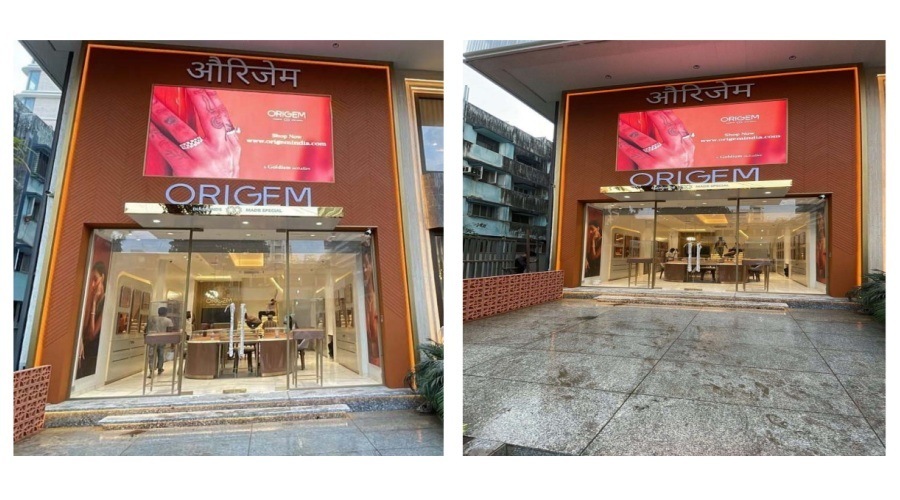
They’ve also launched their first B2C retail venture, ORIGEM, with 19 stores open and another 20+ coming. The stores are losing money on purpose (₹2.5 crore operating loss Q3), but management swears they’ll be profitable at scale. In India, they’re targeting ₹40 Mn monthly revenue per mature store by 2028. In the US, they’re selling ₹1,800 Mn of inventory on consignment across major retailers. Meanwhile, Titan just launched “beYon” to compete in the lab diamond space. Buckle up.
Feb 2026 Concall Gold: Management disclosed wallet share with their largest US client remains “slightly below 2%” — meaning a ton of headroom for growth without needing new logos. They also casually mentioned that major US retailers are consolidating to the “largest 10–15 players” post-COVID, and Goldiam is one of the chosen few. Not bad for a 38-year-old jewelry maker from Gujarat.
03 — Business Model: WTF Do They Even Do?
They Grow Diamonds in a Box. Then They Make Rings. Then They Sell to America.
Lab-grown diamonds are real diamonds. They’re carbon. They’re formed through HPHT (high-pressure, high-temperature) or CVD (chemical vapor deposition) processes. They’re chemically identical to mined diamonds. The only difference: they cost a fraction as much to produce, and for some reason, Western consumers still believe they’re somehow “less authentic” — because scarcity messaging works, and De Beers did their job 80 years ago.
Goldiam’s model is fully backward-integrated. They grow LGD diamonds at their facilities (the company owns cut-and-polish capacity). Then they design rings, earrings, pendants, bridal sets. They source gold and settings. They finish the jewelry. Then they either (a) sell finished jewelry to US retailers on consignment or outright, or (b) ship pieces to international wholesalers. About 80% goes to major retailers; 20% to smaller wholesalers.
The magic is in speed and customization. A US retailer can ask for a 1.5 carat VS quality, 9KT gold, six-prong solitaire — and Goldiam can deliver within 5–10 days. Traditional mined diamond supply chains take 8–10 weeks. That speed advantage drives wallet share at major retailers, especially for bridal and engagement rings. Management calls this the “consignment + capital support” moat: Goldiam consigns finished jewelry and provides working capital to retailers so they can stock collections risk-free. If pieces sell, they reorder. If they don’t, Goldiam takes them back.
Q3 highlights from concall: Management disclosed that 90.5% of Q3 export sales are LGD (up from 80% in prior year Q3) — a dramatic mix shift. Online sales hit 31.6% of revenue. Piece volumes grew 7–8% YoY, but revenue growth of 18% means ASP (average selling price) is expanding due to higher-caratage bridal mix. Translation: customers are buying bigger rocks, and Goldiam is selling more expensive jewelry.
LGD Mix Export90.5%Q3 FY26 vs 80% Q3 FY25
Online Revenue31.6%Emerging Channel
US Market Exposure95%Revenue Concentration
Backward Integration Note: Goldiam owns LGD growing, cutting, polishing, jewelry design, manufacturing, and distribution. This is rare in global jewelry supply. Most competitors either grow diamonds or make jewelry. Goldiam does both. The captive advantage: faster turnaround, tighter cost control, ability to customize designs for individual retailers. This is why they can sell at scale to Tiffany and other major US brands.
💬 Would you buy a lab-grown diamond engagement ring if it costs 60% less than mined? Or is the “mined” story still too strong in your head?
04 — Financials Overview
Q3 FY26: Numbers That Should Make Stock Go Up (But Won’t)
Result type: Quarterly Results | Q3 FY26 EPS: ₹6.06 | Annualised EPS (Q3×4): ₹24.24 | TTM EPS: ₹14.15
| Metric (₹ Mn) |
Q3 FY26
Dec 2025 |
Q3 FY25
Dec 2024 |
Q2 FY26
Sep 2025 |
YoY % |
QoQ % |
| Revenue | 3,200 | 2,803 | 1,929 | +14.1% | +65.9% |
| EBITDA | 908 | 708 | 397 | +28.2% | +128.7% |
| EBITDA Margin % | 28.4% | 25.2% | 20.6% | +320 bps | +780 bps |
| PAT | 684 | 499 | 315 | +37.1% | +117.1% |
| EPS (₹) | 6.06 | 4.42 | 2.78 | +37.1% | +117.8% |
The Good, The Better, The Best: Revenue up 14% YoY looks modest until you realize Q3 is always the biggest quarter (US holiday demand). QoQ growth of 66% shows sequential acceleration. PAT up 37% YoY is the headline that should drive valuations, but instead drove a -4.82% stock reaction that day. EBITDA margins expanded 320 basis points YoY to 28.4%. Management attributed margin expansion to (1) USD/INR depreciation benefit (they earn in USD, expense in INR), (2) investment income from higher cash balances post-QIP, and (3) “small uptick” from tariff clarity at US retailers. The 9M FY26 picture: ₹7,773 Mn revenue (+30% YoY), ₹1,334 Mn PAT (+42% YoY). Translation: Goldiam is firing on all cylinders. The stock decided to underperform anyway.
05 — Valuation Discussion
Fair Value Range: Three Methods, One Conclusion
Method 1: P/E Based
TTM EPS = ₹14.15. Industry median P/E (gems & jewelry) = 19.2x. Goldiam’s justified multiple based on growth (30%+ revenue, 40%+ profit) and ROCE (24.6%) should command 1.4x–1.7x sector median. Fair P/E band: 27x–33x.
Range: ₹382 – ₹467
Method 2: EV/EBITDA Based
TTM EBITDA = ₹1,853 Mn. Current EV = ₹2,995 Cr (Market Cap) + ₹24 Mn net debt = ₹3,019 Cr → EV/EBITDA = 16.3x. Peers in jewelry/luxury goods trade at 12x–18x. Given growth momentum, justified range: 14x–18x.
EV range (14x–18x): ₹25,942 Mn – ₹33,354 Mn → Per share:
Range: ₹245 – ₹315
Method 3: DCF Based
Base FCF (TTM operating CF): ~₹1,100 Mn (approx). Conservative growth: 18–20% for 5 years, then 8% terminal. WACC: 12%.
→ PV of 5-year FCFs: ~₹4,800 Mn
→ Terminal Value (8% growth / 12% WACC): ~₹8,200 Mn
→ Total EV: ~₹13,000 Mn (less net debt)
Range: ₹310 – ₹385
Fair Min: ₹245
CMP: ₹291 | TTM P/E: 20.6x
Fair Max: ₹467
CMP ₹291
⚠️ EduInvesting Fair Value Range: ₹245 – ₹467. CMP ₹291 sits in the lower-middle of the range. This is an area of caution — growth is real, but valuation requires execution on retail (ORIGEN) and sustained US order flow. This fair value range is for educational purposes only and is not investment advice. Please consult a SEBI-registered investment advisor before making any financial decision.
06 — What’s Cooking: News, Triggers & The Drama
Stones, Tariffs, and Retail Expansion: The Goldiam Saga