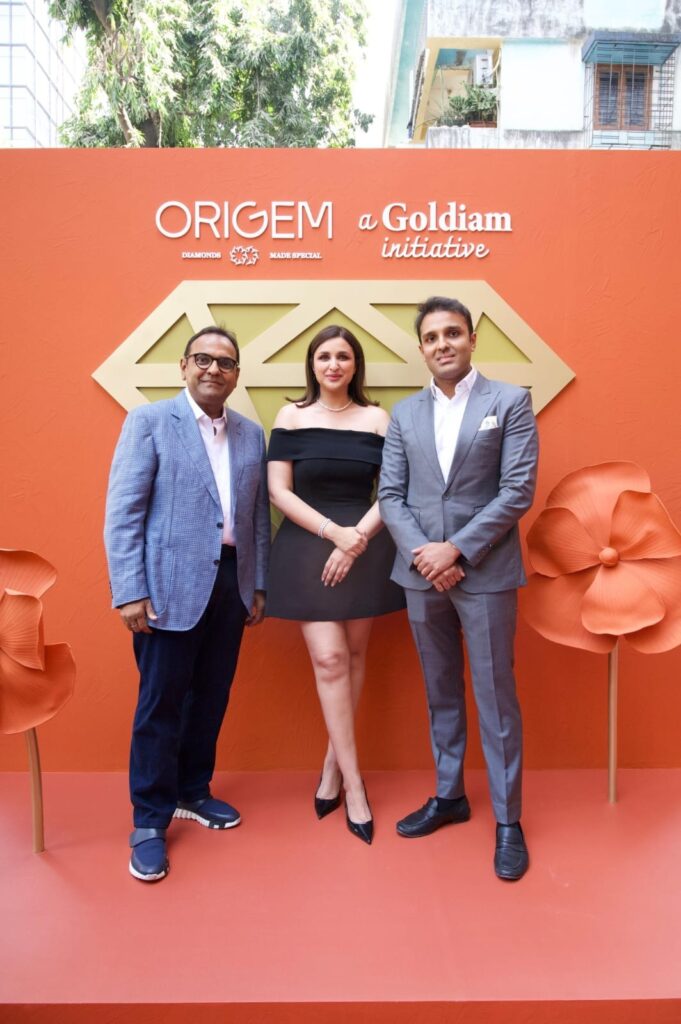
1. At a Glance
Goldiam International Ltd is currently sitting at a market cap of roughly ₹4,100 crore, trading around ₹366, down ~25% over the last one year despite delivering a 37% YoY jump in Q3 profits. Yes, the stock has corrected. No, the business has not. In fact, the company just reported Q3 FY26 revenue of ₹3,397 million and PAT of ₹684 million, with operating margins touching a shiny 22%. Return ratios remain solid – ROCE at ~25% and ROE ~17% – while debt is almost cosmetic at ₹24 crore with an interest coverage ratio so high (340x) it’s basically mocking banks.
The real headline, however, is not the quarter. It’s the business transformation. 77% of revenue now comes from lab-grown diamonds (LGD), a segment Goldiam entered early, scaled aggressively, and backward-integrated like a paranoid control freak (in a good way). Add to that an expanding ORIGEM retail footprint, a B2B e-commerce platform in the US, a ₹270 crore order book, and interim dividends being declared like clockwork – and you have a company that’s behaving more like a disciplined consumer-tech hybrid than a traditional jewellery exporter.
But if everything looks so good, why is the stock sulking? Let’s unpack the sparkle and the scratches.
2. Introduction
If you still think Goldiam is just another diamond exporter from SEEPZ shipping rings to American malls, you’re living in FY18. This company has quietly morphed into India’s most serious listed avoider of mined diamonds. While the industry was busy arguing whether lab-grown diamonds are “real love or fake shine,” Goldiam was busy building LGD growing, cutting, jewellery manufacturing, distribution, omnichannel retail, and B2B tech platforms. Basically, vertical integration on steroids.
Founded in 1986, the company spent decades doing what most Indian jewellery exporters do – export natural diamond-studded jewellery, mostly to the US. Then came two inconvenient realities:
- Mined diamonds are supply-controlled, price-rigid, and marketing-heavy.
- US millennials don’t care about cartel narratives; they care about price, ethics, and Instagram aesthetics.
Goldiam picked the hint early. It pivoted hard into lab-grown diamonds, not as a side hustle, but as the core engine. Fast forward to Q2 FY25, LGDs contribute 77% of revenue, with higher realizations due to larger average carat sizes. And unlike most peers who buy stones and assemble jewellery, Goldiam decided to own the entire chain. Control issues? Maybe. Margin issues? Definitely solved.
Now add a new twist: retail stores in India, B2B platforms in the US, and consignment inventory sitting inside customer stores abroad. This is no
longer a boring exporter. This is a jewellery company trying very hard to behave like a D2C brand plus SaaS logistics backend. Confusing? Yes. Interesting? Very.
So the question is simple: is the market underestimating how different this company has become, or is it right to stay cautious? Let’s dig.
3. Business Model – WTF Do They Even Do?
At the surface, Goldiam designs and manufactures diamond jewellery – rings, bands, earrings, pendants, the usual wedding-industrial complex. But the important distinction is what kind of diamonds and how they are sold.
Product Stack
- Lab-Grown Diamond Jewellery (LGD) – 77% of Q2 FY25 revenue
- Natural Diamond Jewellery – 23% (slowly being shown the exit door)
Within LGDs, sales are split between:
- In-store international retail (~65%)
- Online channels (~12%)
- Remaining via wholesalers and B2B channels
Customer Geography
About 95% of revenue comes from the USA. Yes, that’s concentration risk. No, it’s not accidental. The US is the largest LGD adoption market globally, and Goldiam has optimized everything – design, price points, logistics – around US consumer behaviour. The company sells roughly 80% to retailers and 20% to wholesalers, which gives it both scale and margin control.
Backward Integration – The Control Obsession
Goldiam is fully backward integrated in LGDs:
- Diamond growing
- Cutting & polishing
- Jewellery manufacturing
- Distribution & retail
This reduces dependency on external suppliers, speeds up design-to-shelf cycles, and allows rapid customization. Translation: when a US retailer asks for a design tweak, Goldiam doesn’t wait 8 weeks. It ships in one week.
Jewel Fleet – The B2B Amazon Moment
The company launched Jewel Fleet, a B2B e-commerce platform targeting small and independent jewellers in North America. Earlier, these jewellers had to wait
