01 — At a Glance
The Commodity Stock That Keeps Growing Like Your Credit Card Debt
- 52-Week High / Low₹222 / ₹96
- FY25 Revenue (Full Year)₹23,339 Cr
- FY25 PAT (Full Year)₹299 Cr
- Full-Year EPS (FY25)₹10.14
- TTM EPS₹10.14
- Book Value₹41.2
- Price to Book4.43x
- Dividend Yield0.00%
- Debt / Equity0.48x
- Stock Return (1Y)+57.2%
The Paradox: Gokul Agro closed FY25 with ₹23,339 crore revenue (+29.5% YoY), operating margins of 2.7%, a ROCE of 34.2%, and a 5-year profit CAGR of 66.8%. The stock returned +57.2% in one year. Yet 9M FY26 results (Jan 2025 to Sep 2025, ₹25,877 crore consolidated PAT) show the company is still doing the heavy-lifting work of running an agro-commodity business with razor-thin margins. Three new refineries later, the math hasn’t fundamentally changed — just the scale.
02 — Introduction
Welcome to Industrial Scale Khichiwalas: The Edible Oil Saga
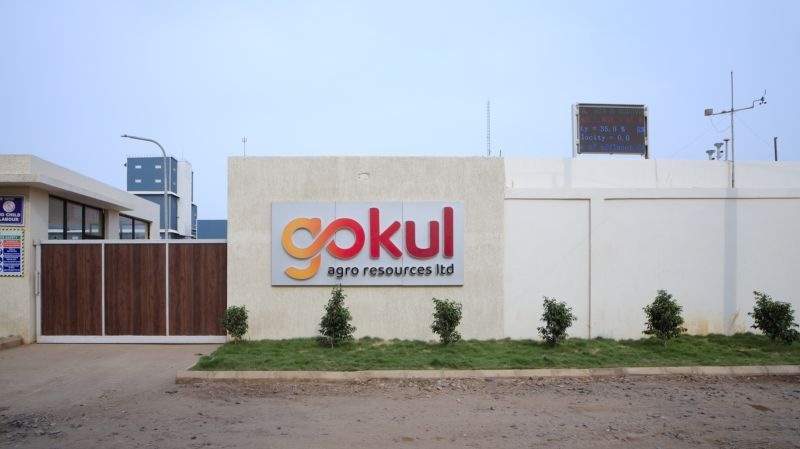
Gokul Agro Resources (GARL) is what happens when a single Gujarati entrepreneur family — the Thakkars — decide to turn oilseeds and commodity trading into a vertically integrated industrial powerhouse. Since 1982, when the business was literally just Kanubhai Thakkar and associates trading in oil, it’s now a 6,250 TPD refining capacity monster spread across Gandhidham, Haldia, Krishnapatnam, and Mangalore.
The business is straightforward: Buy crude edible oils (palm, soya, sunflower) from global markets, refine them at scale, pack them under brands like Vitalife, Mahek, Richfield, and Puffpride, then dump them into the Indian FMCG supply chain and export corridors. The company operates 40+ products, has ~700+ dealers-distributors, and caters to companies like Parle, ITC, Britannia, and Balaji Wafers. Top 5 clients = 20–25% of revenue. Diversified enough to not be a single-customer risk, concentrated enough to feel real.
Here’s the brutal part: It’s a commodity business. Oil prices swing wildly. Government regulates it (minimum support prices on oilseeds, import-export duties). Margins stay permanently thin. But volumes? Volumes have been stunning. FY25 saw 41% revenue growth, driven by two massive refinery capacity additions and relentless operational leverage. The stock went from ₹120 (Jun 2024) to ₹184 (Mar 2026). Which is nice, but the real question nobody asks: Is this sustainable, or are we watching a beautiful rise before commodity reality slaps hard?
The Thakkar Family Legacy: Running an agro-commodity empire for over 40 years — which in India means you’ve survived license raj, GST transition, multiple duty regimes, sudden port shutdowns, shipping crises, and three generations of currency depreciation. That’s not a business model. That’s a survival manual.
03 — Business Model: The Assembly Line of Liquid Gold
Oil In. Oil Out. Repeat. Profit: Tiny. Repetition: Infinite.
The business model is commodity processing + distribution at scale. The company sources crude edible oils from global suppliers (through Singapore-based subsidiaries Maurigo and Riya International for cost arbitrage and logistics ease). It refines them through owned plants using standard hydrogenation and degumming processes. It sells to FMCG majors, bakeries, and general trade under brands. The entire margin game depends on: (a) procurement efficiency, (b) operational utilization, (c) byproduct value-add (de-oiled cake, castor derivatives), and (d) not getting blitzed by sudden commodity price swings.
The company’s newest edge? Capacity diversification. With Haldia (1,350 TPD, acquired in FY24), Krishnapatnam (1,400 TPD, FY24), and Mangalore (acquired late FY25), it’s no longer just a Gandhidham story. Port proximity means cheaper logistics. Coastal positioning means easier global sourcing. Utilization has averaged 75–77.5%, which is healthy for a capital-intensive agro-processor. The pending 300 TPD biodiesel unit at Gandhidham (₹105 crore capex, operational post-FY26) and a 10 MW solar plant (₹40–50 crore estimated) show management is actually thinking about margins, not just volumes.
Revenue mix breakdown (FY25): ~90–95% from edible oils (palm 40%, soya 35%, sunflower 15%, others 10%); ~5–10% from non-edible (castor oil, derivatives, exports). Export contribution: ~7% of revenue (down from 10% in FY23 due to Indian domestic focus). ROCE is a solid 34.2% because of high asset-turns and low net working capital (creditor-financed model).
Refining Capacity6,250 TPDAcross 4 Plants
Seed Crushing3,200 TPDGandhidham
Operating Margins2.7%FY25 OPM
Capacity Util.76%Refining + Crushing
The Margin Reality Check: 2.7% operating margin sounds like a typo in finance. For context: FMCG averages 15–18% OPM. Pharma: 20–30%. Here’s the thing — in commodity oil processing, 2.7% is actually respectable. Because commodities don’t let you mark up. The profit comes from running plants at 75%+ utilization + managing raw material costs ruthlessly + selling byproducts. GARL does all three.
💬 Real question: If oil is 90% of revenue and margins are 2.7%, how much margin comes from the remaining 10% (non-edible oils)? Is castor oil the actual profit engine? Drop your thoughts.
04 — Financials Overview: 9M FY26 & Full-Year Trends
Dec 2025 Results: The Growth That Keeps Growing (And Growing…)
Result type: Half-Yearly (9-Month) Results | 9M FY26 Consolidated PAT: ₹258.77 Cr | Annualised EPS (9M × 4/3): ₹10.96
| Metric (₹ Cr) |
9M FY26
(Apr-Dec 2025) |
9M FY25
(Apr-Dec 2024) |
YoY % |
Full Year FY25 |
| Revenue | 17,936 | 13,095 | +37.0% | 23,339 |
| Operating Profit | 485 | 307 | +57.9% | 604 |
| OPM % | 2.7% | 2.3% | +40 bps | 2.6% |
| PAT (Consolidated) | 258.77 | 161.60 | +60.2% | 299.00 |
| Annualised EPS (₹) | 10.96 | 6.85 | +60.0% | 10.14 |
The Math Check: 9M FY26 PAT of ₹258.77 Cr × 4/3 (to annualize) = ₹345 Cr implied annual profit. If the full FY26 lands anywhere close to ₹330–350 Cr, we’re looking at FY26 EPS around ₹11–12. Current P/E of 18.1x on ₹10.14 base EPS might be understating growth. But — and it’s a big but — this assumes capacity ramp-up margins stay sticky. Commodity prices could reverse any quarter. CRISIL upgraded ratings to A/Stable in Aug 2025, citing margin expansion and deleveraging potential. Translation: Bankers think the worst is behind.
05 — Valuation: Fair Value Range Only
What’s This Commodity Roller Coaster Actually Worth?