Godavari Biorefineries Ltd Q2 FY26 – From Cane to Cancer Drugs: India’s Biofuel Rockstar Goes Full Biotech Mode
1. At a Glance
Godavari Biorefineries Ltd (GBL), part of the Somaiya Group dynasty, is currently trading at ₹258 — which, ironically, is less than the cost of one fancy “organic” sugar scrub they could probably make from their own molasses. With a market cap of ₹1,321 crore, this biofuel-to-biochemicals hybrid has had quite a ride. Over the last six months, the stock has rallied ~30%, though the last quarter saw a -4% dip, probably because even ethanol stocks can get a hangover.
Q2 FY26 (Sep 2025) wasn’t the sweetest quarter. Revenue stood at ₹431 crore, down 19% QoQ, with a net loss of ₹41.6 crore. EBITDA turned negative at ₹4.4 crore — because apparently, profitability also went on a bio-break. ROCE is at 5.79%, ROE negative at -3.79%, and debt at ₹493 crore. On paper, P/E stands at 28.4, but given the loss, it’s more like “P/E – Please Explain.”
Still, the story is fascinating — from being India’s largest manufacturer of MPO and one of only two global producers of natural 1,3 Butylene Glycol, to now holding patents for anti-cancer molecules. That’s not diversification; that’s an entire reincarnation.
2. Introduction – Sugar, Spirits, and Science
Once upon a time (1939, to be exact), Godavari Biorefineries was born with a simple mission — crush sugarcane, make sugar, and light up people’s lives with ethanol. Fast-forward 85 years, and it’s now making molecules that could fight cancer. That’s not evolution — that’s a Bollywood-level glow-up.
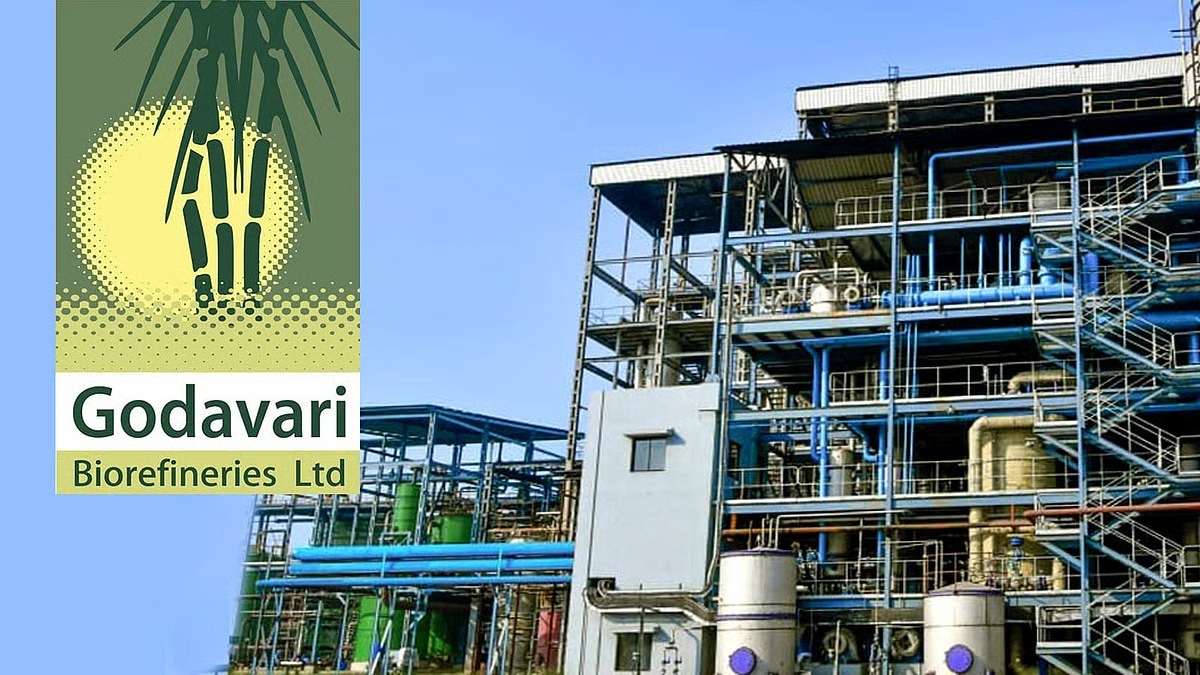
GBL isn’t your typical sugar mill. It’s a full-blown biorefinery circus: sugar, ethanol, biochemicals, and renewable power. The company operates two main facilities — one at Sameerwadi, Karnataka (for sugar, distillery, and power), and another at Sakarwadi, Maharashtra (for bio-based chemicals). Between them, they’ve managed to merge sustainability with chemistry better than most PhDs can manage on PowerPoint.
But the biofuel business is cyclical, the sugar margins are as unpredictable as monsoon rains, and ethanol pricing keeps changing faster than Nitin Gadkari’s speeches. So, GBL decided: why not make butylene glycol (for cosmetics), MPO (for fragrances), and even anti-cancer molecules (for pharma)? Because when life gives you molasses, you make molecules.
In FY24–25, GBL reported ₹1,991 crore in revenue, ₹146 crore in operating profit (OPM 7%), and ₹20 crore in net profit — not bad for a company juggling sugarcane and science experiments. Sure, PAT dipped into losses this year, but who cares when you just secured patents for a novel anti-cancer molecule across China, Europe, and the UK? Talk about global reach!
3. Business Model – WTF Do They Even Do?
So, what exactly is Godavari Biorefineries? Imagine a sugar factory that decided to do an MBA in biotechnology and a PhD in chemistry. That’s GBL in a nutshell.
a) Sugar Segment (~42% of revenue): They crush sugarcane — 12.74 lakh quintals of it in 9M FY25 — producing branded sugar under the name Jivana (sold in Maharashtra, Gujarat, and Karnataka). Because apparently, even sugar needs branding now.
b) Distillery Segment (~27%): They convert molasses into ethanol. Soon, thanks to a ₹324 crore capex plan, they’ll also produce ethanol from grain — maize, corn, and anything else that grows in abundance. A 200 KLPD grain-based distillery is under construction, targeting commissioning by H2 FY26.
c) Bio-based Chemicals (~32%): Now we’re talking! This is the future-facing vertical. They manufacture Ethyl Acetate, MPO, and natural 1,3 Butylene Glycol. They’re the only company in India with a bio-based Ethyl Vinyl Ether (EVE) facility and one of two globally for 1,3 BG. The latter is used in cosmetics and skincare — meaning your moisturizer might owe its softness to a sugar mill.
d) Power: A by-product cogeneration plant because nothing goes to waste — not even bagasse.
The company exports 10% of its chemicals, mainly to the Middle East, Europe, and Africa. They even have offices in the Netherlands and Philadelphia — because if you’re going global, better do it with Dutch efficiency and American ambition.
4. Financials Overview
Quarterly Comparison Table (₹ crore):
Metric
Latest Qtr (Sep ’25)
Same Qtr Last Year (Sep ’24)
Previous Qtr (Jun ’25)
YoY %
QoQ %
Revenue
431
321
533
34.2%
-19.1%
EBITDA
-4.4
-33
6
+86.6%
-173.3%
PAT
-41.6
-75
-16
+44.5%
-160%
EPS (₹)
-8.13
-17.88
-3.13
+54.5%
-160%
Commentary: Losses reduced YoY — so technically, that’s “progress.” The EBITDA slipped into the negative again after one profitable quarter, likely due to ethanol realisation issues or chemical pricing pressure. Annualised EPS would be a negative number, so P/E is about as “meaningful” as sugar-free candy.
5. Valuation Discussion – Fair Value Range
Method 1: P/E Approach FY25 EPS (TTM) = ₹3.93 Industry P/E (FMCG Diversified peers) ≈ 42x GBL P/E = 28x Fair value range (assuming re-rating between 25x–40x): = ₹3.93 × (25–40) = ₹98–₹157
Method 2: EV/EBITDA EV = ₹1,776 Cr; EBITDA (TTM) = ₹163 Cr EV/EBITDA = 10.9x If fair multiple range = 8x–12x, Then EV Range = ₹1,304–₹1,956 Cr Subtract Net Debt (₹493 Cr): Equity Value Range = ₹811–₹1,463 Cr Fair Price per Share = ₹158–₹285
Method 3: DCF (simplified) Assume FCF grows 10% CAGR over next 5 years, discount at 12% → value converges to ~₹250–₹300.
Fair Value Range (Educational Purpose Only): ₹150 – ₹290 per share. Disclaimer: This range is for educational discussion and not investment advice.
6. What’s Cooking – News, Triggers, Drama
Now this is where things get spicy:
Patents, Patents Everywhere! Between July and November 2025, GBL secured Chinese and European patents for its anti-cancer molecule (HYDROXY-1,4-NAPHTHALENEDIONE). Apparently, it’s effective against breast and prostate cancer. From ethanol to oncology — only in India, folks.

One Response
Is it fair to compare GBL with FMCG like HUL and ITC ? could have used other sugar/ethanol producers.