01 — At a Glance
The Bottle Boss That’s Waiting for Government Permission to Print Money
- 52-Week High / Low₹1,742 / ₹653
- Q3 FY26 Revenue (Consolidated)₹357.22 Cr
- Q3 FY26 PAT (Consolidated)₹4.75 Cr
- TTM EPS₹15.13
- Annualised EPS (Q3 × 4)₹7.08
- Book Value / Share₹471
- Price to Book1.67x
- Total Installed Capacity2,86,000 MTPA
- PET Bottles Recycled (FY25)8+ Billion
- Debt to Equity0.43x
Flash Summary: Ganesha delivered consolidated Q3 PAT of ₹4.75 crore — down a heartbreaking 84% YoY due to subsidiary weakness from government regulatory limbo. Legacy business roared back with ₹15.94 crore PAT, highest in years. Stock trades at 54x P/E, is down 52.7% in one year, and has a promoter pledge of 29.8%. The company recycles more plastic than anyone in India, yet the market treats it like a lottery ticket waiting for the right number.
02 — Introduction
The Irony: India’s Biggest Waste Problem Solver Waiting for a Govt Notification
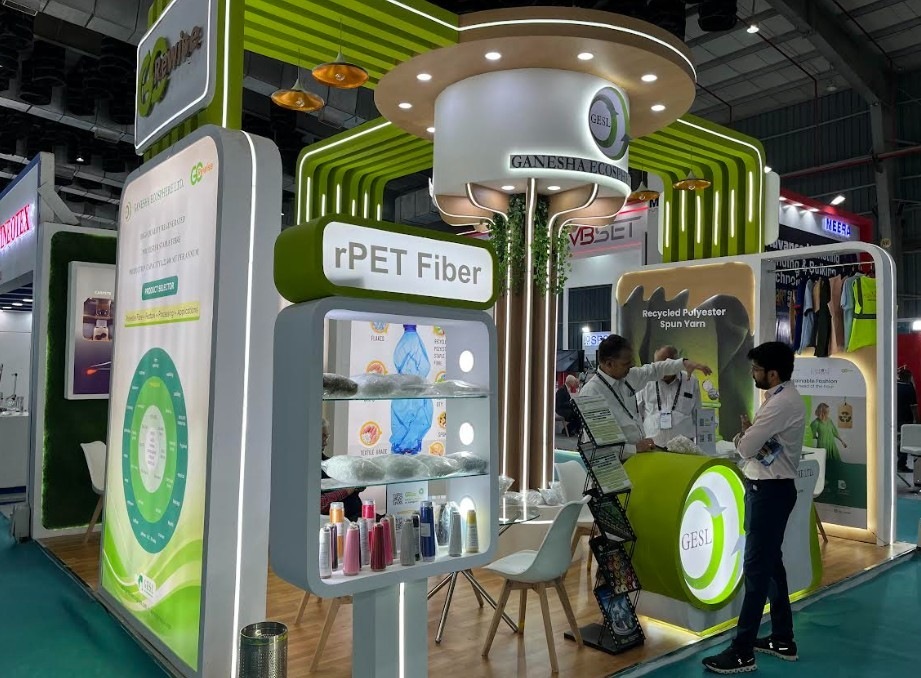
Ganesha Ecosphere is India’s largest PET bottle recycler. Not “one of the largest.” The largest. It recycles 16–18% of India’s entire PET bottle waste annually, has converted 150,000+ MTPA of plastic since inception, and has recycled more bottles than the population of most countries. Let that sink in.
The company manufactures recycled polyester staple fibre (rPSF), spun yarn, and dyed textured yarn. It runs six facilities across India and Nepal with 2,86,000 MTPA capacity. It serves over 400 customers, from spinning mills to non-woven manufacturers to automobile OEMs. The business model is elegant: buy plastic waste at ₹45–47 per kg, convert it to fibre or yarn, sell at ₹85–95 per kg, pocket the 50%+ spread, rinse, repeat forever.
But here’s the problem. The government issued a mandate requiring manufacturers to use 30% recycled plastic in FY26, ramping to 60% by FY29. Brilliant policy. Except in June 2025, the Ministry of Environment released a draft allowing companies to defer shortfalls for three years. Not final. Unnotified. Yet it froze the entire market. Everyone said “let’s wait for the final rule,” demand evaporated, and Ganesha’s newer subsidiaries (which exist specifically to capture this B2B2C opportunity) sit at 50% utilisation. As of February 2026, the final notification still hasn’t arrived. Three quarters have passed. Opportunity lost.
CARE Ratings Note (Jan 2026): CARE A+; Stable for long-term facilities, CARE A1+ for short-term. CARE acknowledges PET waste has no other major usage except rPSF manufacturing, meaning the company has pricing power on raw materials during downturns. But they also flagged working capital intensity and subsidiary stabilisation risks as key negatives. Translation: great business at 100% capacity, problematic at 50%.
03 — Business Model: WTF Do They Even Do?
They Turn Your Coca-Cola Bottle Into Your T-Shirt. You’re Welcome, Earth.
Ganesha’s operations are conceptually simple. They collect discarded PET bottles from across India via 300+ suppliers, feeding a network that gathers ~450 tons of PET waste daily. The bottles go through a series of processes: washing, shredding, melting, extruding, and converting into fibre or yarn. The output portfolio includes 500+ product variants — rPET fibre, spun yarn, doped-dyed fibre, micro fibre, hollow fibre, recycled granules.
The customer base is segmented: spinning (65%), non-woven technical (25%), stuffing (10%). Applications range across apparel, home textiles, industrial uses, and increasingly, food-grade packaging. A major recent win: a global textile brand qualified their recycled filament yarn, expected to ramp from February 2026 at “good margins.” They’ve also become a regular supplier to the ICC for stadium flags made from recycled materials — which, yes, is actually a thing and actually impressive.
Geographically, 91% of revenue is domestic, 9% exports. They operate three wholly owned subsidiaries driving the rPET granules/food-grade expansion. Management describes the business as “integrated backward and forward” — they control procurement, manufacturing, and distribution. This vertical integration is supposed to be a moat. In theory. In practice, when demand freezes due to regulatory uncertainty, vertically integrated capacity is just expensive idle machinery.
Spinning Segment65%of customer base
Non-Woven Segment25%of customer base
Bottled Recycled (FY25)8 Billion+units
Domestic Revenue Mix91%stable composition
Fun fact: The company’s Warangal facility is now zero-liquid-discharge — 90% of water is recycled, only 10% is fresh consumption. They run ~40% of their plants on renewable solar energy. The company has invested ₹11.49 MWp of rooftop solar capacity. So you get a recycled bottle, a recycled job, and a carbon-neutral production process. If only the government could recycle notifications that quickly.
04 — Financials Overview
Q3 FY26: The Good, The Bad, And The Regulatory Limbo