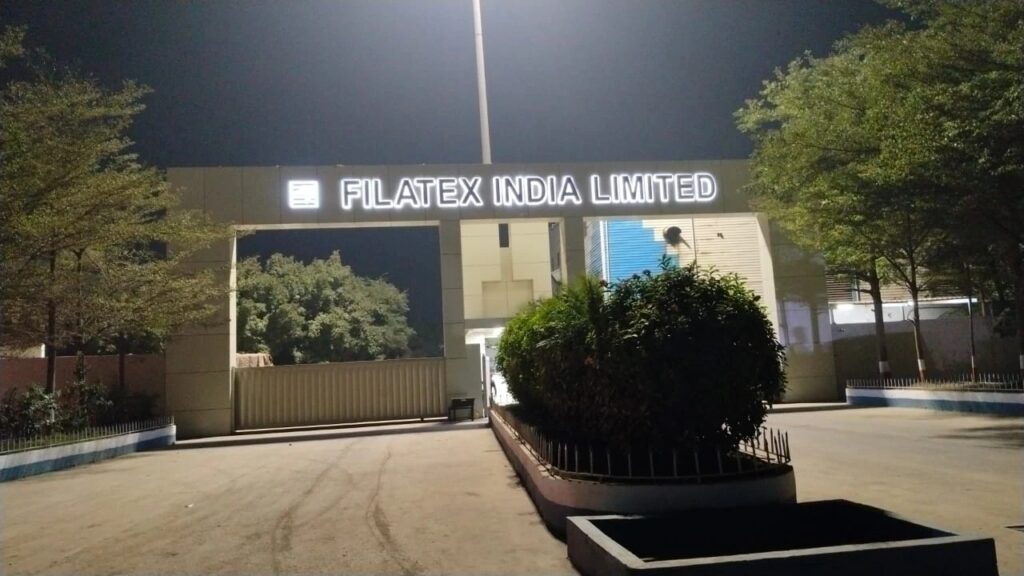
1. At a Glance
Filatex India Ltd is one of those companies that looks boring on the surface but hides enough industrial ambition to keep analysts awake at night. Market cap sits around ₹2,138 crore, the stock price hovers near ₹48, and the last three months have been painful with a ~18% correction, reminding investors that textiles are cyclical and mercy is not a core raw material.
Despite weak sentiment, Q3 FY26 delivered ₹1,049.7 crore revenue and ₹55.3 crore PAT, with profit growth of ~17% YoY, even as topline slipped marginally QoQ. ROCE stands at ~14%, debt-to-equity is a comfortable 0.10, and interest coverage is a relaxed 12.5x, which means lenders sleep well, even if shareholders don’t.
The real story, however, is not today’s earnings. It’s the company juggling ₹235 crore yarn capacity expansion, ₹300 crore textile-to-textile recycling, ₹85 crore steam monetisation, and renewable energy investments, all while trying to convince the market that polyester can still be sexy in a world obsessed with EVs and AI chips. Curious already?
2. Introduction
Filatex is not a startup, not a turnaround fairy tale, and definitely not a meme stock. It is a deep-cycle, asset-heavy polyester yarn manufacturer, the kind of company that rewards patience in some years and tests it brutally in others.
Over the last decade, Filatex has grown sales steadily, but profits have behaved like a moody teenager—strong spurts followed by sulks. FY22 was a blockbuster with record margins, FY23–FY24 sobered everyone up, and FY25–FY26 looks like management trying to engineer stability rather than chasing adrenaline highs.
What sets Filatex apart is its integrated manufacturing model, proximity to raw materials, and willingness to reinvest aggressively even when industry sentiment is lukewarm. Add to that a promoter group holding ~65%, zero pledge, and a habit of funding projects largely through internal accruals, and you get a company that’s conservative in finance but aggressive in capex.
But here’s the big question:
Is Filatex building a future-ready polyester platform, or just adding more looms to a cyclical rollercoaster?
3. Business Model – WTF Do They Even Do?
In simple words, Filatex converts crude oil derivatives into yarn that eventually becomes your
clothes, bedsheets, athleisure wear, and industrial fabrics. Glamorous? No. Essential? Absolutely.
The company manufactures a wide range of polyester yarns:
- DTY (40%) – the cash cow
- FDY (31.3%) – smoother, premium-ish
- POY (27.6%) – the raw material of choice for downstream players
- Minor contributions from PP yarns and narrow woven fabrics
Filatex doesn’t just sell commodity yarn. It pushes value-added variants branded under categories like Comfort, Touch, Fancy Effect, with products such as Sewfil, Filaspun, Wooly, Flexifil, etc. These help protect margins when commodity pricing turns ugly.
Customers span apparel, innerwear, athleisure, home textiles, industrial uses, and even healthcare textiles. About 170–180 dealers handle domestic distribution, and repeat orders dominate, which tells you switching costs exist, even if they’re not dramatic.
Exports used to be 10–12% of sales, but have dropped below 2% since FY23 due to a natural hedge strategy. Translation: management chose margin stability over FX bravado. Sensible, but it also caps upside when global cycles turn favourable.
Does this sound boring? Yes. Does boring pay bills? Also yes.
4. Financials Overview
Quarterly Performance (Q3 FY26 vs YoY vs QoQ)
| Metric | Latest Qtr | YoY Qtr | Prev Qtr | YoY % | QoQ % |
|---|---|---|---|---|---|
| Revenue (₹ Cr) | 1,049.7 | 1,069.0 | 1,076.0 | -1.8% | -2.4% |
| EBITDA (₹ Cr) | 90 | 78 | 83 | +15.4% | +8.4% |
| PAT (₹ Cr) | 55.3 | 47 | 48 | +16.7% | +15.2% |
| EPS (₹) | 1.25 | 1.07 | 1.07 | +16.8% | +16.8% |
Annualised EPS (Q3 rule): Average of Q1–Q3 EPS × 4 ≈ ₹4.1–4.2, broadly matching TTM EPS of ₹4.17.
Margins have quietly improved, even though revenue hasn’t. That’s cost control, energy optimisation, and product mix doing their job.
But let’s be honest—topline growth is uninspiring.
