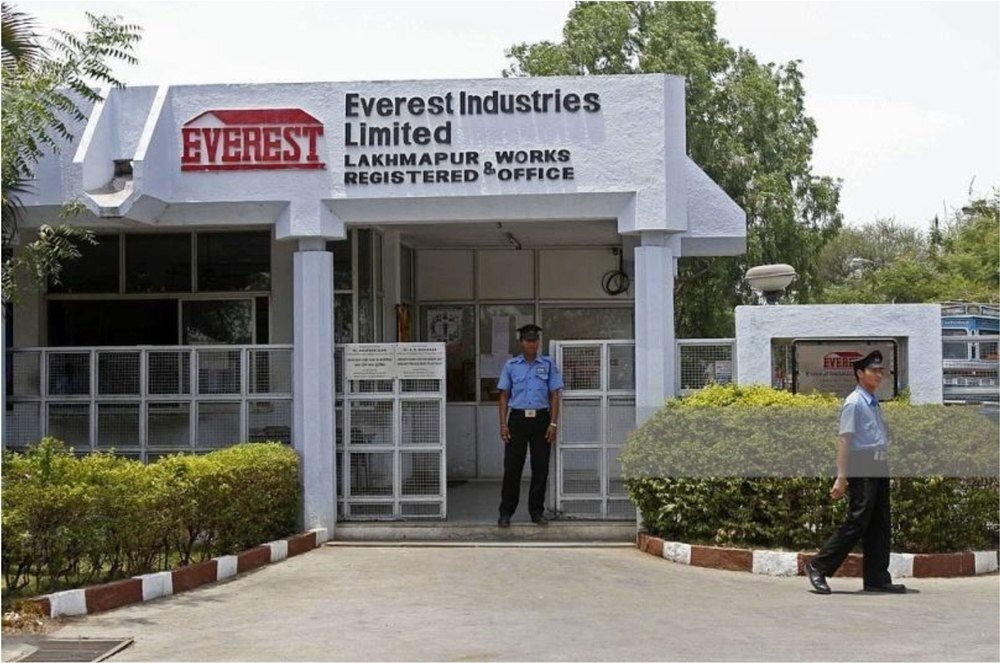
1. At a Glance – Cement Sheets, Steel Sheds & Serious Headaches
Everest Industries Ltd is what happens when a 90-year-old company tries to balance legacy products, modern construction dreams, and a balance sheet that’s quietly screaming for help. Market cap sits at roughly ₹689 crore, while the stock is chilling near ₹435, down ~25% in just 3 months and ~35% over one year. This is not a stock chart, this is a ski slope.
Latest quarterly numbers (Q3 FY26, Dec 2025) were… let’s be polite and say “character building.” Quarterly sales came in at ₹283 crore, down 23.7% YoY, while PAT crashed to –₹38 crore, courtesy of operating losses and a chunky exceptional gratuity charge. ROCE is barely breathing at 0.75%, ROE is negative, and EV/EBITDA is a comical 85x—not because EBITDA is strong, but because it’s nearly vanished.
Despite all this, Everest still has ₹1,542 crore in annual sales, 50.2% promoter holding, no promoter pledging, and a brand that has survived wars, bans, regulations, and multiple construction cycles. So the real question: is this a cyclical hiccup… or a structural mid-life crisis?
2. Introduction – A 1934 Legend Stuck in a 2026 World
Everest Industries was incorporated in 1934, which means it was selling roofing solutions when most of us were not even a thought in our grandparents’ minds. Over nine decades, it built a reputation in asbestos cement (AC) roofing, boards, panels, and later expanded into pre-engineered steel buildings (PEB).
On paper, this sounds solid—literally. Construction materials, housing, infra, warehouses, logistics parks, industrial sheds… India is building everything everywhere. So why is Everest bleeding?
Because legacy is a double-edged sword. Everest’s biggest revenue contributor is also its biggest existential risk: asbestos cement roofing. While it still dominates rural and semi-urban India due to low cost and durability, asbestos is banned in
53+ countries. India hasn’t banned it yet, but regulatory risk hangs like a monsoon cloud.
Add to that:
- Weak margins
- High working capital
- Rising debt
- Volatile steel business
- GST litigations popping up like WhatsApp forwards
And suddenly, Everest doesn’t look like a boring building materials company—it looks like a case study.
3. Business Model – WTF Do They Even Do?
Think of Everest as having two personalities:
🧱 A. Building Products (69% of FY23 Revenue)
This is the old soul.
Products include:
- Asbestos Cement (AC) Roofing Sheets – still a cash cow in rural India
- Fibre Cement Sheets & Supercolor Roofing
- Boards & Panels – cement boards, heavy-duty boards
- Designer Ceilings
- Artewood – fancy boards pretending to be teakwood
These products are used in low-cost housing, sheds, warehouses, and industrial buildings. Volumes are decent, but margins are thin, competition is brutal, and asbestos risk never sleeps.
🏗️ B. Steel Buildings (31% of FY23 Revenue)
This is Everest trying to be young again.
The company designs and erects pre-engineered steel buildings for:
- Warehouses
- Factories
- Logistics parks
- Industrial sheds
They’ve delivered 3,000+ buildings and worked with big names like L&T, Godrej, Reliance, and Indospace. A new steel plant is being set up in Mysore (FY24–25) via a subsidiary.
Sounds sexy, right? Yes—but
