1. At a Glance – Blink and You’ll Miss the Punchline
ESAF Small Finance Bank is trading at ₹29.3, with a market cap of ~₹1,513 crore, which is roughly the valuation equivalent of a mid-sized housing project in Kochi — except this one runs ₹27,000+ crore of assets. The stock has bounced ~4.3% over the last 3 months, but is still down ~20% YoY, reflecting investor fatigue after FY24–FY25 turned into an NPA detox camp.
Latest quarter (Q3 FY26) delivered a ₹7.12 crore profit, which sounds cute until you remember the TTM PAT is still -₹373 crore, ROE is -23.5%, and GNPA only looks better because ₹1,693.65 crore of bad loans were sold to ARCs for ₹183 crore (translation: haircut so deep even the barber cried).
Loan book stands at ₹19,216 crore, deposits at ₹21,613 crore, CASA a modest 22.7%, and NIM a headline-grabbing ~10.7% (yes, microfinance margins are spicy). The catch? Micro loans form ~62% of advances, and when rural stress sneezes, ESAF catches pneumonia.
So is this a turnaround or just a temporary oxygen cylinder? Let’s open the files.
2. Introduction – From Poster Child to Problem Child (and Maybe Back?)
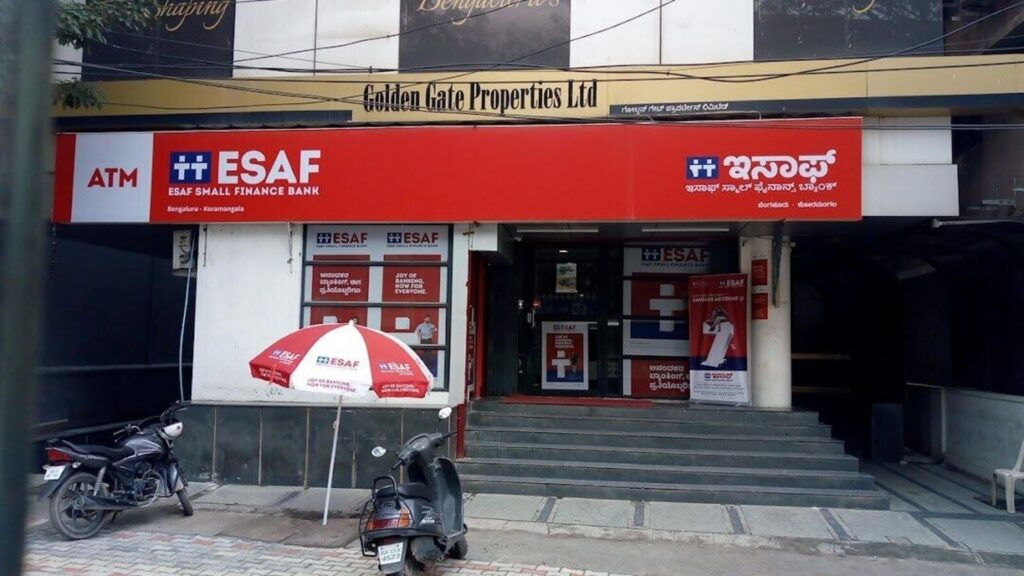
ESAF began life in 1992 with missionary zeal — microfinance, financial inclusion, Kerala roots, social impact brochures, the works. Over time, it graduated into a Small Finance Bank, expanded across 24 states and 2 UTs, and built a formidable on-ground franchise with 756 banking outlets, 646 ATMs, and 8,834 customer touchpoints serving ~89.4 lakh customers.
Then FY24 arrived like an uninvited relative who overstays. Asset quality deteriorated sharply — GNPA jumped from 2.5% (FY23) to 4.8% (FY24) and then to 6.6% in Q1 FY25, peaking at 8.54% by Sep FY25. Slippages piled up, provisions exploded, and profitability evaporated.
Management responded with the financial equivalent of “burn the furniture to stay warm”:
• Aggressive provisioning
• Sale of NPAs to ARCs
• Cutting reliance on promoter-linked
BCs
• Raising Tier-II capital at 11–11.65% coupons
Q3 FY26 finally printed black ink. But before you celebrate, ask yourself: was this profit earned, or engineered?
3. Business Model – WTF Do They Even Do?
At its core, ESAF is a microfinance-heavy lender pretending to be a diversified bank — and to be fair, it’s trying.
Lending Engine
- Micro Loans (~62%): Joint liability groups, rural women, small ticket, high yield, emotionally resilient… until monsoon or inflation hits.
- Retail & Other Loans (~38%): Housing, LAP, vehicle loans, MSME, gold loans — the “please de-risk us” bucket.
Liability Side
- Deposits ₹21,613 crore, CASA at 22.7% — decent, not delicious.
- Still relies meaningfully on wholesale borrowings, hence the chunky interest expense sensitivity.
Distribution
- 756 outlets, heavy rural presence (70% outlets).
- Institutional Business Correspondents (IBCs) — though ESAF has now deliberately cut exposure to its largest BC (ESMACO), which earlier handled ~54.5% of gross advances. Yes, promoter BC concentration was a thing.
Digital
Internet banking, mobile banking, QR, UPI — functional, not flashy. This is Bharat banking, not neo-banking.
So ESAF’s business model is simple: high-yield loans + high operating cost + high credit risk = volatile profits. The trick is controlling the last two.
4. Financials Overview – Numbers Don’t Lie, But They Do Laugh
Quarterly Comparison Table (₹
