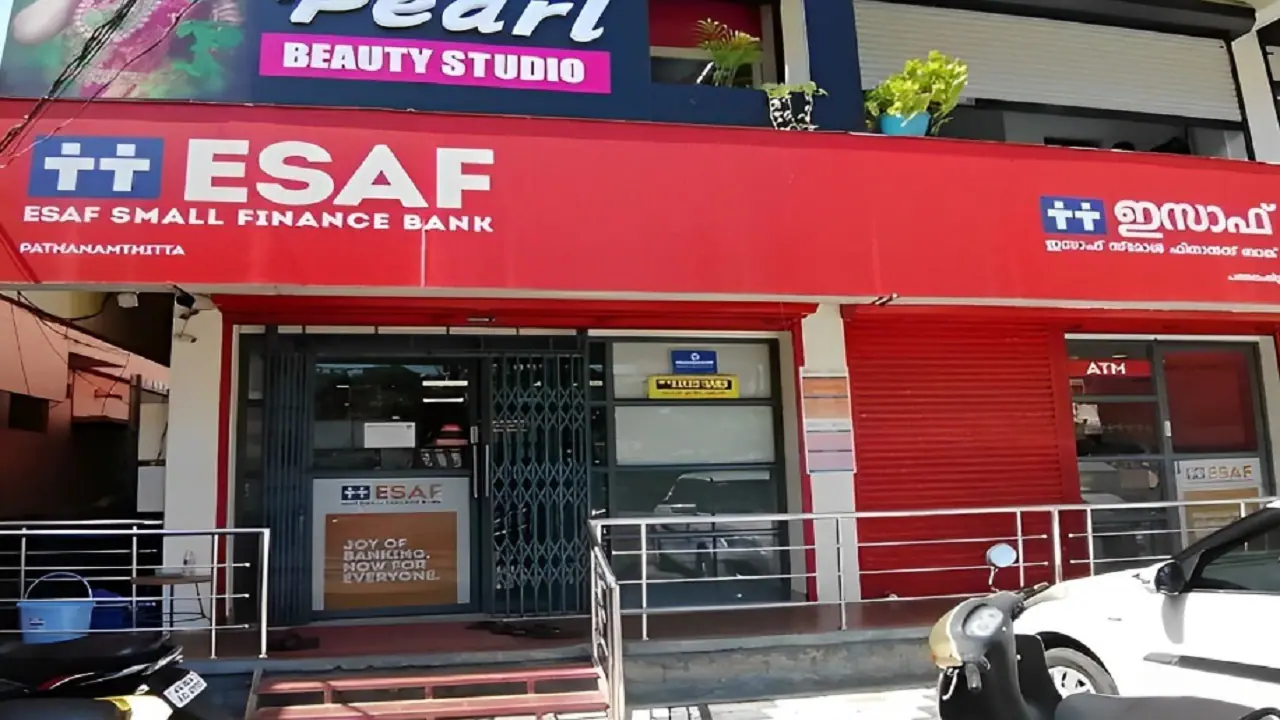
1. At a Glance
Welcome to the world of ESAF Small Finance Bank Ltd (ESAF SFB) – a financial fairy tale where social mission meets spreadsheets full of red ink. Incorporated way back in 1992, this “purpose-driven” Kerala-based lender has morphed from a microfinance crusader into a small finance bank with ₹27,129 crore in total assets (as of Sep 2025) — but also a mountain of debt (₹25,007 crore) and a bleeding PAT of -₹116 crore in Q2FY26.
Trading at just ₹27 per share and a market cap of ₹1,389 crore, the stock now sits at 0.8x its book value — technically cheap, but emotionally expensive for anyone who’s held it since IPO. Its return on equity (ROE) is an eye-watering -23.5%, GNPA has ballooned to 8.54%, and the NIM (Net Interest Margin) still flaunts a stunning 10.7%, proving that high margins don’t necessarily mean high profits — especially when your NPAs party like there’s no tomorrow.
Still, ESAF boasts 756 branches, 646 ATMs, and nearly 89 lakh customers across 24 states and 2 UTs, mostly in rural and semi-urban India. The mission is noble. The balance sheet? Not so much.
So what happens when a “socially-conscious lender” tries to play grown-up in a cutthroat banking world? Grab your chai — this is going to be a fun forensic ride.
2. Introduction
Once upon a spreadsheet, a small finance bank from Kerala dreamed of changing lives through microfinance. Fast forward to FY26, ESAF is changing more investor heart rates than rural livelihoods.
The bank’s story began in 1992, with a heartwarming mission of “building a just and fair society through financial inclusion.” Admirable. But the financial inclusion fairy seems to have overdone it — including way too many NPAs.
In FY24, ESAF had already seen its GNPA climb from 2.5% to 4.8%, and by Q1FY25, it hit 6.6%. Q2FY26? A new high of 8.54% — a number that would give even PSU bankers flashbacks of the 2018 NPA crisis.
The bank’s loan book stands at ₹19,216 crore, with 62% microloans, 38% retail & other loans, and deposits worth ₹21,613 crore. The CASA ratio is a modest 22.7%, while debt-to-equity has climbed to a Himalayan 14.3x — which basically means every rupee of shareholder equity is supporting ₹14 of borrowed funds. Heroic? Maybe. Healthy? Not really.
And yet, management continues to expand operations, launch new insurance tie-ups, and procure Oracle’s core banking software. Because why fix the NPAs when you can buy new tech?
If you’ve ever wondered what a hybrid of microfinance empathy and corporate finance chaos looks like — ESAF is your case study.
3. Business Model – WTF Do They Even Do?
In the simplest terms, ESAF SFB is a bank that lends small and collects big — big dreams, big NPAs, and big aspirations of pan-India presence.
The business revolves around microloans, MSME loans, agri-loans, and retail lending, peppered with para-banking services like debit cards, insurance distribution, mutual funds, and foreign exchange.
Their product mix looks like a buffet for every rural entrepreneur:
- Micro Assets: Microfinance loans, enterprise loans, and Vyapar Vikas Yojana (because even small traders deserve fancy loan names).
- Agri-Lending: Dairy development, Haritha loans, Kisan Credit Cards, and financing for Farmer Producer Organisations.
- MSME Segment: Loans like Udyog Saral, MSME LAP, GST Power — basically, every SME acronym you can imagine.
- Retail Assets: Home, personal, gold, and vehicle loans.
- Third Party Products: Insurance, mutual funds, NPS, broking services, and Aadhar centers.
They deliver all this through 756 branches, 35 Institutional Business Correspondents (IBCs), and digital channels. Until recently, a promoter-linked entity — ESAF Swasraya Multi-State Agro Co-operative (ESMACO) — handled more than 54% of the loan book. The bank decided to “reduce concentration” by discontinuing part of that relationship in June 2024. Translation: too many eggs,