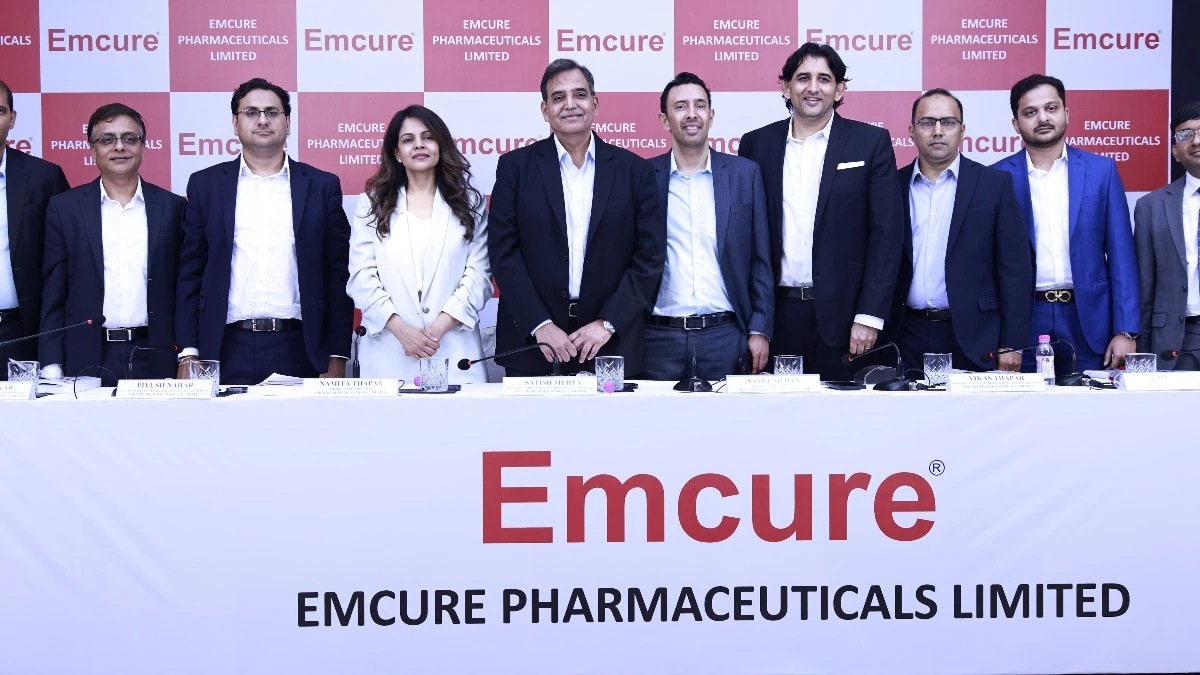
Emcure Pharmaceuticals Ltd Q2 FY26 – From Semaglutide to Zuventus, This Pharma Unicorn Is on a Prescription-Strength High!
1. At a Glance
Emcure Pharmaceuticals Ltd just pulled off a clinic in Q2 FY26, delivering a revenue of ₹2,270 crore and a PAT of ₹251 crore – a 25% YoY profit jump that would make even your gym trainer proud. With a market cap of ₹26,116 crore and a stock price of ₹1,379 (down ~5% in 3 months, probably because traders can’t read balance sheets), the company continues to flex serious financial muscle.
Operating margins hit 21%, P/E stands at 32.6x (which means the market believes this company is smarter than most doctors), and ROCE of 20.7% puts it ahead of many pharma peers still struggling to find their pulse.
And oh, Emcure is not just a desi brand anymore—it’s an export machine with ~52% of revenues coming from global markets. Whether it’s developing biotech drugs under Gennova, signing with Gilead for Lenacapavir, or dropping ₹7,249 mn to make Zuventus its fully-owned subsidiary—Emcure is running more partnerships than a Bollywood production house.
The icing? The US FDA gave its Sanand oncology facility a clean chit (zero observations!). In pharma world, that’s equivalent to Virat Kohli getting a hundred and a clean sheet in one match.
2. Introduction – The Desi Multinational That Refuses to Sit Quiet
Founded in 1981, when Walkmans were cool and pharma exports were “aspirational,” Emcure Pharmaceuticals has evolved into a global formulation and biotech beast. From Pune to the planet, Emcure now operates 13 manufacturing facilities and 5 R&D centers that look more like secret research lairs than factories.
Over the decades, the Mehta family—helmed by the ever-calm Satish Mehta—has turned this company from a generics maker into a serious player in complex APIs, biosimilars, and formulations. And yes, that’s the same Mehta family where Namita Thapar, Shark Tank India’s most composed judge, occasionally looks like she’s evaluating business plans while internally calculating EBITDA margins.
While peers like Sun Pharma and Lupin went on world tours, Emcure quietly built its empire brick by brick, molecule by molecule. With a brand presence in over 70 countries and more than 350 brands in India, it now sits in every doctor’s prescription drawer.
The company’s latest stunts include tying up with Novo Nordisk to bring “Poviztra” (a semaglutide 2.4 mg product) to India—a move that essentially makes it India’s official partner in the global obesity drug mania. Somewhere, gym chains are sweating nervously.
So what’s the mood in the Emcure boardroom? Probably a mix of celebration and “now let’s not mess this up.”
3. Business Model – WTF Do They Even Do?
Let’s break it down for the MBA crowd and meme investors alike.
Formulations: This is Emcure’s bread, butter, and full-course meal. It develops branded generics and patented formulations across gynaecology, cardiology, anti-infectives, and a pharmacy full of other therapeutic areas. Think of it as the McDonald’s of medicine—different menus for every geography.
Biologics (Gennova Biopharmaceuticals): Now here’s where things get sci-fi. Gennova, a wholly-owned subsidiary, works on biotherapeutics and RNA vaccines. It has mammalian and microbial platforms, six launched biologics, and even an AI-enhanced vaccine project for the Nipah virus. Basically, if biology were cricket, this is where Emcure bats like a young Sachin.
APIs: From S-Amlodipine to Eribulin, Emcure makes APIs that are the building blocks for other pharma products. It’s like the chef who not only cooks but also grows the ingredients.
Contract Manufacturing & Partnerships: With agreements like the one with Gilead for Lenacapavir and the exclusive Sanofi distribution deal for Amaryl® and Cetapin®, Emcure is proving that partnerships are its new growth hormone.
And if that wasn’t enough, they just launched Emcutix Biopharmaceuticals for dermatology products. Because why stop at the bloodstream when you can own skincare too?
4. Financials Overview
Metric
Q2 FY26
Q2 FY25
Q1 FY26
YoY %
QoQ %
Revenue (₹ Cr)
2,270
2,001
2,101
13.4%
8.0%
EBITDA (₹ Cr)
475
381
417
24.6%
13.9%
PAT (₹ Cr)
251
202
215
24.3%
16.7%
EPS (₹)
12.84
10.29
10.92
24.8%
17.6%
If Excel had feelings, this table would be smiling. Revenue’s up, profits are up, and margins are thicker than ever. Annualised EPS stands around ₹51.4, which at a CMP of ₹1,379 gives a P/E of ~26.8x—slightly below the reported 32.6x but well within “pharma premium” territory.
Operating margins touching 21% is no joke, especially in an industry haunted by raw material inflation and USFDA nightmares.
5. Valuation Discussion – Fair Value Range Only
Let’s get nerdy but keep it real.
Method 1: P/E Method Annualised EPS (₹51.4) × Industry PE (31.6) → ₹1,625 If we go conservative (25x) → ₹1,285 📊 Fair Value Range (P/E basis): ₹1,285–₹1,625
Method 2: EV/EBITDA EV = ₹27,286 Cr; EBITDA (FY25 TTM) = ₹1,656 Cr → EV/EBITDA = 16.4x Assume fair range 14x–18x → Fair EV = ₹23,184–₹29,808 Cr Less net debt (₹1,659 Cr) → Equity value ₹21,525–₹28,149 Cr Per share (190 Mn shares) → ₹1,132–₹1,480