01 — At a Glance
The Slow Burn: Retail’s Favorite Oxymoron
- 52-Week High / Low₹168 / ₹75.6
- FY25 Revenue (Full Year)₹6,965 Cr
- FY25 PAT (Full Year)₹160 Cr
- Full-Year FY25 EPS₹4.16
- Q3 FY26 EPS₹0.77
- Book Value₹40.4
- Price to Book2.30x
- Debt / Equity1.26x
- Store Count (9M FY26)219
- 1-Yr Return-22.2%
The Confession: Electronics Mart delivered Q3 FY26 revenue of ₹1,940 Cr (+7.5% YoY), EBITDA margin of 6.1%, and announced 215 stores. The 1-year stock return is -22.2%. Which means they’re expanding the empire while shareholders are slowly exiting via the emergency exit. Welcome to the patience game — with 50% of your store base still ramping. The stock has lost over 45% from its 52-week high of ₹168. Think of it as a classic overheated IPO correction finding its true level.
02 — Introduction
The Bajaj-Backed Retail Empire That Learned to Disappoint
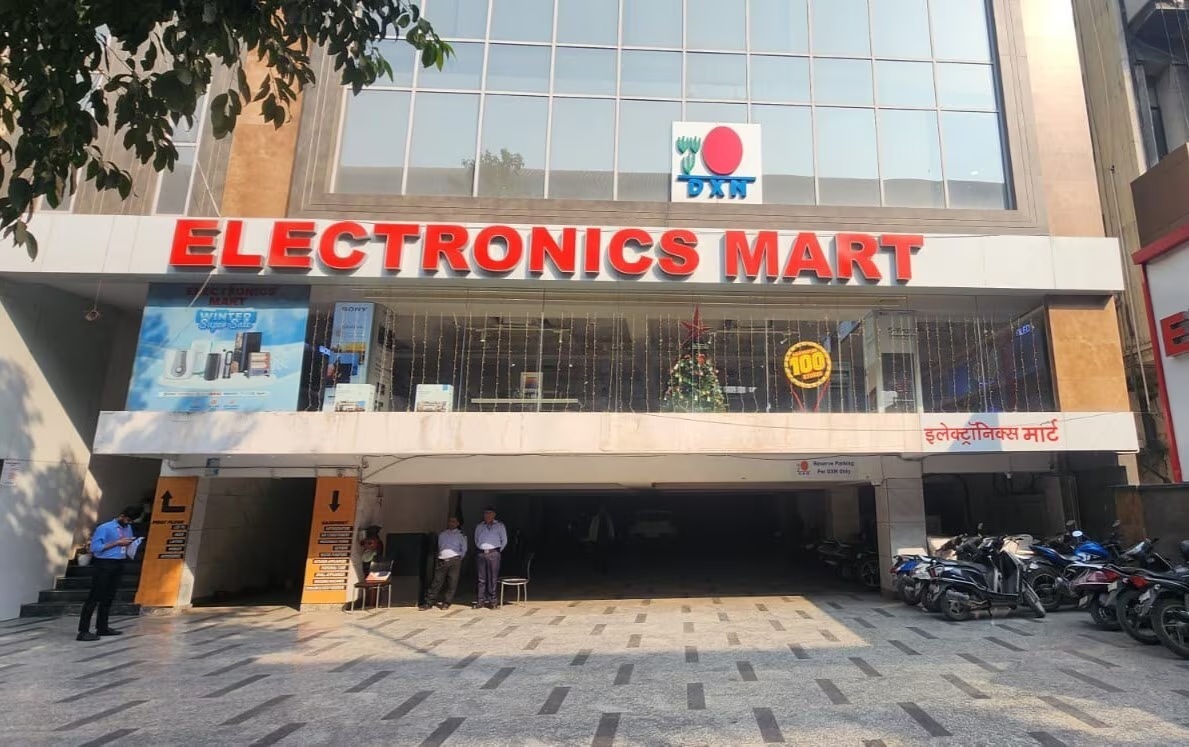
Electronics Mart India — the 4th largest consumer electronics and appliance retailer in India — is owned 65% by the Bajaj family. Founded in 1980, it’s been quietly dominating the south, particularly Andhra Pradesh and Telangana, while watching Amazon and Flipkart pick at its margins like crows at a picnic.
The business model is simple: own/lease real estate, stock 8,000+ products from 100+ brands, hire aggressive sales teams, and pray that consumers walk through the door more often than your leasing costs go up. Until FY25, that formula worked fine. Then something happened: the company decided to triple-down on expansion. 215 stores now. About 50% of them are in the “ramping up” phase, burning fixed costs like a kerosene heater in summer.
Here’s where the funny part starts. The company’s Feb 2026 concall revealed something managers usually hide: they’re running two completely different businesses. Mature stores (4+ years old) are EBITDA-margin happy at ~7%. New stores (under 4 years) are running at ~3% margins while management prays for scale. Overall result? A blended 6% EBITDA margin on ₹6,965 Cr revenue, which is respectably mediocre for a company that’s supposed to be “the market leader.”
The stock has reflected this reality by crashing 40%+ from highs. Q3 was a brief sugar-rush thanks to a GST rate cut on air conditioners and the festive season. Management sounded optimistic on the call. Investors remained skeptical. Let’s break down why.
Concall Candor (Feb 2026): “After the 2 big seasons, we would see a little slowdown in approval rate… normal trend.” — Management on EMI approvals. Translation: festive season demand is artificial, summer cooling demand isn’t guaranteed, and your finance partners know it.
03 — Business Model: WTF Are They Even Doing?
Sell Electronics. Scale. Hope Margins Improve. Repeat Until Broke.
Electronics Mart runs a multi-brand retail model that’s about as unique as a chai stall in Delhi. They operate 215 stores as of 9M FY26, split between multi-brand outlets (MBOs), exclusive brand outlets (Samsung, Apple, LG), and specialty concepts like “Kitchen Stories” and “Audio & Beyond.” The real estate mix is roughly 14 owned stores and 201 leased/rental arrangements. The lease model is strategic — it’s capital-light. Unfortunately, it’s also cash-flow light because you pay rent no matter what.
The product mix: large appliances (~42-43% of revenue), mobiles (~44%), and small appliances/IT/others (~12-13%). Large appliances is their cash cow — ACs, washing machines, TVs. But it’s also their volatility pit. A weak summer (i.e., cooler-than-expected weather) = AC inventory death spiral. FY25 taught them this lesson when they got stuck with a quarter’s worth of unsold AC units at year-end because March was too cool. Management explicitly admitted in Feb 2026: “We’re a little cautious on inventory pile up” this time around.
Revenue per store is now ₹340-350 Cr annualised for blended portfolio (new + mature). Five years back, it was ₹390-420 Cr. That’s a ~15% deterioration from the baseline, largely because half your stores are under 4 years old and not yet at productivity inflection. The problem? Those new stores need 2-3 years to mature. The opportunity? If they do, your consolidated ROCE goes from 10.4% to something respectable. The bet is on “if.”
Large Appliances~42%Revenue Mix
Mobiles~44%Revenue Mix
Mature Stores37%of Total (83/219)
New Stores63%Still Ramping (136/219)
Store Maturity Math: 83 mature stores (4+ yrs): ~₹3,523 Cr revenue, ~7% EBITDA margin. 136 immature stores (<4 yrs): ~₹1,528 Cr revenue, ~3% EBITDA margin. Do the math: you’re diluting your best performing assets with dilutive new ones. Management says this improves. The market is betting it doesn’t — hence the 40% drawdown.
💬 If you were a shareholder, would you trust management’s “stores will mature” story, or would you be looking at the 1-year return of -22% and wondering if your cash is better parked elsewhere? Drop your view.
04 — Financials Overview
Q3 FY26: The Numbers Don’t Lie, They Just Disappoint
Result type: Quarterly Results | Q3 FY26 EPS: ₹0.77 | Annualised EPS (Q3×4): ₹3.08 | Full-year FY25 EPS: ₹4.16
| Metric (₹ Mn) |
Q3 FY26
Dec 2025 |
Q3 FY25
Dec 2024 |
Q2 FY26
Sep 2025 |
YoY % |
QoQ % |
| Revenue | 19,396 | 18,048 | 15,914 | +7.5% | +21.9% |
| Operating Profit | 1,185 | 1,018 | 821 | +16.4% | +44.3% |
| OPM % | 6.1% | 5.6% | 5.2% | +50 bps | +90 bps |
| PAT | 296 | 339 | 223 | -12.7% | +32.7% |
| EPS (₹) | 0.77 | 0.87 | 0.56 | -11.5% | +37.5% |
The Plot Twist: Revenue grew 7.5% YoY (respectable for retail), EBITDA margin expanded to 6.1% (thanks to GST cuts and festive tailwinds), but PAT fell 12.7%. Why? Higher interest costs. Working capital borrowing went up because they’re funding inventory builds for the summer AC season. The annualised EPS on Q3 is ₹3.08, but FY25 full-year EPS was ₹4.16. Do the math: H2 is underperforming H1 because summer inventory risk is baked in. Oh, and the stock trades at P/E 38.7x (vs industry median of 39.2x). Translation: you’re paying full price for below-average returns.
05 — Valuation Discussion: What’s Fair?
Fair Value Range: Somewhere Between Meh and Ouch
Method 1: P/E Based
FY25 full-year EPS = ₹4.16. FY26 guidance (management): 9-10% revenue growth, stable margins, but margin recovery only from 2HFY26 onwards. Conservative FY26 EPS estimate: ₹3.80-4.00. Retail sector median P/E: ~39x. EMIL’s justified P/E given store expansion dilution: 25x-35x.
Range: ₹95 – ₹140
Method 2: EV/EBITDA Based
FY25 EBITDA = ₹4,505 Mn. Current EV = ₹5,501 Cr → EV/EBITDA = 12.2x. Specialty retail (premium positioning) trades at 10x-14x. EMIL’s growth trajectory justifies 11x-13x. Net debt = ₹1,963 Cr (borrowings) – minimal cash.
EV range (11x-13x): ₹4,955 Mn – ₹5,856 Mn. Per share:
Range: ₹100 – ₹150
Method 3: DCF Based (Conservative)
Base FCF (FY25): ₹1,757 Mn (from operations). Assuming 6% growth for 5 years (retail ceiling), terminal growth 3%, WACC 11%.
→ PV of 5-year FCFs at 11%: ~₹6,800 Mn
→ Terminal Value (3% growth / 8% cap rate): ~₹9,100 Mn
→ Total EV: ~₹15,900 Mn (post-debt net)
Range: ₹110 – ₹160
Fair Min: ₹95
CMP: ₹92.6
Fair Max: ₹160
⚠️ EduInvesting Fair Value Range: ₹95 – ₹160. CMP ₹92.6 sits near the lower end, suggesting limited upside unless store maturity accelerates faster than modeled. This fair value range is for educational purposes only and is not investment advice. Please consult a SEBI-registered investment advisor before making any financial decision.
06 — What’s Cooking: News, Triggers & The Real Drama
From Godowns on Fire to AC Inventory Anxiety