1. At a Glance – Espresso Shot First
CCL Products is what happens when a boring commodity like coffee decides to go global, leverage debt, build plants across India, Vietnam, and Switzerland, and then quietly compound earnings while retail investors are busy debating Arabica vs Robusta on Twitter.
As of February 2026, the stock trades at ₹985, giving it a market cap of ₹13,169 Cr. Over the last year, the stock is up 45.5%, which means either management executed well, or coffee prices went berserk — spoiler alert: both happened.
Latest Q3 FY26 results show ₹1,051 Cr in revenue (up 38.5% YoY) and ₹100 Cr in PAT (up a spicy 59.1% YoY). Operating margins held near 18%, despite raw coffee prices exploding from ~$1,000/tonne (2015–20) to ~$5,000/tonne. That alone deserves a slow clap.
Valuations? Not cheap. P/E at ~35x, EV/EBITDA ~20x, P/B at 6.3x. This is not “chai pe charcha” valuation — this is “specialty FMCG pretending to be a commodity exporter.”
Question before we go deeper:
👉 Is CCL a coffee company… or a brand + manufacturing platform hiding inside a coffee sack?
2. Introduction – From Finance Company to Global Coffee Mafia
CCL’s journey started in 1961 as a finance company (yes, really), morphed into Continental Coffee Limited in 1994, and finally became CCL Products (India) Ltd in 2002 when it fully embraced instant coffee manufacturing.
Today, CCL is one of the world’s largest private-label instant coffee manufacturers, supplying coffee to 90+ countries. You’ve probably consumed their coffee without knowing it — airlines, hotels, vending machines, private labels in Europe — CCL is the silent partner behind the caffeine addiction.
What makes CCL interesting is not glamour, but process discipline + scale + customer stickiness. Their blend library has grown from ~500–600 blends (2015–20) to ~1,000 blends by FY25, which means customers don’t just switch suppliers overnight unless they enjoy
reformulating taste profiles across continents.
But the story isn’t just exports anymore. Management is clearly nudging CCL from B2B bulk exporter to B2C FMCG aspirant, via the Continental brand, vending machines, institutions, and now acquisitions in Europe.
So the real question becomes:
👉 Can a bulk coffee exporter successfully play the FMCG branding game without burning margins and sanity?
3. Business Model – WTF Do They Even Do?
Let’s simplify this for a lazy but intelligent investor.
CCL buys green coffee beans, processes them through a capital-intensive multi-step manufacturing process, and sells the output in different avatars:
A. B2B Export Business (The Cash Cow)
- Private-label instant coffee
- Spray-dried & freeze-dried
- Sold in bulk to global brands
- Accounts for the majority of revenue
This is where scale, consistency, and long-term contracts matter. Margins are decent, volatility is manageable, but working capital can get ugly when coffee prices spike (hello inventory days of 208).
B. Domestic B2B + Institutional
- Airlines (Indigo, Air Asia)
- Hotels (Club Mahindra, Ibis, Radisson, Sarovar)
- Corporate vending machines
Not flashy, but sticky and recurring.
C. B2C – The “Let’s Be FMCG” Experiment
Brands include:
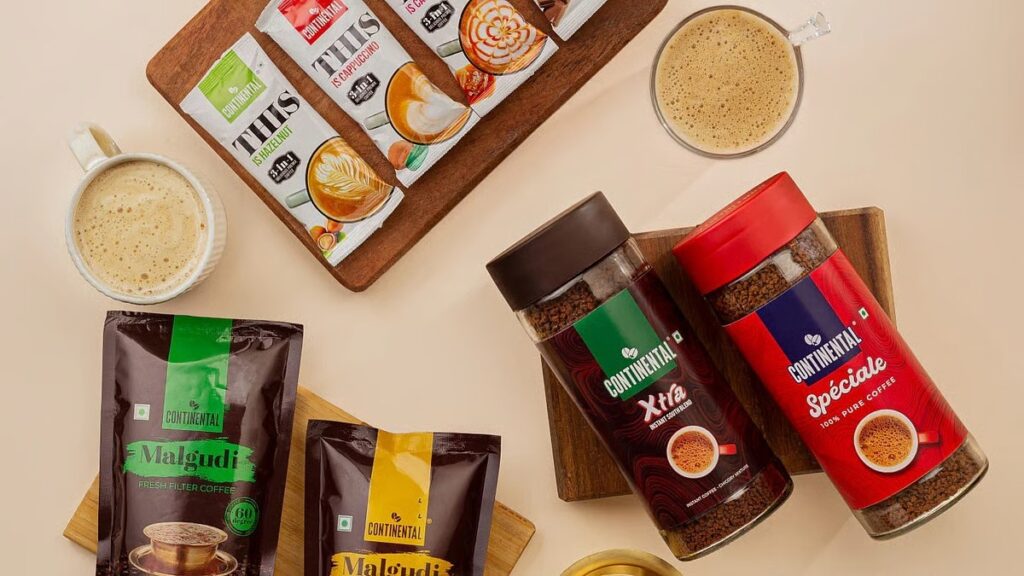
- Continental Xtra / Speciale
- Continental THIS (3-in-1 premix)
- Continental Black Edition
- Continental Malgudi (Roast & Ground)
They’ve even set up a dedicated Andhra Pradesh plant for small packs:
- 5,500 MT
